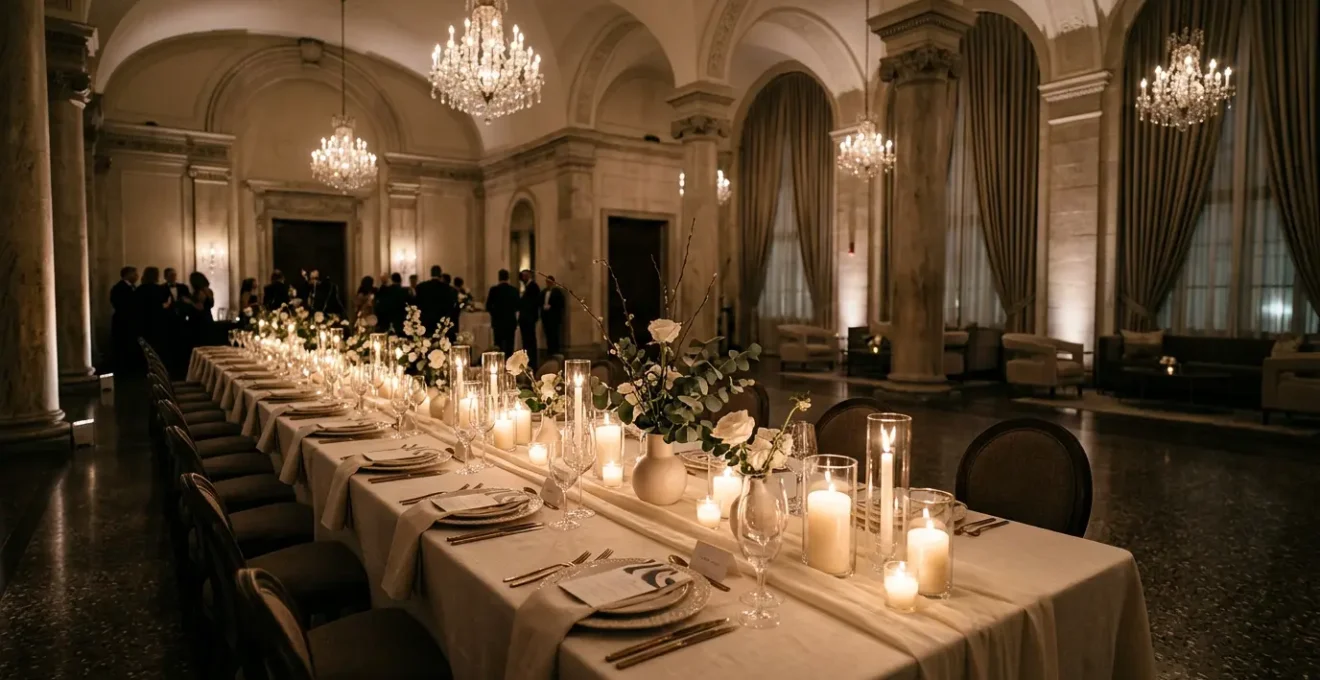
True intimacy in a grand wedding is not about reducing scale, but about masterful emotional choreography.
- Intimacy is a designed experience, built through a sequence of sensory and personal touchpoints that guide guest emotion and attention.
- Prioritizing “emotional resonance” over purely “visual impact” in your budget creates memories that last longer than the night itself.
Recommendation: Shift your focus from simply decorating a space to crafting a multi-sensory narrative where every detail, from the scent in the air to the shape of the tables, serves to connect your guests to each other and to your story.
The very concept of a 200-guest, black-tie wedding evokes images of grandeur, opulence, and breathtaking scale. Yet, for the couple at its heart, the deepest desire is often the complete opposite: a feeling of closeness, of shared joy, of profound intimacy. The challenge, then, becomes an artistic one. How do you make a vast ballroom feel as warm and personal as a private dinner party? How do you ensure that amidst a sea of familiar and distinguished faces, the day still feels uniquely, unmistakably *yours*?
Many will advise logistical solutions: smaller tables, a detailed seating chart, or a quick receiving line. While well-intentioned, these are merely tactics. They address the logistics of a crowd but fail to touch the soul of the experience. They are notes, not music. The prevailing wisdom often overlooks the most potent tools at a designer’s disposal: the subtle, powerful levers of human psychology and sensory experience.
But what if the key to intimacy wasn’t about shrinking your wedding, but about expanding its emotional depth? This guide is built on that very principle. We will move beyond generic advice to explore the art of emotional choreography. It’s a design philosophy centered on crafting a narrative journey for you and your guests—a symphony of carefully orchestrated moments, sensory details, and atmospheric shifts that foster connection and create a palpable sense of warmth, even in the grandest of settings. We will deconstruct how to design an event that doesn’t just look magnificent, but *feels* profoundly personal.
This article provides a blueprint for transforming your large-scale celebration into an intimate masterpiece. Below, we explore the specific design principles and strategic decisions that make this possible, from the architecture of conversation to the lasting power of an olfactory signature.
Summary: How to Create a Sense of Intimacy for a Black-Tie Wedding With 200 Guests?
- Why Round Tables Kill Conversation Compared to Long King Tables?
- How to Carve Out “Just Us” Moments in a Packed Wedding Schedule?
- Visual Impact vs. Emotional Resonance: Where to Spend Your Decor Budget?
- The “Unplugged” Rule That Actually Works for High-Profile Guest Lists
- Scenting Your Wedding: The Subtle Detail That Elevates Luxury Perception
- How to Dim Lights Strategically to Shift Energy from Dinner to Dancing?
- The “Rule of 14 Inches”: How Low or High Should Centerpieces Be?
- How to Get Candid Photos If You Are Awkward in Front of the Camera?
Why Round Tables Kill Conversation Compared to Long King Tables?
The choice between round and long tables is one of the most consequential decisions in event design, directly shaping the energy and flow of conversation. While round tables are the traditional default, lauded for their supposed egalitarian nature, they often create conversational islands. A guest is typically limited to speaking with the two people on either side of them, effectively isolating them from the rest of the table and creating a fragmented social dynamic. The promise of whole-table conversation rarely materializes, resulting in pockets of polite, but often superficial, chatter.
Long, king-style tables, by contrast, function as magnificent conversational bridges. They create a stunning visual line that adds to the grandeur of the room while paradoxically fostering greater intimacy. Guests are seated directly across from one another, making eye contact and conversation natural and effortless. This linear arrangement encourages smaller, more dynamic groups of four to six people to form, dissolve, and reform throughout the meal. The result is a gentle, continuous hum of meaningful interaction, reminiscent of a lively, elegant family dinner. This is a principle confirmed by research on the psychology of seating charts, which highlights how different shapes facilitate distinct social patterns.
Moreover, long tables create a powerful sense of a shared experience. The continuous line of decor, florals, and candlelight unifies the entire guest list into a single, cohesive celebration. Instead of being one of twenty separate groups, each guest feels they are part of one spectacular, unified event. This visual and psychological cohesion is a cornerstone of creating a feeling of collective intimacy within a large crowd.
How to Carve Out “Just Us” Moments in a Packed Wedding Schedule?
The greatest paradox of a wedding day is that the two people it’s all about can often spend the least amount of quality time together. Between greeting guests, posing for photos, and adhering to a tight timeline, the day can feel like a series of public appearances rather than a personal celebration. True intimacy at your wedding begins with you. Engineering private, sacred pauses is not an indulgence; it is an absolute necessity for grounding yourselves in the emotion of the day and creating memories that are solely your own.
This is where emotional choreography becomes personal. Instead of letting the day run you, you must proactively design moments of quiet connection. These don’t need to be long, drawn-out affairs. A few strategically placed five-to-fifteen-minute intervals can be profoundly restorative. Think of them as sensory check-ins, opportunities to exhale, look each other in the eye, and absorb the magnitude of the moment without an audience. These are the memories that will carry the most emotional weight for years to come.
A perfect example is a post-ceremony champagne hideaway. After you’ve walked back down the aisle, instead of being immediately swept into family photos, have your planner guide you to a secluded, pre-staged area—a small library, a beautiful balcony, or a quiet garden corner—with two glasses of champagne waiting. This 15-minute celebratory exhale allows you to connect, laugh, and toast to your new reality before rejoining the festivities. It creates a beautiful, private anchor in an otherwise public day.
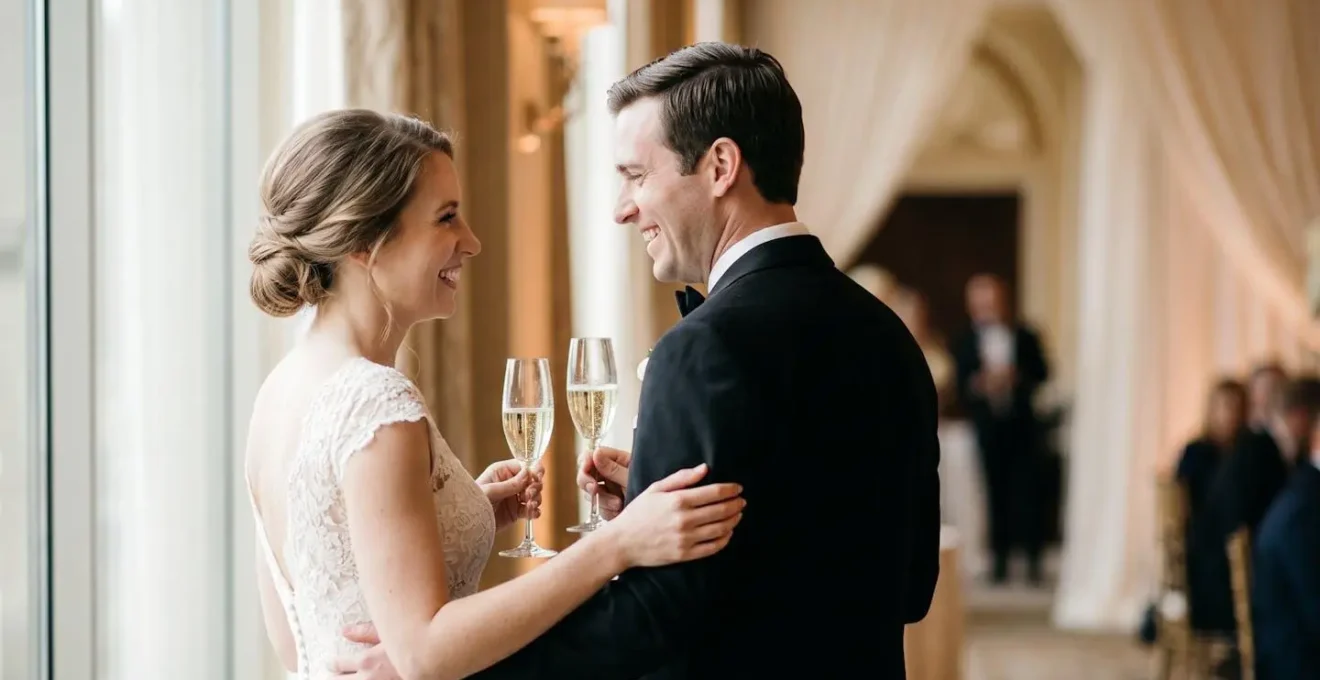
To ensure these moments happen, they must be explicitly built into your formal schedule. Here are a few concrete ways to weave them into your timeline:
- Schedule a Private Vow Exchange: Before the public ceremony, share your most personal vows with only each other and your photographer present. This front-loads the day with profound emotional meaning.
- Plan Sensory Check-Ins: Schedule three or four five-minute breaks throughout the day to simply pause, hold hands, and connect on what you’re seeing, smelling, and feeling.
- Weaponize Transition Time: Plan a ten-minute private, scenic route between your ceremony and reception venues, allowing for a moment of quiet transit together.
Visual Impact vs. Emotional Resonance: Where to Spend Your Decor Budget?
When faced with a large space and a significant budget, the temptation is to focus on grand, sweeping gestures—the massive floral arch, the dramatic ceiling installation, the elaborate stage backdrop. While these elements create immense visual impact and stunning photographs, they often lack what the soul craves: emotional resonance. A guest might marvel at an ice sculpture, but they will be moved by the texture of a high-quality linen napkin they touch all evening. This strategic allocation is paramount, especially when data shows that the average wedding cost in 2024 now exceeds $30,000.
Creating intimacy is an exercise in sensory scaffolding. It’s about building an experience that engages more than just the eyes. The most memorable and luxurious weddings are those that consider the hierarchy of the senses, prioritizing elements that guests will physically touch, hear, and smell. These are the details that communicate quality and care on a subliminal level, making guests feel personally attended to. A comfortable chair is a more intimate gesture than a towering floral arrangement that blocks sightlines.
Therefore, when allocating your budget, shift your thinking from passive viewing to active experience. Invest first in the elements that directly impact guest comfort and sensory engagement. This could mean upgrading to velvet-cushioned chairs, selecting heavyweight, beautifully textured linens, or ensuring the sound system for your live musicians is crystal clear. These choices create an environment of effortless comfort that allows guests to relax and connect more deeply. Only then should you layer in the larger visual statements. This approach ensures your decor isn’t just a backdrop, but an active participant in creating an intimate atmosphere.
Your Action Plan: The Hierarchy of Senses Budgeting Approach
- Prioritize Touch: Allocate funds first for items guests physically interact with. This includes high-quality linen napkins, comfortable and elegant chairs, and substantial, well-crafted flatware.
- Invest in Scent: Dedicate a portion of the budget to what guests will smell. This can be ambient, professional scenting of the space or ensuring an abundance of fresh, fragrant florals on the tables.
- Perfect the Soundscape: Budget for what guests will hear. This means investing in a quality sound system and talented live musicians whose music can fill the space without being overwhelming.
- Design for the Journey: Focus on key guest journey touchpoints. A stunning welcome installation makes a powerful first impression, while personalized place settings make each guest feel seen and valued.
- Choose Interactive Decor: Opt for decor that invites participation over passive viewing. Consider a custom perfume bar, a wish tree for guests to hang notes on, or a live painter capturing the scene.
The “Unplugged” Rule That Actually Works for High-Profile Guest Lists
The request for an “unplugged ceremony” has become commonplace, but a simple sign at the entrance is often not enough, especially with a high-profile guest list accustomed to documenting their lives. A sea of glowing screens not only ruins the professional photos you’ve invested in but, more importantly, it shatters the collective sense of presence and intimacy. To be truly effective, the unplugged rule cannot be a polite suggestion; it must be an integral part of the attention architecture of your event.
For a sophisticated audience, the approach must be one of hospitality, not restriction. The message should be, “We want you to be fully present with us for this sacred moment, and we have taken care of capturing it perfectly for you.” This isn’t just about asking guests to put their phones away; it’s about providing a superior alternative. This is a growing trend, as Zola’s First Look Report revealed that 75% of couples in 2024 embraced phone-free elements in their weddings.
The most effective strategy involves a three-pronged communication approach. First, include a beautifully worded note in your invitation suite explaining your wish for a present, intimate ceremony. Second, have the officiant make a warm, engaging announcement just before the ceremony begins, framing it as an invitation to connect emotionally. Finally, and most crucially, promise the immediate delivery of professional photos. Let guests know that a gallery of stunning ceremony photos will be available for them to view and share within 24 or 48 hours. By removing the fear of missing out (FOMO) and providing a better, more beautiful product, you replace restriction with a compelling incentive, making compliance feel like a luxury, not a limitation.
Scenting Your Wedding: The The Subtle Detail That Elevates Luxury Perception
Of all the senses, scent is the most powerfully and directly linked to memory and emotion. While visual decor creates an immediate impression, an olfactory signature is what lingers, creating a deep, subconscious association with the joy and elegance of your day. Scenting your wedding is one of the most sophisticated and underutilized tools for crafting an immersive, intimate atmosphere. It’s a layer of detail that elevates the perception of luxury from something you see to something you feel and breathe.
The goal is not to overpower the space with a strong perfume, but to create a subtle, ambient fragrance that becomes part of the environment itself. This can be achieved through several methods. Professional scenting companies can use nebulizing diffusers to disperse a custom-blended fragrance evenly throughout the venue. Alternatively, a more organic approach involves layering scents through your floral design—using fragrant blooms like gardenias, tuberoses, or jasmine—and placing scented candles (in safe locations) to add a warm, flickering glow and a gentle aroma. The key is consistency, using the same scent profile from the entrance to the ballroom to the powder rooms.
As one expert notes, this detail adds a powerful dimension to the guest experience, turning a fleeting moment into a lasting memory.

Scentscaping adds to the multisensory experience of the wedding for the guests as well as the couple, creating a distinctive association of that specific scent with that special day. Like a wedding photo, smelling the scent in the future will create recollections of that day.
– Perfumer interviewed by Refinery29, Wedding Scentscaping Trend Article 2025
Choosing a scent becomes part of your wedding story. It could be a fragrance that evokes a shared memory—the scent of pine from a memorable trip, the night-blooming jasmine from your engagement spot—or a completely new blend that will forever be known as “your” scent. It’s an invisible thread of intimacy that connects every guest to the heart of your celebration.
How to Dim Lights Strategically to Shift Energy from Dinner to Dancing?
Lighting is the silent conductor of your wedding’s orchestra, capable of directing guest attention, shaping mood, and dictating the energy of the entire event. Nowhere is this more crucial than in the transition from the elegant formality of dinner to the high-energy celebration of the dance floor. A clumsy, abrupt change in lighting can be jarring, but a strategic, programmed shift is a masterstroke of emotional choreography. It signals to guests, on a primal level, that the evening is entering a new, more dynamic phase.
The transition should be a gradual crescendo, not a sudden flip of a switch. During dinner, the lighting should be warm, intimate, and focused. Think soft, golden tones (in the 2200-2700K color temperature range) with pin-spotting on the centerpieces to make them glow, while keeping ambient light low enough to encourage close conversation. The focus is horizontal, drawing guests into the world of their table.
To shift the energy, the lighting design must pivot from horizontal to vertical. The process can be programmed to begin slowly over the final moments of dinner, timed to the music. As the beat builds, so does the light. This strategic shift involves several key techniques:
- Shift the Color Temperature: Gradually transition from the warm, candle-like tones of dinner to more energetic, neutral, or cool tones (3000-4000K) for dancing.
- Focus the Light: Dim the lights over the tables and use focused spotlights and moving lights to make the dance floor the brightest, most magnetic area in the room.
- Activate Vertical Space: Use uplighting on architectural features like columns, drapery, and the ceiling. This draws the eye upward and creates a more expansive, club-like atmosphere.
This carefully managed sequence doesn’t just tell guests it’s time to dance; it makes them *feel* the shift in energy, pulling them instinctively towards the celebration. It’s a seamless, sophisticated way to guide the flow of your evening without a single verbal announcement.
The “Rule of 14 Inches”: How Low or High Should Centerpieces Be?
In the pursuit of visual splendor, a common mistake is creating centerpieces so grand they become beautiful barriers. The primary function of a table is to facilitate connection, and any decor that obstructs sightlines fundamentally works against this goal. This brings us to a critical principle in event design: the “Rule of 14 Inches.” This rule dictates the non-negotiable dead space for guest interaction—the vertical zone directly in front of a seated guest where vision must remain clear. Nothing should interrupt the ability to make eye contact with the person across the table.
This means your centerpieces must adhere to a strict height discipline. There are two primary options: low or high. There is no in-between. As a general guideline, wedding design experts recommend centerpieces be kept under 12-14 inches in height. This allows for lush, full arrangements that add beauty and color to the tablescape without rising into your guests’ field of vision. These low arrangements create a feeling of a shared garden, enhancing the communal atmosphere.
The alternative is to go dramatically high. Tall arrangements should begin their substantive floral element well above head height, typically at least 24 inches from the tabletop, supported by a slender, unobtrusive vase or stand. This creates a breathtaking “canopy” effect, adding drama and drawing the eye upward without creating a visual wall. The space between 14 and 24 inches is the danger zone, where arrangements are guaranteed to block views and stifle conversation.
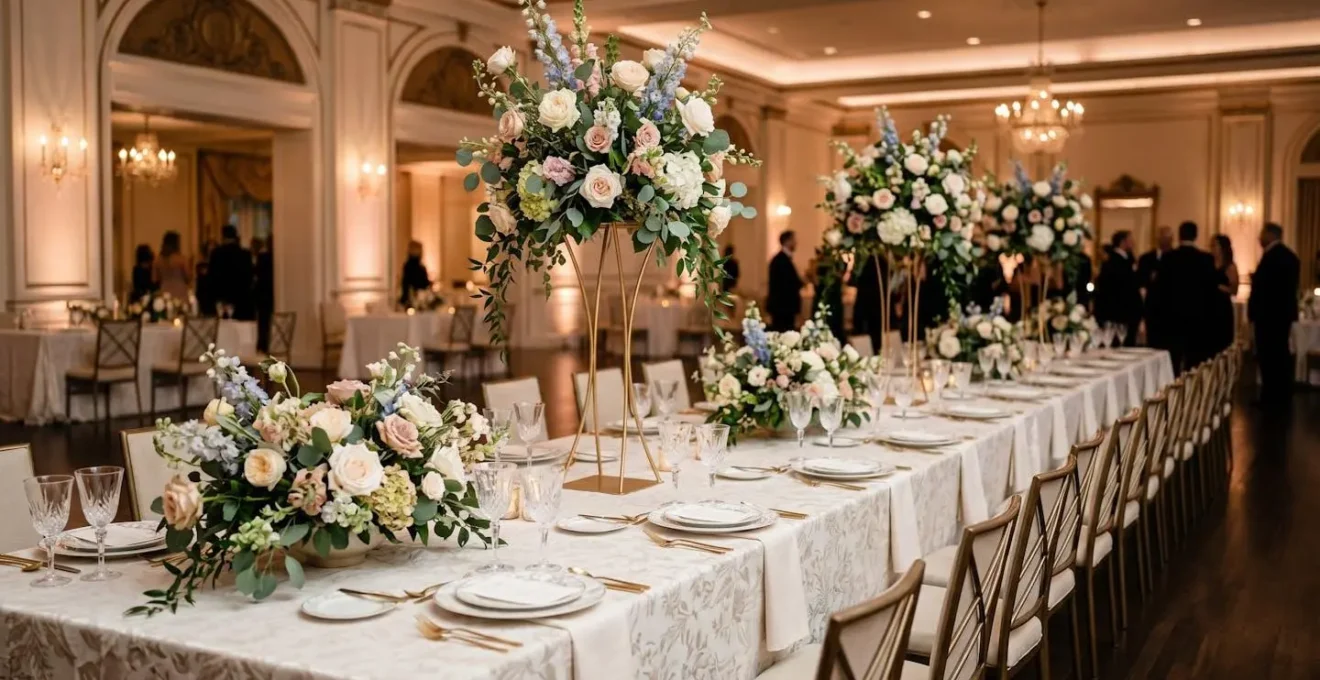
For the most dynamic and visually interesting room, the best approach is often to alternate. Using a mix of stunning high and lush low arrangements creates a varied tablescape, adds architectural interest, and plays with the scale of the room. This rhythm prevents visual monotony and ensures that no matter where a guest is seated, their ability to connect and converse is thoughtfully preserved.
Key Takeaways
- Intimacy at a large wedding is an engineered outcome, achieved by choreographing sensory details and emotional moments.
- Invest in what guests touch, smell, and hear. Sensory engagement creates deeper emotional resonance than purely visual spectacle.
- Design for connection: use long tables to build conversational bridges and keep centerpieces outside the 14-inch sightline rule.
How to Get Candid Photos If You Are Awkward in Front of the Camera?
After meticulously designing an event filled with intimate, authentic moments, the final piece of the puzzle is capturing that emotion truthfully. For many couples, however, the presence of a camera induces instant awkwardness, replacing genuine smiles with stiff, posed expressions. The secret to getting candid, soulful photos isn’t to “act natural”—it’s to create scenarios where you forget you’re being photographed altogether. It’s no surprise that wedding industry data confirms photographers are the most sought-after professionals; their ability to capture these fleeting moments is priceless.
The first step is building a genuine rapport with your photographer. This person will be in your intimate space for the entire day, and feeling comfortable with them is non-negotiable. Schedule a chemistry call or, even better, a casual pre-wedding coffee or engagement shoot. This allows you to build a personal connection, so on the wedding day, their presence feels like having a trusted friend nearby rather than an intrusive lens.
The second, and most critical, element is to shift from posing to prompting. A great photographer who understands this will replace “Smile at the camera!” with action-oriented prompts that evoke real emotion. Instead of being told where to stand, you’ll be given a simple, connective task. This technique bypasses the self-conscious part of your brain and elicits authentic reactions—the soft smile, the burst of laughter, the gentle touch—that make for the most powerful photographs. The best moments are often unscripted, such as your genuine reactions to the speeches during toasts.
To achieve this, collaborate with your photographer on a series of prompts and activities:
- Use Storytelling Prompts: A prompt like, “Tell your partner the exact moment you knew you wanted to marry them,” will elicit far more emotion than any pose.
- Structure the First Look Around an Activity: Instead of just a reveal, build the first look around a shared experience, like exchanging private letters, sharing a glass of a meaningful wine, or practicing your first dance alone.
- Focus on the Speakers During Toasts: This is a prime time for photojournalistic captures. Your unguarded reactions to the heartfelt words of your loved ones are pure gold.
By weaving these principles of emotional choreography into every decision, your grand, black-tie wedding will be remembered not for its scale, but for its heart. To begin crafting this narrative for your own celebration, the next step is to start a conversation with a designer who understands that true luxury is measured in moments, not just aesthetics.