In summary:
- Feeling awkward in photos often stems from the “spotlight effect”—the belief you’re being scrutinized more than you are.
- The secret isn’t to “ignore” the camera, but to actively redirect your focus with tangible actions and sensory anchors.
- Engaging in an activity, focusing on your partner’s touch or laugh, and understanding the value of “in-between” moments are key.
- Small, intentional posture adjustments can dramatically improve how you look and feel in spontaneous shots.
That feeling of dread when a camera lens points your way is almost universal. You’re told to “just act natural!” or “forget the camera is there,” but that advice feels impossible. Your smile tightens, your shoulders tense up, and you suddenly don’t know what to do with your hands. You want photos that capture the real, emotional, and beautifully imperfect moments of your love story, but you fear a gallery filled with stiff poses and forced grins. This isn’t about a lack of confidence; it’s a natural reaction to being observed.
Most guides will tell you to trust your photographer or practice in a mirror, but these tips often miss the core of the issue. The problem isn’t your ability to smile; it’s the overwhelming self-consciousness that takes over your brain. But what if the solution wasn’t about trying harder to ignore the camera, but about giving your mind something better to do? The key is to actively replace that feeling of being watched with a specific, tangible focus rooted in your connection with your partner.
This guide is your practical toolkit, designed by a posing coach for people who hate posing. We’ll move beyond useless platitudes and into actionable techniques. You will learn the psychological reason why it feels so hard, how to use simple activities and sensory cues to ground yourself in the moment, and why the most magical photos happen when you’re not trying at all. It’s time to get the authentic, emotional photos you deserve, without having to “perform” for the camera.
This article breaks down the practical strategies and psychological shifts that will transform your experience in front of the lens. Explore the sections below to build your confidence step-by-step.
Summary: A Practical Guide to Natural Photos for Camera-Shy Couples
- Why “Ignoring the Camera” is Harder Than It Sounds?
- The “In-Between” Moments: Why Transition Times Yield the Best Photos?
- Why Props or Activities Create Better Candids Than Standing Still?
- The “Turtle Technique”: A Simple Trick to Look Better in Spontaneous Shots
- How to Focus on Your Partner to Forget the Camera is There?
- How to Create a Sense of Intimacy for a Black-Tie Wedding With 200 Guests?
- How to Structure a Full-Day Elopement That Doesn’t Feel Empty?
- Film vs. Digital: Why Fine Art Photography Costs 30% More?
Why “Ignoring the Camera” is Harder Than It Sounds?
The core reason “just act natural” is terrible advice is a psychological phenomenon known as the spotlight effect. It’s the brain’s tendency to make you feel as though a giant spotlight is following you, highlighting every flaw and awkward movement for the world to see. You’re not just being photographed; you feel like you’re being scrutinized. This feeling is powerful, persistent, and almost entirely in your head. It triggers a self-preservation instinct, causing your body to freeze and your expression to become guarded.
Researchers have studied this extensively, confirming it’s not just a feeling but a measurable cognitive bias. As experts Thomas Gilovich, Victoria Medvec, and Kenneth Savitsky noted in their foundational study on the topic:
people overestimate the extent to which their actions and appearance are noted by others, a phenomenon dubbed the spotlight effect
– Thomas Gilovich, Victoria Medvec, and Kenneth Savitsky, Journal of Personality and Social Psychology study on the spotlight effect
Just how much do we overestimate this? The same research provides a startling answer. In experiments, participants overestimated the number of observers who would notice their appearance by approximately 50%. This means that half the awkwardness you feel is invisible to everyone else, including the camera. Understanding this is the first step to liberation. Your photographer isn’t judging your “bad side,” and your partner isn’t critiquing your smile. They are simply there to capture the connection that exists when you can turn down the volume on that internal spotlight.
The “In-Between” Moments: Why Transition Times Yield the Best Photos?
The most authentic and emotional photographs are rarely the ones taken when you’re holding a formal pose. Instead, they happen in the transitional dynamics—the small, unscripted moments between the “official” shots. Think about the instant you break into a real laugh after a posed smile, the way you adjust your partner’s tie, the quiet glance you share while walking from one location to another, or the deep breath you take right after the ceremony. These are the “in-between” moments where your self-consciousness fades because your mind is occupied with the next small action.
Documentary-style photographers build their entire approach around capturing these transitions. As wedding photojournalist Zoe Larkin explains, the best candids emerge when people are engaged in an activity and forget about the photographer’s presence. This could be during speeches, in the shuffle between events, or simply walking together. These moments yield photos where subjects are completely un-self-conscious, often revealing a natural expression or interaction they’ve never seen in themselves before. It’s in these un-posed seconds that your true dynamic as a couple shines through.
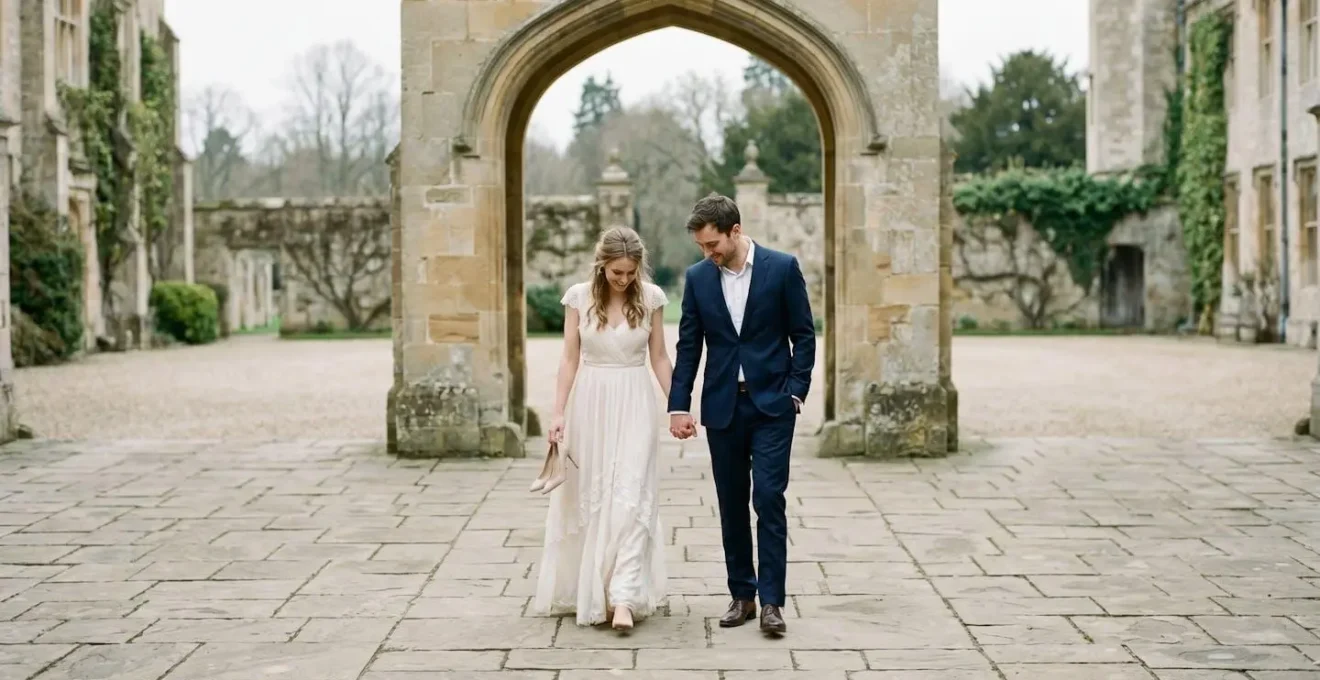
The beauty of these moments, as seen above, is their honesty. There’s no time to “get in your head” or worry about how you look. Your body language is natural, and your expressions are genuine. The key for you as a couple is to embrace these transitions. Instead of freezing when the photographer moves, keep interacting. Walk slowly, talk to each other, fix a stray hair. Give the photographer the opportunity to capture the authentic, fluid story of your day, not just a series of static portraits.
Why Props or Activities Create Better Candids Than Standing Still?
One of the most effective strategies for dissolving camera-awkwardness is what we can call action-based distraction. The human brain isn’t great at multitasking, especially when it comes to being self-conscious while performing a task. By introducing a simple prop or activity, you give your brain—and your hands—a clear job to do. This immediately diverts your mental energy away from “How do I look?” and toward “What am I doing?” The result is a more relaxed posture, a natural facial expression, and photos that feel like a real moment in time.
Standing still and trying to look natural is a recipe for stiffness. But when you’re engaged in an action, your body moves with purpose. Consider these scenarios. Instead of just standing in a field, you could lay out a blanket and have a picnic. Instead of just holding champagne flutes, you could actually pop the bottle, with all the spontaneous laughter and surprise that comes with it. Instead of facing each other and smiling, you could read letters you wrote to one another.
These activities provide a narrative for the photos. They create a reason for you to interact, to touch, to laugh, and to look at each other with genuine emotion. The prop or activity becomes a vehicle for connection. It could be as simple as sharing an umbrella in the rain, lighting sparklers at dusk, or even just playing your favorite song on a phone and having a slow dance. The goal isn’t to perform for the camera, but to create a genuine experience that the photographer can document authentically.
The “Turtle Technique”: A Simple Trick to Look Better in Spontaneous Shots
While the goal is to be natural, one tiny bit of postural intentionality can make a world of difference in how you look in every single photo, posed or candid. It’s called the “Turtle Technique,” and it’s a simple trick to prevent the dreaded “double chin” and create a more defined, elegant jawline. When we feel awkward or are caught off guard, our natural tendency is to retract our neck slightly, much like a turtle pulling its head into its shell. This simple, subconscious movement is rarely flattering.
The fix is equally simple. First, focus on relaxing your shoulders, letting them drop down and away from your ears. Then, gently push your chin forward and slightly down. Imagine you are trying to push your forehead toward the camera. It will feel a bit unnatural at first, almost like you’re jutting your head out, but the effect on camera is transformative. This simple action elongates your neck and creates a clear separation between your jawline and your neck, which is universally flattering for any face shape or body type.
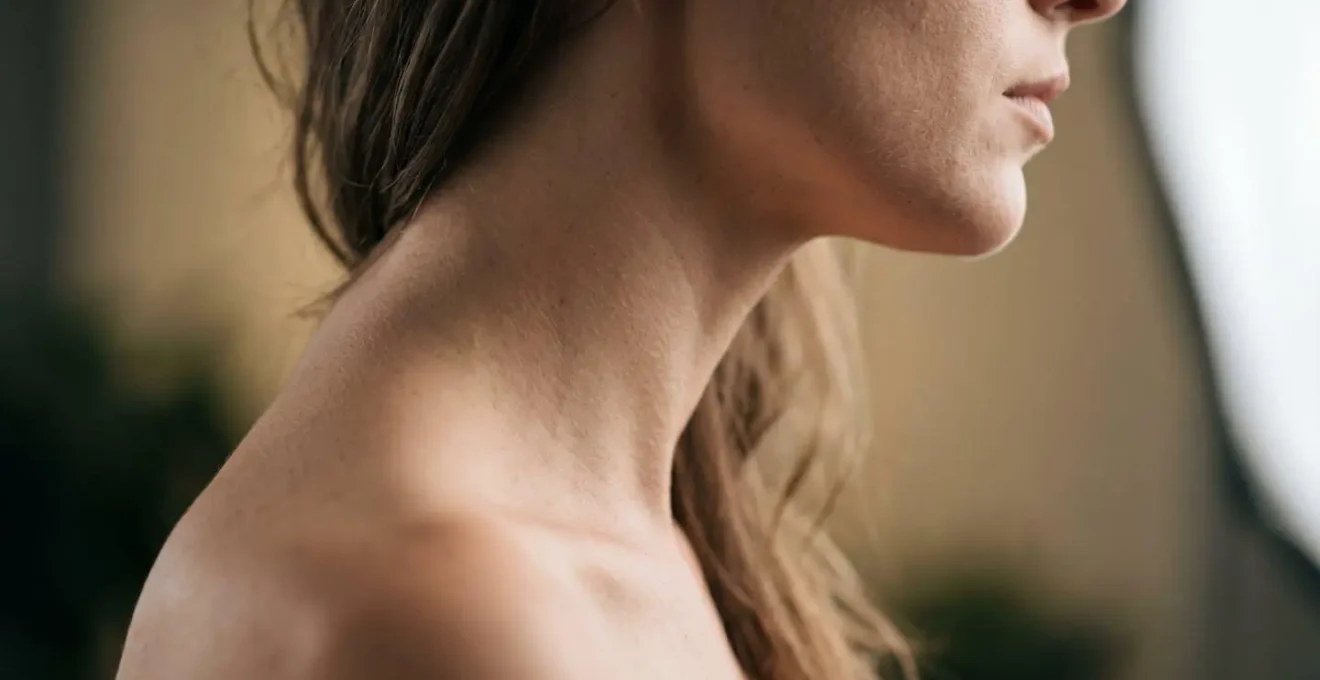
Unlike a pose, this isn’t something you “hold.” It’s a subtle adjustment you can practice until it becomes second nature. Try it in the mirror: see the difference between your normal stance and your posture with the turtle technique. The goal is to make this your default stance whenever a camera is around. By building this small piece of postural awareness, you ensure that even the most spontaneous, in-between moments are captured from your best angle, allowing you to relax and focus on your partner, knowing you already look great.
How to Focus on Your Partner to Forget the Camera is There?
The most powerful tool you have to combat camera-consciousness is your partner. The challenge is that “look at your partner” can feel just as awkward as looking at the camera if you’re not truly connecting. The secret is to move beyond just visual focus and engage in sensory anchoring. This means actively concentrating on a specific, non-visual sense related to your partner. By channeling your mental energy into the feeling of their hand in yours, the sound of their laugh, or a shared memory, you leave no room for the self-critical voice in your head.
This isn’t an abstract idea; it’s a series of concrete exercises you can do during your photoshoot. Instead of thinking about your smile, think about the warmth of your partner’s body next to yours. Instead of worrying about your eyes, close them for a moment and just listen to the sound of their breathing. This shift in focus from the external (the camera) to the internal (your sensory experience of your partner) is what produces genuine emotion and, in turn, beautifully candid photos. The camera stops being an observer and simply becomes a witness to a real moment of connection.
Action Plan: Exercises to Reconnect with Your Partner
- Auditory Focus: Close your eyes and focus only on the precise sound of your partner’s breathing or their laugh. Try to describe it to yourself.
- Tactile Anchoring: Pay attention to the physical sensation of your partner’s hand in yours. Notice the texture of their skin and the warmth of their body.
- Conversational Prompts: Engage in a real conversation. Talk about your favorite shared memory, the moment you knew you were in love, or what you’re most excited about for your future together.
- Sustained Eye Contact: During any moment you’re asked to face each other, truly make eye contact. Look for the little flecks of color in their irises. Let it create a genuine smile.
- Secret Signals: Agree on a pre-arranged keyword or a subtle inside joke. Use it during the shoot as a signal to relax, take a breath, and reconnect with each other, shutting out the rest of the world.
How to Create a Sense of Intimacy for a Black-Tie Wedding With 200 Guests?
A large, formal wedding with a guest list of 200 people can feel like the ultimate challenge for an intimate, candid photo experience. The sheer scale of the event, the packed timeline, and the pressure to greet every guest can leave you feeling more like event hosts than a couple in love. In this environment, creating genuine moments of connection requires intentionality. The key is not to find more time, but to build pockets of intimacy directly into the structure of your day.
This means working with your planner and photographer to schedule moments of downtime. It might be 15 minutes alone together immediately after the ceremony, before you join the cocktail hour. It could be a designated “quiet moment” away from the reception hall later in the evening. As one wedding photographer recommends, a highly effective strategy is to add buffer hours into the timeline specifically for this purpose. This flexibility allows for spontaneous moments without the pressure of a ticking clock.
Case Study: The Cocktail Hour Strategy
A practical and powerful approach to maintaining connection during a large reception is to re-think your cocktail hour strategy. The default for many couples is to “divide and conquer” to greet as many guests as possible. However, this separates you and prevents any candid moments together. A more effective method for generating authentic photos is to stay close to your partner throughout the cocktail hour. Make your rounds as a unit. By navigating the crowd together, you’ll naturally hold hands, share whispered comments, and experience the event as a couple, providing your photographer with a wealth of genuine interactions to capture amidst the crowd.
Ultimately, intimacy at a large wedding is a choice. It’s about prioritizing your connection over your hosting duties, even if just for a few curated moments. By structuring your day with these intimate pockets, you give yourselves the space to breathe, reconnect, and create the memories that will become your most cherished photographs.
How to Structure a Full-Day Elopement That Doesn’t Feel Empty?
An elopement offers the ultimate freedom to create a day that is entirely about you. However, a full day of “just us” can sometimes feel daunting to plan. Without the formal structure of a traditional wedding, how do you fill eight or ten hours in a way that feels meaningful and not just… empty? The solution is to think of your elopement not as a long photoshoot, but as a narrative with a distinct story arc. By structuring the day with a beginning, middle, and end, you create a natural flow of energy and emotion that leads to a richer experience and more dynamic photos.
Instead of just a ceremony and portraits, build a day around a series of activities that tell your story. This framework turns the entire day into a series of “in-between” moments, eliminating the pressure to be “on” for the camera. The photographer becomes a storyteller, documenting the unfolding adventure. This approach ensures your final gallery is a complete narrative, filled with a variety of emotions, locations, and activities that reflect who you are as a couple.
A successful full-day elopement timeline can be broken down into a classic five-part narrative structure:
- Buildup Phase: This is the quiet, anticipatory start. It could involve making coffee together, writing your vows in separate corners of your cabin, or helping each other get ready. These are the calm, intimate moments that set the emotional tone for the day.
- Rising Action: This phase involves movement and adventure. It’s the journey to your ceremony spot, whether it’s a scenic drive up a mountain, a hike through a forest, or a boat ride to a secluded cove.
- Climax: This is the emotional peak of your day—the ceremony itself. Because you’ve built up to this moment, the emotions captured will be genuine and heightened.
- Falling Action: The celebration begins here. This could be a luxury picnic with champagne, your first dance on a cliffside, or heading to a local brewery for a celebratory drink. It’s the joyful release after the emotional peak.
- Resolution: These are the calm, closing moments of your story. Watching the sunset, stargazing, or sharing a quiet moment of reflection by a fire pit brings your day to a peaceful and satisfying close.
Key takeaways
- Your feeling of awkwardness is the “spotlight effect” in action; you are your own harshest critic.
- Don’t just try to ignore the camera. Actively replace your self-consciousness with tangible actions, activities, or a deep focus on your partner.
- The most authentic photos are born in the “in-between” moments—the transitions, the adjustments, the unscripted laughs. Embrace them.
Film vs. Digital: Why Fine Art Photography Costs 30% More?
When choosing a photographer, you might encounter some who specialize in film photography, often categorized as “fine art” and priced at a premium. This price difference, which can be 30% or more, isn’t just about the cost of film rolls and development. It reflects a fundamental difference in methodology that is deeply connected to the pursuit of authentic, candid moments. The limitations of the medium force a level of intentionality that is the very essence of capturing genuine emotion.
The core difference lies in the number of shots. As documented in photography resources, film photographers work with only 16-36 frames per roll, whereas a digital photographer can take thousands of images at no extra cost. This scarcity changes everything. A film photographer cannot afford to mindlessly click away, hoping for a good shot. Every single press of the shutter is a deliberate decision. They must wait, observe, and anticipate the perfect moment—the genuine laugh, the fleeting glance, the tearful embrace—before committing a frame.
Case Study: The “Soulful Storytelling” Approach
Canon Ambassador Markus Morawetz describes his film-influenced style as “soulful storytelling.” His technique is built around the reportage of true moments, emphasizing the intentionality born from the limitations of film. He describes his method as being as stealthy as possible, using cameras that perform well in low light and fast prime lenses to capture authentic moments as they happen, without flash or staging. This approach isn’t about creating moments, but about being patient and skilled enough to recognize and capture them when they organically occur. This deliberate, observant method is a direct result of a mindset shaped by the preciousness of each frame.
For a couple who feels awkward on camera, a photographer with this film-honed mindset can be a perfect match. Their process is inherently less intrusive and more observant. They are trained to see the “in-between” moments because that’s where the magic lies. So while the price tag may be higher, you’re not just paying for a different look; you’re investing in an approach rooted in patience, observation, and a deep commitment to capturing authenticity.
Now that you have the tools to feel more comfortable and the knowledge to choose the right approach, you are ready to get the emotional, candid photos you’ve always wanted. The next step is to start a conversation with photographers whose work resonates with this desire for authenticity and share what you’ve learned about creating a space for genuine connection.