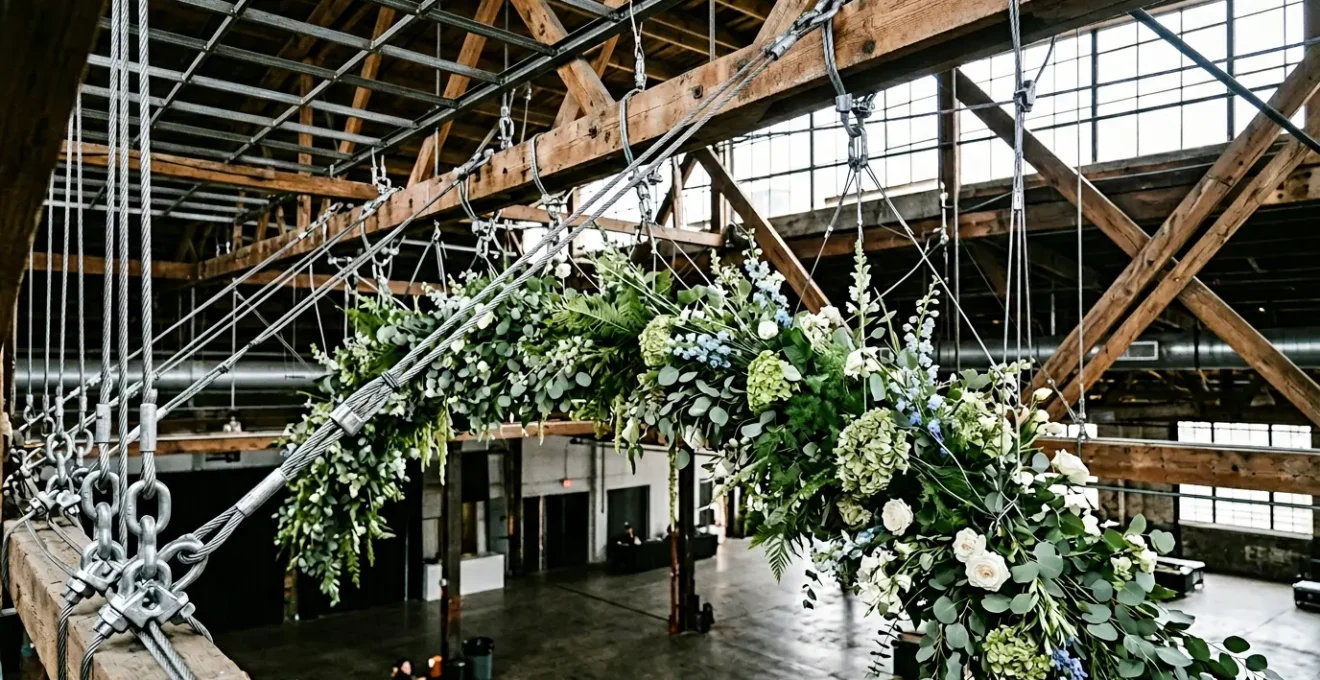
The biggest cost of hanging florals isn’t the flowers—it’s the physics, specialized labor, and engineering required to safely defy gravity.
- The weight of wet flowers and mechanics requires structural verification of your venue’s rigging points, a non-negotiable safety and cost factor.
- Installation and late-night removal (“strike”) often involves certified riggers and can constitute 40-60% of your total floral bill.
Recommendation: Before falling in love with a ceiling installation, ask your venue for its structural load report and discuss rigging logistics with your floral designer first.
That breathtaking image on your Pinterest board—a ceiling dripping with peonies and wisteria, floating effortlessly above the head table—is a powerful vision. It promises romance, drama, and an unforgettable experience for your guests. The common advice you’ll hear is that “it’s expensive” or “you need a professional.” While true, this advice barely scratches the surface and misses the fundamental point. The challenge isn’t just floral artistry; it’s a temporary work of structural engineering.
Most couples budget for the cost of the blooms, but the real expenses are hidden in factors you likely haven’t considered: structural load capacities, the physics of heat in a crowded room, specialized labor that works on lifts instead of tables, and the non-negotiable cost of taking it all down at 2 AM. This isn’t just about arranging flowers; it’s about building a safe, temporary structure in a space not always designed for it.
But what if the real key to achieving your dream wasn’t a bigger flower budget, but a deeper understanding of the mechanics behind the magic? This guide moves beyond aesthetics to deconstruct the engineering, labor, and logistical realities of hanging florals. We will explore the critical questions to ask your venue, break down the true cost of labor, understand the environmental challenges, and analyze the financial impact of your flower choices. By understanding the “why” behind the costs, you can have a more productive and realistic conversation with your designer, transforming your vision from a potential budget-breaker into a stunning, well-executed reality.
To navigate this complex topic, we’ve broken down the essential components that contribute to the final cost and feasibility of your dream hanging floral installation. This structure will guide you through the critical considerations, from the venue’s bones to the final teardown.
Summary: Deconstructing the True Cost of Ceiling Floral Installations
- Can Your Venue’s Beams Actually Support 50kg of Wet Floral Foam?
- Why Installation Labor Costs More Than the Flowers Themselves?
- Heat Rises: Why Ceiling Flowers Wilt Faster Than Table Centers?
- The “Strike Fee”: What It Costs to Remove Installations at 2 AM?
- Chicken Wire vs. Foam Free: Which Mechanic is Safer for Overhead Installs?
- Rigging from Beams: What You Need to Ask the Venue Manager?
- How to Light High Barn Ceilings Without a Cherry Picker?
- Why Importing Peonies in August Can Triple Your Floral Bill?
Can Your Venue’s Beams Actually Support 50kg of Wet Floral Foam?
The first and most critical question has nothing to do with flowers and everything to do with physics. Before a single stem is chosen, you must determine if your venue’s ceiling can safely support your vision. A seemingly light and airy floral installation is deceptively heavy. Water-soaked floral foam, metal mechanics, and the flowers themselves quickly add up to a significant structural load. A single large arrangement can easily exceed 50kg (110 lbs), concentrated on one or two small points.
Many historical barns or architecturally beautiful venues have “decorative” beams that were never intended to bear weight. Attempting to rig from these can lead to catastrophic failure, property damage, and serious injury. Professional venues with experience in large-scale events should have a “rigging plot” or a structural engineer’s report detailing the load capacity of designated rigging points. These are not suggestions; they are hard limits based on safety standards. For instance, entertainment industry safety protocols often require a single rigging point to handle a minimum of 100 pounds (about 45kg) at mid-span, a standard your floral production team must respect.
Ignoring this step is the single most expensive mistake you can make. It could mean a last-minute, heartbreaking cancellation of your design or, far worse, a dangerous situation on your wedding day. Your floral designer is not a structural engineer; they rely on the venue’s certified information to proceed safely. This is a foundational, non-negotiable first step.
Why Installation Labor Costs More Than the Flowers Themselves?
One of the most common points of confusion for couples is the labor line item on a floral quote for a hanging installation. How can the work cost more than the beautiful, premium flowers? The answer lies in the radical difference between creating a centerpiece and building an aerial installation. Table arrangements are created in a studio under ideal conditions. Ceiling installations are built on-site, at height, under time pressure, and often require a specialized team.
This is not a task for a single designer on a stepladder. It requires a team of strong, skilled individuals, often including a certified rigger, working on scissor lifts or tall scaffolding. They are not just arranging flowers; they are hauling heavy mechanics, securing structures with wire and clamps, and working against the clock. This specialized labor is expensive, and it’s why labor can represent 40-60% of the total floral quote. The work is physically demanding and requires precision and expertise to ensure safety.
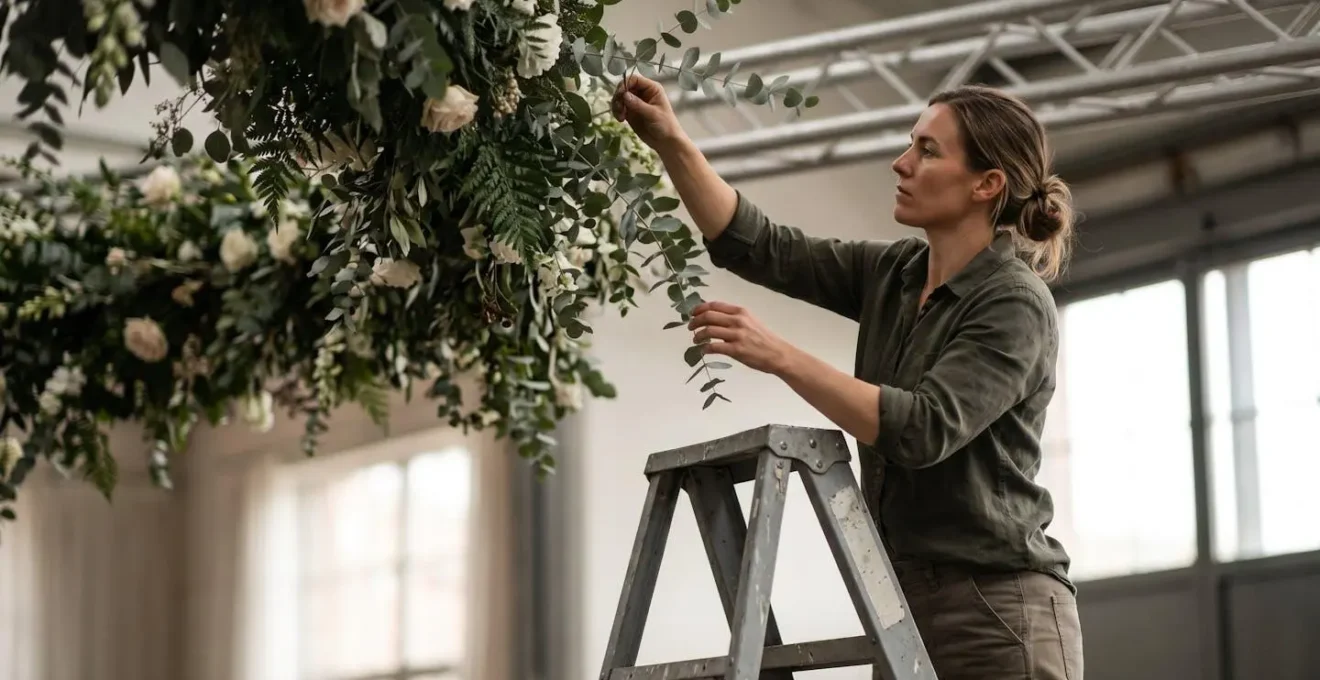
Consider the reality of installing greenery. A professional florist details that the raw material for a smilax vine installation might start at $1,000, but the vines arrive in tangled, thorny bundles that require hours of careful separation and preparation by a team of three or more people before a single vine is hung. A full staircase design can easily start at $10,000, not because of the greenery’s cost, but because of the immense, skilled labor involved in transforming it into a seamless piece of art. When you pay for an installation, you are paying for the expertise, insurance, equipment, and sheer physical effort of a production team.
Heat Rises: Why Ceiling Flowers Wilt Faster Than Table Centers?
A packed wedding reception is a hot environment. With dozens or hundreds of guests, catering equipment, and lighting, the temperature in a room can rise significantly throughout the evening. Because heat rises, the warmest part of your venue is always the ceiling—exactly where your expensive floral installation is hanging. This creates a hostile microclimate for a delicate, living product.
Flowers stay fresh by drawing up water, a process that is accelerated in warmer temperatures. If a flower’s “transpiration” (water loss) outpaces its ability to absorb water, it wilts. Flowers in an overhead installation have a limited water source and are subjected to the highest temperatures and poorest air circulation in the room. A flower that would look perfect for eight hours on a table might start to look stressed and tired after just three hours near the ceiling.
This is where flower selection becomes a matter of science, not just style. Certain flowers are simply not suited for the rigors of an overhead installation. Your designer’s recommendation for heartier, more heat-tolerant blooms is based on hard-won experience and a desire to ensure your investment looks beautiful all night long. Choosing the wrong flower for this environment can lead to a wilted, disappointing display before your main course is even served.
This table illustrates how different flowers perform under the stress of a high-heat, low-water environment typical of ceiling installations. It’s a crucial guide for aligning your aesthetic desires with botanical reality.
| Flower Type | Heat Tolerance Rating | Ceiling Installation Suitability | Special Considerations |
|---|---|---|---|
| Orchids | High | Excellent | Naturally tolerant to heat and low water; retain shape under stress |
| Anthuriums | High | Excellent | Tropical species with high heat adaptation; minimal wilting |
| Succulents | Very High | Excellent | Retain own water; sculptural additions that won’t fade |
| Roses (standard) | Moderate | Fair | Require water stations; sturdy petal structure resists wilting if hydrated |
| Hydrangeas | Low | Poor | High water demand; rapidly wilt in heat and poor air circulation |
| Sweet Peas | Low | Poor | Delicate petals; designed for cooler spring conditions |
| Peonies | Very Low | Very Poor | Require temperatures below 80°F; lack summer heat adaptations entirely |
The “Strike Fee”: What It Costs to Remove Installations at 2 AM?
The party is over, the lights are up, and your guests are heading home. But for your floral production team, one of the most critical parts of the job is just beginning. This is “The Strike”—the complete breakdown and removal of the installation. Venues typically require that the space be cleared the same night, often imposing a strict deadline of 1 AM or 2 AM. This means a sober, insured, and professional crew must return late at night to undo everything they built.
This is not simply “cleaning up.” The strike is a meticulous logistical operation. The team must bring back the ladders or lifts, carefully disassemble the structure to avoid damaging the venue, sort the materials for disposal or return, and pack up every last piece of equipment. It’s demanding work performed during unsociable hours, which commands premium pay. This service is often listed as a “strike fee,” “breakdown fee,” or “retrieval fee” on your invoice. While some florists in certain markets report this fee might be around $500 for combined setup and teardown, for large-scale overhead work, this cost can be significantly higher, reflecting the complexity and late-night nature of the job.
The importance of this process cannot be overstated. As the experts at Sapphire Events explain, the responsibility of the florist extends well beyond the event itself. As they note in their wedding flower cost analysis:
Your florist will be responsible for taking down all of the flower arrangements at the end of the event, and will need to properly dispose of the floral materials, any related packaging used throughout the installation process, and also take care of the rental equipment (vessels, fabrication materials) for inventory and storage.
– Sapphire Events, Wedding Flower Cost Analysis
This fee is not an optional extra; it’s a fundamental cost of ensuring a professional and respectful conclusion to your event, leaving the venue exactly as you found it and protecting you from potential fees for damages or cleaning.
Chicken Wire vs. Foam Free: Which Mechanic is Safer for Overhead Installs?
The internal structure that holds an installation together is known as its mechanics. The two most common methods for overhead work are traditional floral foam cages and “foam-free” techniques, typically using chicken wire as a base. The choice between them has significant implications for weight, safety, and environmental impact.
Floral foam is a dense, water-absorbent plastic. While it provides a stable and hydrated base for stems, it has major drawbacks for hanging designs. Many designers are moving away from it for environmental reasons. As the designer behind Stone House Creative notes:
I try to use as little floral foam as possible in my work (it’s essentially a non-biodegradable single use plastic, and it’s carcinogenic), and though I can’t always figure out a way to work without it, using foam isn’t best in hanging installations because it is very heavy and it often drips.
– Stone House Creative, Guide to Hanging Floral Installations
The weight issue is critical. A block of foam, once saturated with water, becomes incredibly heavy. This exponentially increases the structural load on the rigging points. Furthermore, the risk of dripping water onto a dance floor, electrical equipment, or guests is a significant concern.
Chicken wire, on the other hand, offers a lightweight and reusable alternative. The designer creates a strong, cage-like structure, and stems are woven into the wire grid. This method requires more skill to secure each stem, but the overall structure is much lighter and has a more predictable static weight. The primary safety concern shifts from the total weight of the mechanic itself to the security of each individual stem and, most importantly, the attachment points holding the entire structure. Both methods require meticulous engineering to prevent failure, but foam-free techniques are often preferred for overhead work due to their reduced weight and elimination of water-drip risk.
Rigging from Beams: What You Need to Ask the Venue Manager?
A productive conversation about a hanging installation begins with your venue, not your florist. Arriving at your first floral design meeting armed with concrete information about your venue’s capabilities will save immense time, money, and potential heartache. Your designer needs to know the specific, technical constraints they are working within. Simply knowing “there are wooden beams” is not enough.
You need to ask pointed, technical questions to get the answers that matter. The responsibility for providing this information lies with the venue manager or their technical director. They must provide documentation about the structural integrity of their space. Furthermore, be aware that most venues will require that any rigging be performed by a qualified professional, often someone holding an ETCP certification or with equivalent documented experience. This is a liability and safety requirement that protects you, your guests, and the venue.
Treat this as a crucial part of your venue selection process. A venue that cannot provide clear, documented answers to these questions may not be a suitable choice for a complex overhead installation. Having this information upfront allows your designer to create a proposal that is not only beautiful but also safe, feasible, and accurately priced from the start.
Your Venue Rigging Checklist: Questions to Ask Before You Book
- What is the ceiling structure type: a permanent rigging grid, exposed structural beams, or purely decorative elements?
- What is the documented point load capacity (the maximum weight allowed at a single attachment point) in pounds or kilograms?
- What is the documented total distributed load capacity for the entire ceiling area you wish to use?
- Are there pre-approved, existing rigging points, or must our production team install temporary attachment hardware?
- What specific attachment hardware is permitted (e.g., beam clamps, specific types of shackles, bolt grades)?
- What engineering documentation or plans does the venue require for approval before any rigging can be installed?
- What are the absolute earliest access times for the rigging team to enter and the absolute latest deadline for room clearance?
How to Light High Barn Ceilings Without a Cherry Picker?
A magnificent floral installation can be lost in the shadows of a high barn or ballroom ceiling without thoughtful lighting. However, lighting high ceilings presents the same logistical challenges as installing the flowers themselves: access and rigging. The traditional solution of using a cherry picker or scissor lift to hang lights is expensive and not always possible. As a production designer, I always consider how florals and lighting will work together to create a cohesive atmosphere.
Fortunately, there are many creative and effective ways to illuminate both your installation and the surrounding space without requiring aerial equipment. The key is to think from the ground up. Techniques like uplighting can wash walls and beams with color and ambient light, while gobo projectors can cast patterns (like foliage or monograms) onto the ceiling, creating texture and depth from a distance. The most integrated approach involves building lighting directly into the floral mechanics themselves.
By pre-wiring battery-powered, remote-controlled pin spots or fairy lights into the chicken wire structure during assembly on the ground, the lighting becomes a seamless part of the floral design. When the entire piece is hoisted into place, the lighting is perfectly positioned to make the flowers glow from within. This approach requires careful planning and collaboration between your floral designer and a lighting company, but it avoids the extra cost and complexity of separate lighting rigging and creates a truly magical effect.
Ground-Based Lighting Plan for High Ceilings
- Ground-Supported Truss: Build and light your floral installation on a truss at ground level, then use chain motors to hoist the entire, completed structure into place.
- Integrated LEDs: Incorporate small, battery-powered, remote-controlled LED pin spots directly into the floral mechanics before hoisting to highlight specific blooms from within.
- Gobo Projection: Use powerful ground-based projectors with custom “gobo” patterns to cast light, shadows, or floral motifs onto the ceiling without any physical rigging.
- Architectural Uplighting: Place high-power LED uplights on the floor, aimed up at walls and support posts, to create a dramatic wash of ambient light that highlights the venue’s features.
- Wireless Control: Utilize wireless DMX-controlled lighting to change colors and intensity throughout the night without running cables to the ceiling.
Key Takeaways
- The structural capacity of your venue is the absolute first and most important consideration. No design is worth compromising safety.
- The majority of the cost for hanging installations is in the specialized, insured, and physically demanding labor—not just the flowers.
- The warm microclimate near the ceiling dictates flower choice; prioritize heat-tolerant blooms to ensure longevity throughout your event.
Why Importing Peonies in August Can Triple Your Floral Bill?
Your heart is set on a cascade of lush, blush peonies for your late summer wedding. It’s a beautiful vision, but it’s also a financially and logistically challenging one. Peonies are a spring flower, with a natural peak season in most of the Northern Hemisphere from April to June. Sourcing them out of season, for example in August, means they must be imported from the other side of the world where it is currently their springtime, such as South America or even Alaska.
This journey incurs a cascade of costs. The flowers are flown in refrigerated air freight, must pass through customs, and require special handling at every stage. This complex supply chain can result in a cumulative markup of 3.5 times the farm price by the time the flower reaches your bouquet. Beyond the price premium, there is a significant risk premium. Out-of-season flowers are less reliable. A florist must order 20-30% more than needed to account for spoilage, shipping delays, and flowers that may simply fail to perform under the stress of travel and a warm environment.
Case Study: The Phoenix Peony Failure
A documented wedding in Phoenix, Arizona, attempted to use peonies for a July ceremony. Despite being shipped in refrigerated transport, the intense summer heat was too much. The peonies, which require temperatures below 80°F to maintain their shape, arrived completely wilted before the event could even begin. This case perfectly illustrates that the cost of off-season flowers isn’t just financial; it’s a gamble on the flower’s ability to withstand conditions it was never botanically designed for.
A skilled designer will encourage you to embrace seasonality. By choosing flowers that are naturally at their peak during your wedding month, you get a superior product—one that is larger, more fragrant, and more resilient—at a more reasonable cost. There is almost always a beautiful, in-season alternative that can achieve a similar aesthetic and feel without the risk and expense of long-distance importing.
| Desired Aesthetic | Off-Season Flower (High Cost) | In-Season Alternative (Lower Cost) | Season Availability |
|---|---|---|---|
| Lush, round, romantic | Peonies (April-June only) | Garden Roses | Year-round with peak May-October |
| Full, layered petals | Peonies | Ranunculus | Winter through spring (December-May) |
| Large statement blooms | Peonies | Dahlias (specific dinner plate varieties) | Summer through fall (July-October) |
| Soft texture, volume | Peonies | Lisianthus | Year-round availability |
| Blush/pastel tones | Peonies | Spray Roses | Year-round availability |
Armed with this structural, logistical, and botanical knowledge, you are no longer just a client with a pretty picture; you are an informed partner in the design process. This understanding allows you to collaborate with your floral designer to create something that is not only breathtakingly beautiful but also safe, smart, and sustainable for your budget. The most stunning installations are born from this fusion of artistic vision and technical respect. Now, you can start the conversation in the right place.