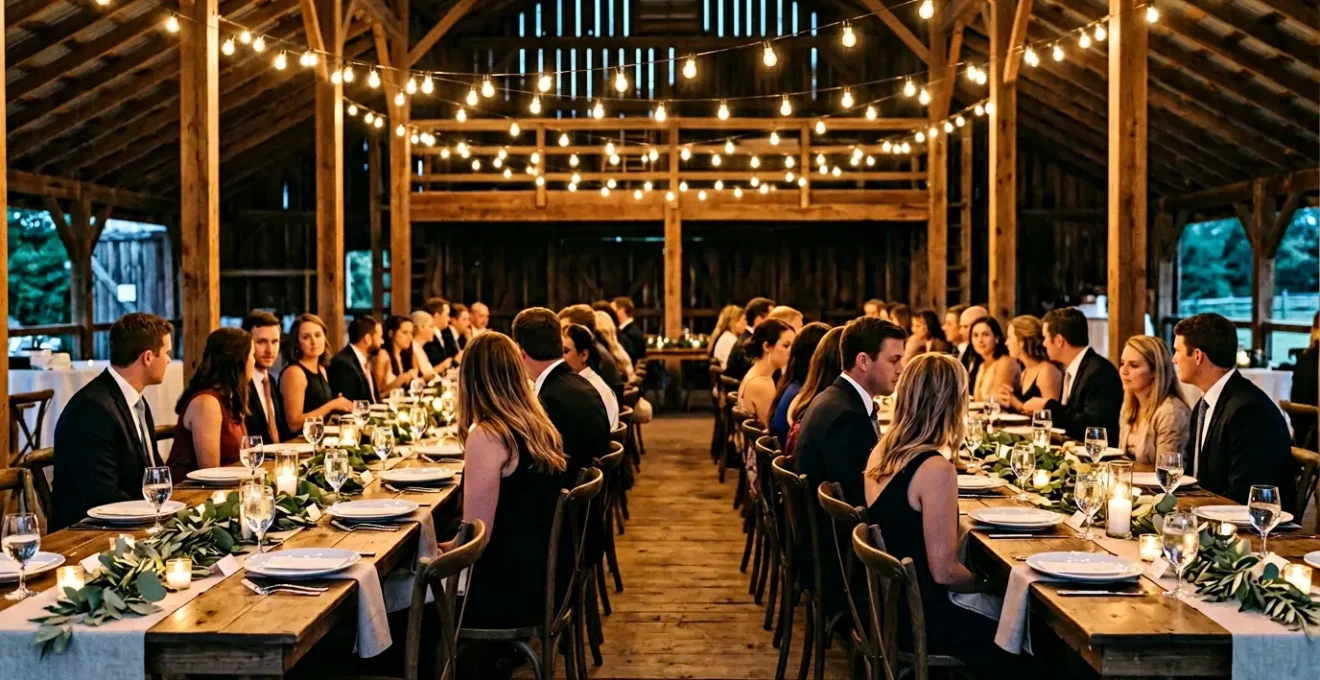
The biggest mistake couples make is treating farmhouse tables as just furniture; their true potential is unlocked when you approach them as social architecture.
- Effective layout is less about rustic aesthetics and more about mastering sightlines, acoustics, and guest flow.
- Centerpiece height, table spacing, and even your service style are critical levers for encouraging or killing conversation.
Recommendation: Shift your mindset from decorator to social architect. Plan your floor plan to intentionally create conversational pathways and eliminate friction points for a more connected guest experience.
You’ve chosen beautiful, rustic farmhouse tables for your wedding. Their long, communal nature promises an intimate, family-style celebration. But here’s the challenge that many couples overlook: a poorly arranged farmhouse table layout can create the exact opposite effect, leading to conversational dead zones, awkward seating, and a disjointed guest experience. The common advice often stops at aesthetic choices like linen runners or floral garlands, treating the table as a static decorative element.
While these details matter, they are secondary to the table’s primary function at a celebration: fostering connection. The real key to a vibrant reception is to stop thinking about furniture placement and start thinking about social engineering. This means analyzing the spatial dynamics of your venue and using your tables to deliberately craft an environment where conversation flows effortlessly. The secret lies not in what you put on the table, but in how you master the invisible architecture of sightlines, acoustics, and movement around it.
This guide will walk you through the critical checkpoints of farmhouse table arrangement. We’ll deconstruct everything from the subtle acoustic impact of a table runner to the large-scale strategic choice of service style, giving you the tools to design a layout that truly brings your guests together.
Summary: A Strategic Guide to Conversational Wedding Layouts
- Runner vs. Bare Wood: Which Look Protects the Rental Table?
- How to Decorate Wide Tables Without Blocking Eye Contact?
- The Trestle Leg Problem: How to Seat Guests Comfortably at Ends?
- Round vs. Rectangle: Which Shape Fits More People in Your Venue?
- Why Heavy Farm Tables Cost Double in Labor to Set Up?
- The “Wall of Flowers” Mistake That Kills Conversation at Dinner Tables?
- How to Create a Sense of Intimacy for a Black-Tie Wedding With 200 Guests?
- Buffet vs. Plated: Which Service Style Actually Gets Guests Fed Faster?
Runner vs. Bare Wood: Which Look Protects the Rental Table?
The choice between a fabric runner and the bare wood of a farmhouse table often feels purely aesthetic. You weigh the rustic charm of exposed grain against the softness and color a runner can provide. While protecting the table from scratches and spills is a valid concern, there’s a more important, often-ignored factor at play: acoustics. Your reception’s soundscape has a profound impact on the quality of conversation.
Hard surfaces like bare wood reflect sound, amplifying the clatter of cutlery, scraping chairs, and the cumulative hum of background chatter. This forces guests to raise their voices to be heard, increasing the overall noise level and making intimate conversation difficult. A simple fabric runner acts as an acoustic damper. According to studies on acoustic materials, textiles absorb sound waves rather than reflecting them. This subtle change can significantly reduce ambient noise, creating a quieter, more comfortable environment where guests can converse without shouting across the table.
Think of it as adding a layer of sonic insulation. Venues that strategically use soft materials report a marked improvement in guest comfort, as conversations become clearer and less strained. So, while a runner does protect the wood, its greatest contribution is protecting the conversational clarity of your event. It’s a small detail of social architecture that yields a huge return in guest experience.
How to Decorate Wide Tables Without Blocking Eye Contact?
Wide farmhouse tables offer a generous canvas for stunning centerpieces, but this space is a double-edged sword. The most common layout mistake is creating a beautiful tablescape that inadvertently builds a wall down the center of the table, severing conversational pathways between guests seated opposite each other. The goal of your decor should be to enhance the environment without creating visual friction points.
The key is to control the vertical space. All decor must exist either well below or well above your guests’ natural sightlines. A seated guest’s eye level is typically around 12-14 inches off the table surface. Any object that occupies this crucial zone becomes an obstacle. To avoid this, event designers follow a simple rule: keep your centerpieces either under 12 inches tall or over 24 inches tall. This creates clear channels for eye contact, either over the low arrangements or under the tall ones.
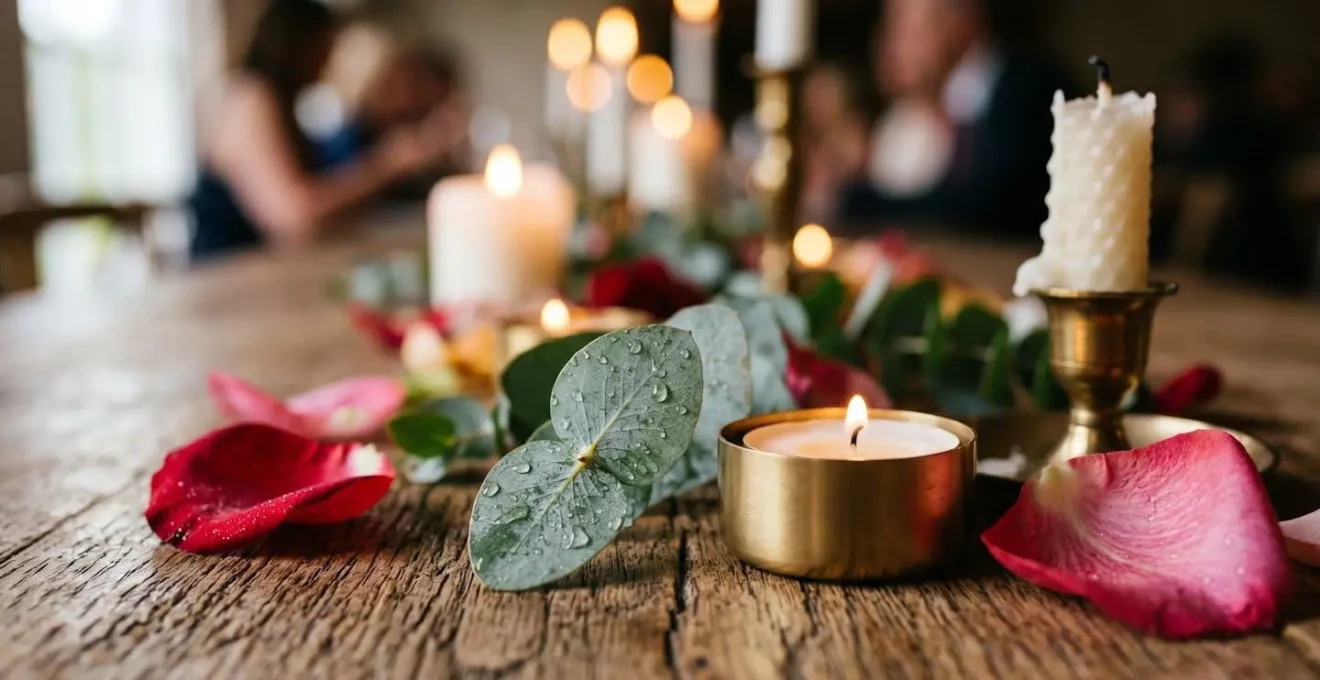
For long farmhouse tables, a series of low, distributed elements is often more effective than one large, central piece. A garland runner interspersed with bud vases, taper candles, or scattered tea lights maintains a lush look without creating a barrier. If you opt for tall arrangements, ensure they have a slim base, like a candelabra or a tall, slender glass vase, to minimize their footprint and allow guests to see around them. The decor should frame the conversation, not block it.
The Trestle Leg Problem: How to Seat Guests Comfortably at Ends?
The trestle base is a defining feature of many farmhouse tables, contributing to their sturdy, rustic appeal. However, this design element introduces a significant “friction point” for seating arrangements: the table legs obstruct knee space at the ends and corners. Simply placing chairs at the head of a standard trestle table often leads to a deeply uncomfortable experience for your guests, who will be forced to straddle a large wooden beam all evening.
Ignoring this ergonomic detail can effectively reduce the usable capacity of your tables. To ensure comfort, you must account for adequate overhang. According to ergonomic design guidelines for trestle tables, you need a minimum of 14 inches of clear space from the edge of the table to the leg for comfortable end seating. Many standard rental tables do not offer this much clearance.
Before finalizing your seating chart, you must verify these measurements with your rental company. If the overhang is insufficient, you cannot comfortably seat guests at the ends. This may require you to either order more tables to accommodate your guest count or to rethink your layout entirely, perhaps by arranging tables in a “U” or “E” shape where end seating is not required. Alternatively, some couples opt to leave the ends open for a more spacious feel or designate those two end seats for children, who require less legroom. Solving the trestle leg problem is a crucial step in translating your floor plan from paper to a comfortable reality.
Round vs. Rectangle: Which Shape Fits More People in Your Venue?
When designing a floor plan, the debate between round and rectangular tables is classic. While round tables are often praised for allowing everyone at the table to see each other, rectangular farmhouse tables are significantly more efficient in their use of space. For couples trying to maximize a venue’s capacity without it feeling cramped, understanding this spatial geometry is key.
A rectangular table layout minimizes the “dead space” that is inherent with round tables. When you place circles in a square room, you inevitably create unused pockets of space in the corners and between tables. Linear tables can be arranged in long, parallel rows that follow the contours of a room, allowing you to fit more guests into the same square footage. This efficiency is not just theoretical; it can have a major impact on your guest count.
This table breaks down the core differences in capacity and efficiency, based on an analysis of event table layouts.
| Factor | Round Tables (60″ diameter) | Rectangular Tables (8′ long) |
|---|---|---|
| Guest Capacity | 8 guests comfortably | 8-10 guests (4-5 per side) |
| Space Per Person | 15 square feet per person | 12 square feet per person |
| Venue Efficiency | Creates dead space in corners | Can increase guest count by up to 20% in same footprint |
| Conversation Pattern | All guests can see each other, but large rounds isolate to immediate neighbors | Single shared conversation along length, easier cross-table interaction |
| Layout Flexibility | Works in most venue shapes | Maximizes narrow or rectangular venue spaces |
While a large round table can make it hard to talk to anyone but your immediate neighbors, the linear nature of a farmhouse table creates a shared conversational channel. It’s easier for guests to engage with those sitting several seats away, fostering a more communal and dynamic social environment. For rectangular venues or guest lists that are pushing the limits of the space, rectangular tables are the superior choice for both capacity and conversational flow.
Why Heavy Farm Tables Cost Double in Labor to Set Up?
When budgeting for rentals, many couples are surprised by the delivery and setup fees associated with farmhouse tables. The line item for labor can often be double or even triple that of standard folding tables, and this isn’t an arbitrary markup. The cost is a direct reflection of the physical reality and logistical “friction points” involved in handling these beautiful but cumbersome pieces of furniture.
First and foremost is the weight. A solid wood 8-foot farmhouse table can weigh anywhere from 150 to over 250 pounds. Unlike lightweight plastic or aluminum folding tables that one person can carry, a farmhouse table requires a team of at least two, and often four, trained movers to transport safely. This immediately increases the manpower required for both delivery and setup. The process is inherently slower and more deliberate.
Furthermore, the risk of damage is much higher. The fine finish of a rustic table can be easily scratched, dented, or chipped. The setup crew must take extra precautions, using moving blankets and specialized dollies, and navigating venue doorways and corners with extreme care. Once in the room, positioning and leveling these heavy tables takes more time and precision than simply unfolding a lightweight alternative. The higher labor cost directly accounts for the additional time, specialized skill, and increased risk involved in ensuring your tables arrive and are set up in pristine condition.
The “Wall of Flowers” Mistake That Kills Conversation at Dinner Tables?
The desire for a lush, abundant tablescape can lead to one of the most common and conversation-killing mistakes in wedding design: the “wall of flowers.” This happens when centerpieces are built to a height that falls directly in the average person’s line of sight, creating a beautiful but frustrating barrier between guests. It effectively cuts the table in half, isolating guests from those sitting directly across from them.
To avoid this, you must be ruthlessly protective of what event designers call the conversational “no-fly zone.” As a general rule, event designers warn that centerpieces between 12 and 24 inches high create a direct visual block. This zone is the absolute worst place to put dense floral arrangements or any other opaque decor. It forces guests to constantly lean and peer around the decorations just to make eye contact, which quickly becomes tiresome and stifles the natural flow of conversation.
The negative impact of obstructive decor isn’t just a theory; it’s a frequent complaint from wedding guests who have experienced it firsthand. As one guest shared after attending two different weddings:
“We couldn’t see anything around on the other side of the table. It was extremely annoying.” In contrast, at another wedding with below-eye-level centerpieces, the guest noted “it was really nice” and could comfortably socialize with everyone at the table.
– Wedding Guest, WeddingWire Forum
This testimony highlights the critical role of sightlines. When designing your tablescape, always perform a “sit test.” Sit down at a mock-up of your table and see for yourself if you can comfortably make eye contact with someone opposite you. If you can’t, your decor is too high, and it’s time to redesign.
How to Create a Sense of Intimacy for a Black-Tie Wedding With 200 Guests?
A large guest list and a formal black-tie dress code can sometimes create an atmosphere that feels grand but impersonal. The challenge is to scale down the feeling of the room and foster genuine connection among 200 people. The solution lies in creating “intimacy bubbles”—smaller, psychologically defined zones within the larger space—using a combination of layout, lighting, and acoustics.
Farmhouse tables are an excellent tool for this. Arranging them in formations other than simple long rows can break up a large room. A U-shape, for instance, creates a focal point and a more inclusive feeling for speeches. Grouping several tables in a square or creating distinct clusters helps form visual “rooms” within the room. As the Alamo Wedding Venue & Events Center notes, this kind of social architecture has a clear purpose:
This setup encourages conversation across the group and evokes the feeling of a big family gathering… Intimate table arrangements can encourage guests to linger and enjoy heartfelt conversations, making the celebration feel seamless and inclusive.
– Alamo Wedding Venue & Events Center, Ultimate Guide to Farmhouse Wedding Table Settings
Lighting is your most powerful tool for creating these bubbles. Instead of flooding the entire venue with uniform light, use focused pools of warm light. Pin-spotting each table makes the dark space around it disappear, enclosing the guests at that table in their own intimate circle. This technique, combined with acoustic considerations, solidifies the effect. The goal is to make a large room feel like a collection of small, lively dinner parties.
Your Action Plan: Creating “Intimacy Bubbles” in a Large Venue
- Install acoustical ceiling clouds: These elements serve a dual purpose, creating stunning visual interest while absorbing sound and preventing the room from feeling like a loud cavern.
- Use pools of soft, warm light: Employ pin-spotting on individual tables to create defined zones of intimacy and make the surrounding space recede.
- Add texture with acoustic panels: Place fabric-covered panels on walls at eye level to absorb speech sound waves and reduce echo, further clarifying conversations.
- Vary table arrangements: Move beyond simple rows. Use U-shapes, E-shapes, or distinct clusters to create smaller “rooms” within the larger venue.
- Concentrate lighting on seating areas: Make the dark, empty space around each table disappear by focusing light directly on the guests and tablescapes.
Key Takeaways
- Think like a social architect, not just a decorator. Layout choices directly impact guest interaction.
- Protect conversational pathways by keeping centerpieces outside the 12-to-24-inch “no-fly zone.”
- Account for physical “friction points” like trestle legs and service style flow to ensure comfort and seamless experience.
Buffet vs. Plated: Which Service Style Actually Gets Guests Fed Faster?
The choice of meal service style is one of the most impactful decisions you’ll make for the flow and social dynamic of your reception. Many couples assume a buffet is faster and more casual, but in reality, it’s often the slowest method and the most disruptive to conversation. Understanding the true “flow dynamics” of each style is essential for a layout built around interaction.
A buffet service fragments your guests. It creates long queues and forces people to leave their tables—and their conversations—for extended periods. By the time the last table is called, the first table may have already finished eating. This staggered timing makes it difficult to create a shared experience. A plated service is more synchronized but can feel formal and keeps guests locked in their seats. The real hero for a conversational, communal meal at farmhouse tables is family-style service.
With family-style, large platters of food are brought directly to each table, and guests serve themselves. This style is not only fast—as everyone at the table gets their food at once—but it actively promotes interaction. The very act of passing dishes, asking “Could you pass the potatoes?”, and coordinating serving creates a natural, ice-breaking social ritual. It transforms a passive meal into an active, shared experience, perfectly complementing the communal nature of a long farmhouse table.
This comparative analysis from an event group’s guide to reception tables clearly illustrates why family style is superior for fostering conversation.
| Service Style | Actual Speed | Conversation Impact | Best For Farmhouse Tables |
|---|---|---|---|
| Plated Service | Moderate (all served simultaneously within 15-20 min) | Formal but can be slow; guests remain seated throughout | Works well but doesn’t leverage communal aspect |
| Buffet Service | Slow (queuing, walking, multiple trips = 30-45 min total) | Chaotic; separates guests and breaks up conversations | Poor fit; family style doesn’t work well with narrow tables |
| Family Style | Fast (all food for table arrives at once) | Excellent; forces interaction as guests pass dishes and engage communally | Ideal; actively promotes conversation and shared experience |
By approaching your table layout as an exercise in social architecture, you move beyond mere decoration and begin to intentionally design an experience. Each decision—from the height of a centerpiece to the style of meal service—becomes a tool to encourage connection. This strategic mindset is what separates a beautiful reception from an unforgettably vibrant and engaging celebration. To put these principles into practice, start by creating a scaled floor plan of your venue and begin mapping out not just where the tables go, but how your guests will interact within that space.