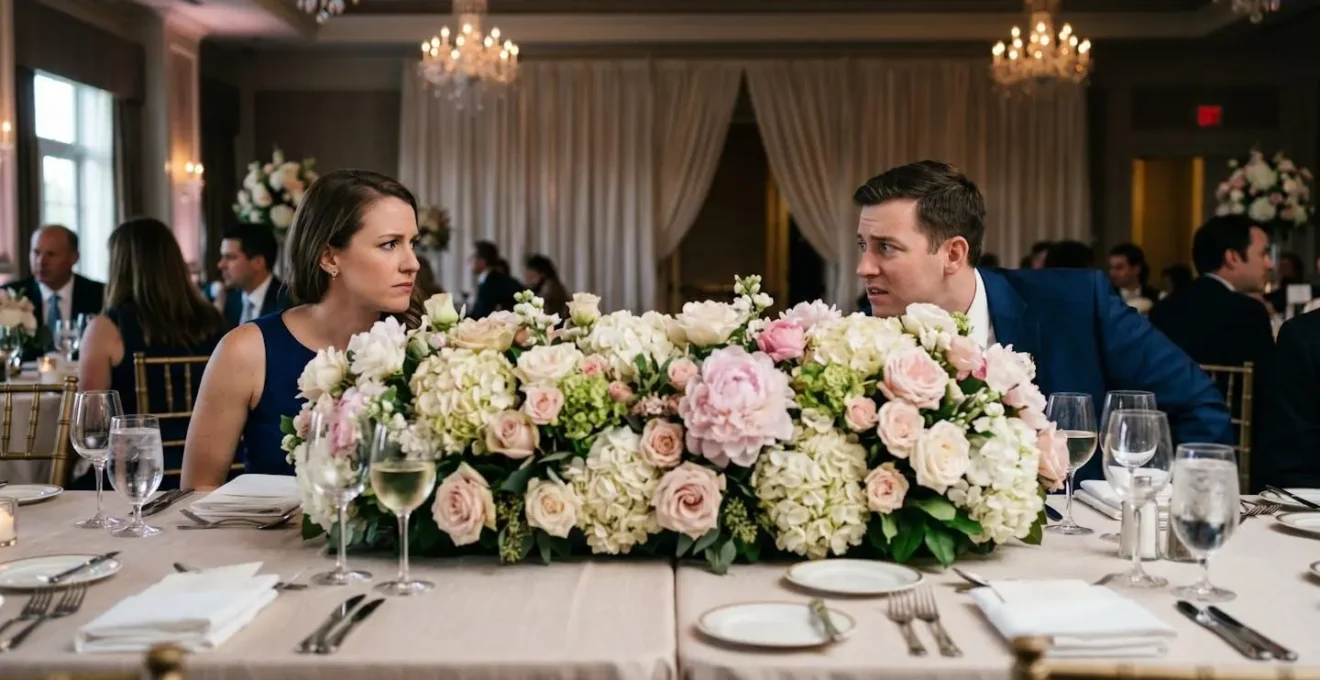
Your beautiful wedding centerpieces are likely preventing your guests from talking to each other.
- Centerpiece height is a science: a “danger zone” between 14 and 24 inches creates a physical and psychological barrier.
- Table shape dictates social dynamics; round tables can isolate guests, while long tables can foster a communal atmosphere if designed correctly.
Recommendation: Stop thinking like a decorator and start thinking like a social architect. Prioritize sightlines and conversational geometry over floral density to create an experience, not just a photograph.
You’ve spent months curating the perfect aesthetic. The linens are exquisite, the charger plates are gleaming, and at the center of it all stands a magnificent floral arrangement. Your guests arrive, find their seats, and are met with… a wall of peonies. They smile politely at the person across the table, whose face is now a blurry shape behind a fortress of foliage. This is the moment where well-intentioned design creates unintentional social isolation. The common advice focuses on color palettes and seasonal blooms, but these are secondary concerns.
The fundamental flaw in most wedding table design is treating it as a static art installation rather than a dynamic social environment. The goal isn’t just to create a beautiful space for a photograph; it’s to engineer an atmosphere that encourages connection, laughter, and shared memories. When a centerpiece is too tall, a table too wide, or a layout too cramped, you introduce interaction friction. You make it harder for your loved ones to do the one thing they came to do: celebrate with you, and with each other. This isn’t just about aesthetics; it’s about social architecture.
This guide reframes the conversation. We will move beyond simple decoration tips to analyze the spatial dynamics of your reception. By understanding the principles of conversational geometry and sightline territoriality, you can make deliberate choices that foster connection. We will deconstruct common myths, provide actionable frameworks, and show you how to design tables that not only look stunning but feel alive with conversation.
To navigate these crucial design decisions, we will explore the core principles that govern social interaction at a seated event. This article breaks down everything from the precise height of your centerpieces to the strategic shape of your tables, providing a clear roadmap to a more connected and memorable reception.
Summary: The “Wall of Flowers” Mistake That Kills Conversation at Dinner Tables?
- The “Rule of 14 Inches”: How Low or High Should Centerpieces Be?
- Tall Vases vs. Wind: Why Top-Heavy Centerpieces are Dangerous Outdoors?
- Candles, Menus, Favors: How to Fit Everything on a Standard Round Table?
- How to Reuse Ceremony Aisle Markers as Reception Centerpieces?
- Bud Vases vs. Compotes: Which Style Uses Fewer Stems for Impact?
- How to Decorate Wide Tables Without Blocking Eye Contact?
- Why Round Tables Kill Conversation Compared to Long King Tables?
- How to Style a Venue That Clashes with Your Color Palette?
The “Rule of 14 Inches”: How Low or High Should Centerpieces Be?
The single most critical factor in centerpiece design is not the type of flower, but its vertical position. A beautiful arrangement that blocks eye contact is a functional failure. It creates what social designers call sightline territoriality, where each guest is visually isolated from half the table. This is not a matter of opinion but of simple geometry. The average person’s eye level when seated is between 12 and 14 inches from the table surface. Any object that occupies the space just above this height becomes a barrier.
To avoid this, event professionals adhere to a strict rule of spatial clearance. Centerpieces must be either low enough to talk over or high enough to see under. According to industry standards, this means centerpieces should be either under 12 inches or over 20 inches tall. The space between 14 and 24 inches is often called the “danger zone”—it’s the perfect height to completely obstruct vision and muffle sound, effectively killing cross-table conversation. When in doubt, the solution is simple: sit at the table. If you cannot make and hold direct, comfortable eye contact with the person opposite you, the design has failed, no matter how beautiful it is.
Your Sightline Audit Checklist: Preserving Conversation
- Measure Low Arrangements: Keep centerpieces below 12-14 inches to ensure they remain comfortably below the eye level of seated guests.
- Measure High Arrangements: If choosing tall designs, confirm they are 24 inches or higher. This allows for clear sightlines underneath the main floral element.
- Avoid the “Danger Zone”: Strictly avoid any significant decorative elements in the 14-24 inch height range, as this zone directly blocks both sight and sound.
- Choose Transparent Stems: For tall arrangements, opt for narrow, transparent glass vases to minimize the visual obstruction of the support structure itself.
- Perform a Seated Test: During your venue walkthrough, place a mockup centerpiece on a table and sit down. This is the only way to truly evaluate its impact on conversation.
Ultimately, the choice of a high or low centerpiece dictates the social energy of the table. Low arrangements create a shared, intimate space, while tall arrangements can add drama and grandeur, provided they respect the fundamental need for human connection.
Tall Vases vs. Wind: Why Top-Heavy Centerpieces are Dangerous Outdoors?
Moving a wedding outdoors introduces a powerful and unpredictable design partner: nature. While the aesthetic of a garden or beachfront reception is unparalleled, it brings physical forces into play that are absent indoors. The most significant of these is wind, which can turn a dramatic, top-heavy centerpiece into an atmospheric hazard. A tall, slender vase with a large floral arrangement at its peak has a very high center of gravity, making it inherently unstable.
The danger is not just aesthetic; it’s a matter of safety and guest comfort. A gust of wind can topple a heavy glass vase, shattering it across the table, ruining food, and potentially injuring a guest. Even the constant fear of it falling creates a subtle tension that undermines the relaxed, celebratory atmosphere you want to cultivate. The design must preemptively account for this risk. This means favoring arrangements with a low center of gravity: heavy, wide-based vessels that are structurally sound and resistant to tipping.
Outdoor-Hardy Design at The Gardens of Castle Rock
The experienced team at The Gardens of Castle Rock venue explicitly advises couples on creating decor that is “outdoor hardy.” They stress that Mother Nature is an active participant in any outdoor event. Their core recommendation is to choose centerpieces with a heavy base, a low center of gravity, and a modest height, all designed to withstand unexpected wind. This approach prioritizes pre-emptive, robust design over last-minute fixes, ensuring the venue’s natural beauty is a backdrop for the celebration, not a source of logistical chaos.
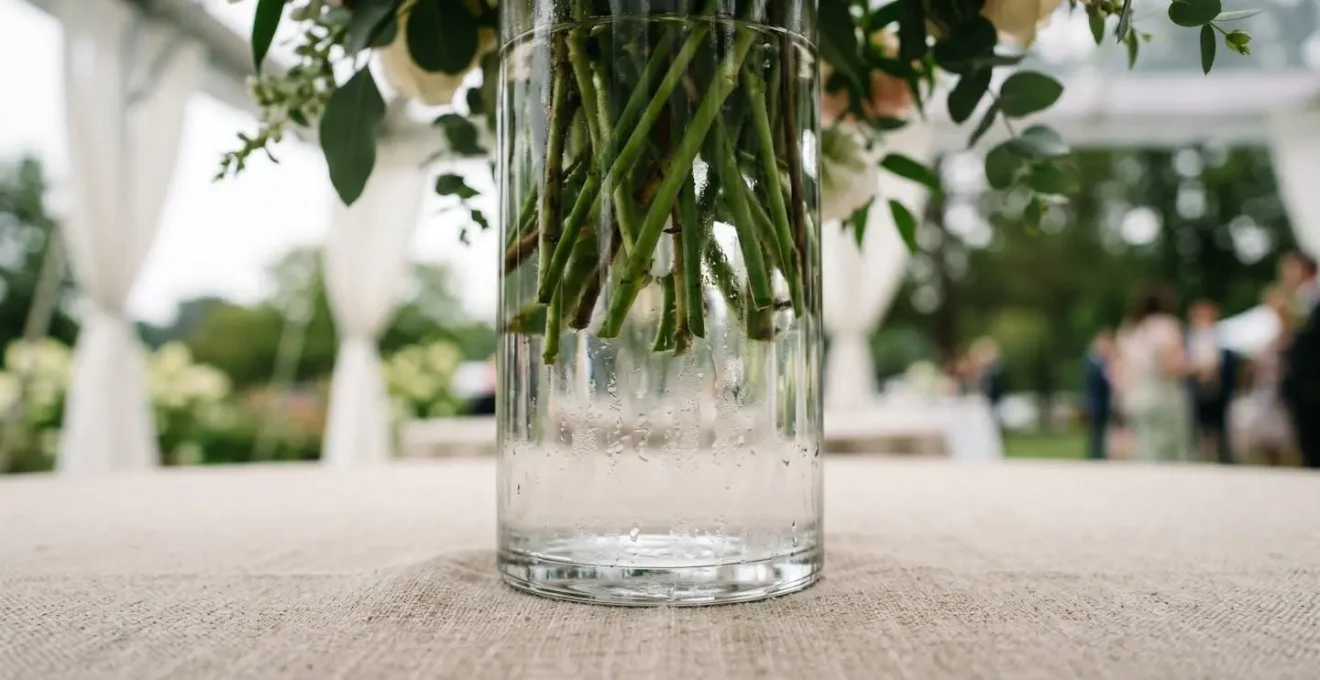
As this image illustrates, the entire stability of the arrangement rests on that tiny point of contact between the vase and the table. Any lateral force, like a sudden breeze, is magnified at the top, creating a lever effect that can easily overcome the friction at the base. For outdoor events, stability must be a primary design consideration, not an afterthought.
Choosing an appropriate outdoor centerpiece is an act of responsible design. It acknowledges the environment and prioritizes the safety and comfort of your guests over a dramatic but fragile aesthetic.
Candles, Menus, Favors: How to Fit Everything on a Standard Round Table?
The surface area of a reception table is one of the most valuable and contested pieces of real estate at your wedding. Each guest requires a full place setting: charger, plates, glassware, and flatware. Then come the shared elements: a centerpiece, candles for ambiance, table numbers for navigation, menus, and perhaps even wedding favors. On a standard 60-inch round table designed for eight guests, this space disappears alarmingly fast. The primary challenge is not just fitting everything, but arranging it in a way that remains functional and uncluttered.
The key is to think vertically and prioritize ruthlessly. Instead of a sprawling centerpiece, consider a cluster of smaller vessels. Elevate elements that don’t need to be touched, such as placing the table number on a tall, slender stand. One of the most effective strategies is to combine functions. A personalized menu can also serve as a place card, or a wedding favor can be integrated into the napkin fold. It’s also crucial to consider the space *between* tables. To ensure guests can move freely and service staff can work efficiently, professional event planners recommend a minimum of 42 inches between tables, with 60 inches for main service aisles. This external constraint further emphasizes the need for an efficient and compact table design.
The following table breaks down the spatial capacity of common round tables, providing a crucial framework for planning your layout and decor. As the table diameter increases, so does the available “real estate” for your centerpiece, but it’s a game of inches.
| Table Diameter | Comfortable Seating | Centerpiece Size Range | Service Considerations |
|---|---|---|---|
| 48 inches | 4-6 guests | 8-12 inches tall, 10-14 inches diameter | Ideal for intimate settings, kids tables |
| 60 inches | 8 guests (most popular) | 12-20 inches tall, 12-18 inches diameter | Ample space for place settings and centerpiece |
| 72 inches | 10 guests (max 12) | 18-24 inches tall, 20-24 inches diameter | Recommend 10 max for family-style service to ensure guests can reach items |
Ultimately, a successful table layout is an exercise in editing. By making smart, multi-functional choices, you can create a tablescape that feels lush and complete without being cluttered, ensuring there is still room for what matters most: the interaction between your guests.
How to Reuse Ceremony Aisle Markers as Reception Centerpieces?
The idea of repurposing ceremony flowers for the reception is one of the most frequently offered budget-saving tips in wedding planning. It is both economically and ecologically sound. However, the advice often glosses over the critical logistical challenge: this transformation has to happen in the 60-minute window of cocktail hour, a period of organized chaos. Successfully executing this move requires not a florist, but a logistics expert. It’s a race against time that must be planned with military precision.
The process involves a “floral strike team”—often your planner or a dedicated floral assistant—swooping in the moment the ceremony concludes. Aisle markers are collected, large altar arrangements are deconstructed, and everything is transported to a staging area. Here, the arrangements are re-hydrated, trimmed, and re-potted into reception-appropriate vessels. As Jamie, a wedding planner with Cape Cod Celebrations, points out in a feature for Bridal Guide:
We love to reuse as much from the ceremony as we can, seeing that most ceremonies are 30 minutes or less.
– Jamie, Wedding Planner, Cape Cod Celebrations
This highlights the practicality of the strategy; the flowers are at their freshest and used for such a short period that not reusing them is a significant waste. The key is having a clear plan, the right number of hands, and pre-prepped vases ready to go. Without this backend coordination, the “smart” money-saving idea can quickly become a frantic, stressful, and ultimately failed endeavor.
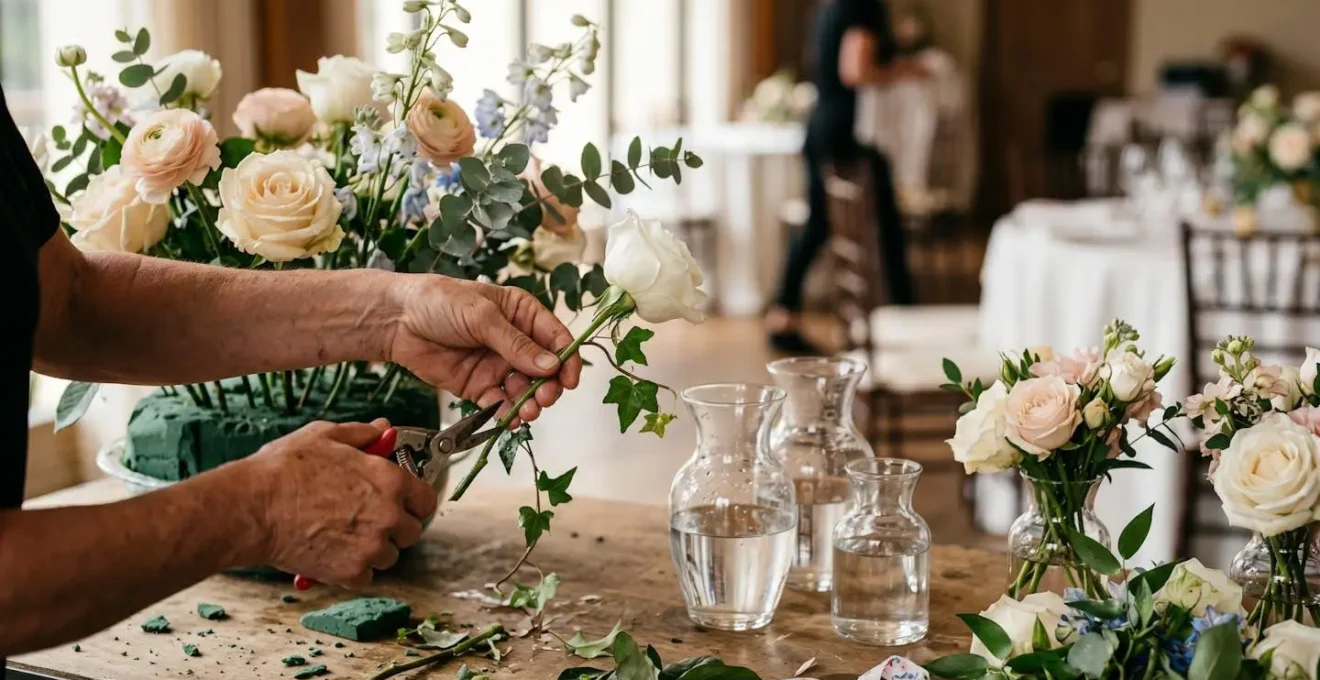
The transition is a behind-the-scenes ballet. While guests are sipping cocktails, a swift and precise operation is underway to give your beautiful florals a second act. It’s a testament to the fact that great event design is often 90% unseen logistics and 10% visible glamour.
When executed flawlessly, this transition is invisible to your guests. They simply walk into a beautifully decorated reception space, never needing to know that the stunning centerpieces on their tables were, just an hour ago, lining the aisle you walked down.
Bud Vases vs. Compotes: Which Style Uses Fewer Stems for Impact?
The choice between different centerpiece styles is a critical decision that balances aesthetic impact with budget reality. Two popular but philosophically opposite approaches are the single, lush compote arrangement and the curated cluster of individual bud vases. A compote is a low, wide-mouthed bowl designed to hold a dense, garden-style arrangement. It creates a single, dramatic focal point but requires a significant number of stems to look full and luxurious. This density comes at a cost, both in raw materials and in the labor required to construct the arrangement.
In contrast, the bud vase strategy focuses on deconstruction. Instead of one large arrangement, the design uses multiple small, slender vases, each holding just one to three stems. When grouped together, these create a “meadow” effect that spreads across the center of the table. This approach has a distinct social advantage: the negative space between the vases creates natural “conversational windows,” making it exceptionally easy for guests to see and interact. Furthermore, it is far more stem-efficient. While a compote might require 50-75 stems for a lush look, an impactful cluster of 5-7 bud vases might use only 15-20 stems in total. This efficiency has a direct impact on the bottom line. According to Zola’s wedding cost data, low centerpieces typically cost $100-$250 each, while tall or dense arrangements can easily range from $250 to over $500 per table. Opting for a bud vase strategy can cut the floral budget for tables by more than half.
The Knot’s Focus on Conversation-Friendly Design
In its roundup of beloved centerpiece styles, The Knot champions the minimalist approach of using a few simple bud vases. They highlight this style as a modern and intimate choice, perfectly suited for weddings that prioritize guest interaction. The core insight is that by deliberately choosing a less dense floral design, couples are implicitly choosing to foster conversation, ensuring guests can easily see the person across the table without a wall of blooms in the way. It’s a design choice that puts social dynamics first.
The decision between a compote and bud vases is therefore a strategic one. It forces a choice between a singular, high-density impact and a deconstructed, conversation-first design that is also significantly more budget-friendly.
How to Decorate Wide Tables Without Blocking Eye Contact?
Long or wide banquet tables present a unique design challenge. While they offer a stunning visual canvas, their increased width can exacerbate the very problem we seek to avoid: blocking sightlines. A centerpiece that would be perfectly acceptable on a narrow table can become a formidable barrier on a wider one. The instinct to fill the expansive central space with a continuous, linear decoration (like a traditional floral runner) is precisely what creates a “wall,” dividing the table in half and killing cross-table interaction.
The solution lies in rhythm and negative space. Instead of a solid line, the design should be a series of curated moments. Think in terms of “islands” of decor rather than a continuous “continent.” This approach maintains visual interest while strategically creating what designers call “conversational windows”—intentional gaps in the decor that act as sightline openings between guests. This allows for both intimate conversations with immediate neighbors and the ability to engage with those further down and across the table. Effective strategies for achieving this include:
- Repeating Clusters: Use repeating groups of low items. For example, a tight cluster of three bud vases, followed by a pair of candles, then an intentional gap of open space, and then repeat the pattern.
- Meandering Runners: Choose a fabric or foliage runner that meanders in an S-shape down the center of the table. This organic line breaks up the rigid geometry and psychologically encourages visual connection across its curves.
- Curated Spacing: Interleave a mix of low-profile items like bud vases, votive candles, and small lanterns every two feet along the center line. This creates a sense of fullness without creating a solid barrier.
- Strict Height Control: On wide farmhouse or head tables, it is imperative to keep all arrangement heights exceptionally low, generally under 10-12 inches, to maintain completely unobstructed views.
–
This rhythmic approach transforms a potential barrier into a dynamic landscape. It guides the eye, adds texture and depth, and, most importantly, respects the fundamental social function of the table by allowing your guests to connect freely.
Why Round Tables Kill Conversation Compared to Long King Tables?
There is a deeply ingrained belief in the event industry that round tables are “ideal for conversation.” The logic seems sound: everyone is equidistant, and everyone can see each other. However, this popular notion crumbles when examined through the lens of social dynamics and acoustics. On a standard 60- or 72-inch round table seating 8-10 people, you can comfortably converse with the person to your immediate left and right. Engaging anyone further away requires raising your voice to a level that feels disruptive, effectively shouting across the table over the ambient noise of the reception. This design forces guests into small, isolated conversational silos of two or three.
Long banquet tables, often maligned as being less social, actually offer a superior conversational geometry when designed correctly. As detailed in a design analysis by Perfect Wedding Guide, long tables create a “visually stunning landscape that encourages conversation and interaction.” While you can still only speak comfortably to your immediate neighbors, the linear layout encourages a different kind of social behavior. It’s easier and more natural to lean back and join a conversation happening two seats down, or to get up and move to an empty spot to chat with someone new. The long table creates a more communal, fluid atmosphere, akin to a family dinner, rather than the formal, partitioned experience of a round table.
The conventional wisdom, as stated by sources like Jamali Garden, that “round tables are ideal for conversation,” fails to account for the practical realities of a loud, crowded room. It’s a theory that works in a quiet boardroom, but not at a wedding reception. The long table, by its very structure, encourages mingling and a more dynamic flow of interaction throughout the evening, breaking down the rigid seating chart and fostering a more unified, communal celebration.
The choice is between creating many small, isolated parties of eight, or one large, interconnected celebration. For fostering a truly communal atmosphere, the geometry of the long table is often the superior social tool.
Key Takeaways
- Prioritize Sightlines: Centerpieces must be below 14 inches or above 24 inches. There is no middle ground.
- Design for a System: A table is a social system. Every element—shape, size, and decor—either adds to or subtracts from guest interaction.
- Embrace Negative Space: On long tables, “conversational windows” (intentional gaps in decor) are more important than continuous floral runners for fostering connection.
How to Style a Venue That Clashes with Your Color Palette?
Sometimes, you fall in love with a venue for its architecture, its location, or its sentimental value, only to realize its permanent decor—be it the boldly patterned carpet, the distinctively colored walls, or the dated curtains—directly clashes with your carefully curated wedding color palette. The common instinct is to try and fight the venue’s existing aesthetic by covering it up with draping or overwhelming it with your own colors. This is often an expensive and losing battle. The more effective strategy is not to fight the clash, but to manage your guests’ attention.
The most powerful tool for this is lighting. By strategically controlling what is lit and what is left in shadow, you can effectively “erase” the offending elements from the guest experience. This is less about hiding the clash and more about rendering it irrelevant. A skilled lighting designer can use several techniques to achieve this:
- Pin-Spotting: This is the most precise technique. It involves using narrow beams of light focused exclusively on the center of each table, highlighting your beautiful centerpieces, linens, and place settings. The surrounding area, including the problematic carpet, is plunged into relative darkness, making it visually disappear.
- Strategic Uplighting: By placing lighting fixtures on the floor and angling them up the walls or columns, you draw the eye upward. This redirects attention toward the vertical surfaces and the ceiling, and away from the problematic flooring.
- Identify a “Bridge Color”: Instead of fighting, find a connection. Scrutinize the venue’s clashing element (e.g., a carpet with gold, blue, and burgundy). If your palette is blush and cream, you can’t force it. But if you can find a tiny thread of a neutral or tertiary color—like a taupe or a deep charcoal—in both your palette and the venue’s decor, you can intentionally emphasize that color in your design to create a deliberate bridge between the two.
Ultimately, you don’t need to change the venue to fit your wedding. You simply need to direct your guests’ focus to the beautiful world you’ve created within it, letting the rest fade into the background.