The secret to fixing a venue that clashes with your vision isn’t to hide its flaws, but to strategically out-design them.
- Create powerful “islands of perfection” at eye-level that command attention and make ugly carpets or wallpaper fade into the background.
- Prioritize high-impact changes like furniture and lighting over less effective solutions like basic chair covers.
Recommendation: Instead of fighting the venue, control your guests’ visual journey by mastering the principles of visual hierarchy and strategic misdirection.
You’ve found it. The venue with the perfect location, the right capacity, and a date that works. There’s just one problem: the carpet is a dizzying pattern from another decade, the curtains are a shade of gold that clashes with your modern aesthetic, or the wallpaper is… memorable, for all the wrong reasons. For many couples, this is a moment of panic. The immediate instinct is to think defensively: how can we cover this up? How can we hide it?
The common advice is often a brute-force approach. You’ll hear suggestions to throw money at full-room draping or to try and “neutralize” the space with generic uplighting. While these can be part of a solution, they often miss the point. They treat the venue as an enemy to be defeated, a battle of aesthetics that can quickly drain your budget and your creative energy. This approach is not only expensive but often less effective than you’d hope, resulting in a space that feels sterile rather than personal.
But what if the key wasn’t concealment, but clever redirection? As a visual correction stylist, I can tell you that the most successful transformations don’t fight the venue’s “bad” elements—they simply make them irrelevant. This guide will shift your perspective from hiding flaws to strategically creating beauty. We will explore how to control your guests’ “attention budget” by building compelling focal points that dominate their visual experience.
We’ll break down the professional techniques for managing clashing elements, from directing the eye away from the floor to understanding the real costs and timelines involved in a successful transformation. By the end, you will have a stylist’s toolkit to create a cohesive, branded event, no matter what design challenges your venue presents.
This article provides a strategic roadmap for transforming any space. We will cover everything from the science of visual hierarchy to the practicalities of acoustics and power needs, ensuring your wedding design is both beautiful and flawlessly executed.
Summary: How to Fix a Venue That Clashes With Your Wedding Vision
- Eye-Level Design: How to Draw Attention Away from Ugly Carpets?
- Draping vs. Lighting: Which Hides Bad Wallpaper More Effectively?
- Why You Can’t Style a Room Properly in a 2-Hour Setup Window?
- The “Too Many Pinterest Boards” Syndrome: How to Edit Your Style?
- Chair Covers or New Chairs: Is it Worth Renting Furniture to Fix the Look?
- Why You Need a Dedicated Generator for Your Lighting Rig?
- How to Soften the Acoustics in a Concrete Industrial Loft?
- Hanging Florals: The Engineering Cost You Didn’t Budget For?
Eye-Level Design: How to Draw Attention Away from Ugly Carpets?
The single biggest mistake couples make when faced with an ugly carpet is trying to fight it on its own terms. You can’t. The solution is not on the floor; it’s at eye-level. The core principle you must embrace is visual hierarchy. Your goal is to create focal points so compelling that your guests’ eyes never even bother to register the floor beneath them. Think of it as spending your guests’ limited “attention budget” on what you want them to see, rather than letting them notice the venue’s flaws.
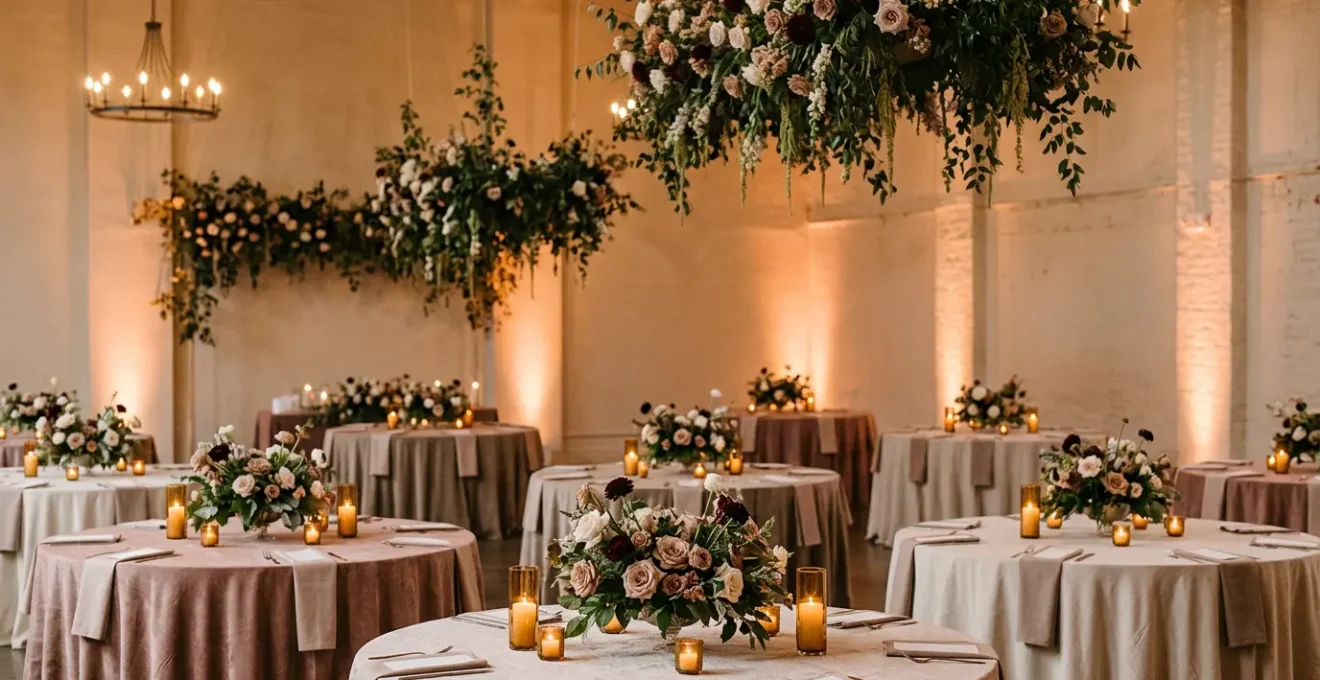
Experts in design understand that the human eye naturally scans a room in predictable ways. By leveraging this, you can create what I call “islands of perfection.” These are meticulously styled zones—the head table, the cake display, the bar, the guest tables themselves—that are so rich in texture, color, and detail that they become the dominant visual story. Lavish floral centerpieces, unique chargers, luxurious linens, and personalized menus all work together at your guests’ direct line of sight. According to design experts who emphasize visual hierarchy, the strategic placement of larger, high-contrast, and beautifully lit elements ensures they win the battle for attention every time.

As you can see, a powerful eye-level composition, rich with texture and warm light, makes the surrounding environment secondary. The focus is on the tactile quality of the florals and the intimate glow of the candles, not what’s happening five feet below. This is strategic misdirection in action. By investing your budget in stunning centerpieces, high-quality tableware, and thoughtful lighting for each table, you make the carpet an irrelevant detail in a much more interesting story.
Draping vs. Lighting: Which Hides Bad Wallpaper More Effectively?
When dealing with a problematic wall—be it dated wallpaper, an unmovable piece of art, or a paint color that screams “90s conference room”—the two most common brute-force solutions are draping and lighting. But they are not interchangeable. Choosing the right tool requires an “aesthetic triage” of the problem. Is the issue a busy pattern, or is it just the wrong color? The answer determines the most effective and cost-efficient solution.
Draping is the ultimate concealer. It offers 100% coverage, making it the undisputed champion for hiding busy patterns, textured wallpaper, or unwanted structural elements. If you have a wall with a floral chintz pattern that directly clashes with your minimalist theme, draping is your most reliable fix. However, this completeness comes at a cost in both dollars and time; full-room draping is a significant investment and requires a lengthy setup window.
Lighting, on the other hand, is a master of transformation. Using uplighting, you can wash walls in a color from your own palette, effectively “repainting” the room with light. This is incredibly effective for walls that are a solid, but wrong, color. It’s generally faster and often more affordable than full draping, but its weakness is that it can’t hide a pattern. In fact, lighting a patterned wall can sometimes make the pattern even more prominent. A hybrid solution, gobo projection, can overlay a new pattern of light, which distracts from the underlying wallpaper but doesn’t fully conceal it.
The following table breaks down the typical investment and effectiveness of each option, based on data from professional lighting and sound companies.
| Solution Type | Average Cost Range | Best For | Coverage Effectiveness | Setup Time Required |
|---|---|---|---|---|
| Uplighting (Basic) | $1,100-$1,300 | Solid wall colors, neutral spaces | 70-80% color transformation | 2-3 hours |
| Uplighting (Multi-feature) | $1,500-$3,500 | Multiple problem areas, comprehensive transformation | 80-90% visual impact | 3-5 hours |
| Pipe & Drape (Partial) | $250-$1,500 | Busy patterns, textured wallpaper, unwanted artwork | 100% coverage of targeted areas | 4-6 hours |
| Pipe & Drape (Full Room) | $3,500+ | Comprehensive venue transformation | 100% complete coverage | 6-8 hours |
| Hybrid (Gobo Projection) | $800-$2,500 | Pattern-on-pattern transformation, monograms, abstract designs | 60-75% distraction/transformation | 3-4 hours |
Ultimately, the choice depends on your specific problem and budget. As an analysis from the lighting and event industry shows, a strategic combination is often the most powerful approach: use targeted draping to hide the most offensive wall pattern and use cost-effective uplighting to transform the color of the remaining walls, creating a cohesive, fully-realized space.
Why You Can’t Style a Room Properly in a 2-Hour Setup Window?
One of the most common and disastrous assumptions couples make is underestimating the time required for a professional setup. Many venues that host multiple events in a day offer a tight 2- or 3-hour window for setup. This is simply not enough time for any significant transformation. To be blunt: you cannot properly drape a room, install custom lighting, or arrange elaborate florals in two hours. It’s a logistical impossibility.
Professional event production is a layered, sequential process. It’s not just about placing items; it’s about building an environment from the ground up. According to event production professionals, full wedding venue builds can take anywhere from 6 to 18 hours. This includes rigging, power distribution, draping, furniture placement, lighting focus, and finally, the placement of delicate floral and tabletop elements. Trying to compress this into a 2-hour window forces a panicked, sloppy execution that undermines your entire design.
If you are stuck with a short setup window, you must perform a ruthless “aesthetic triage.” You must abandon ambitious plans like full-room draping or complex hanging installations and focus exclusively on high-impact, quick-deployment items. Your strategy must shift from transformation to enhancement, focusing on elements that are pre-assembled and can be placed quickly.
Your 2-Hour Setup Triage Plan: A Priority Checklist
- Linens Deployment (Minutes 0-15): Table linens and overlays are your highest-impact, fastest ROI. They cover large surfaces and instantly introduce your color palette. Have them pre-pressed and ready to be placed immediately.
- Chair & Table Placement (Minutes 15-40): Get the basic furniture layout locked in. This plan assumes you are using the venue’s chairs or simple rentals, not elaborate covers with sashes, which are too time-consuming.
- Centerpiece Placement (Minutes 40-60): Use only centerpieces that are fully pre-assembled and require zero on-site arrangement. Your florist should deliver them ready to be dropped directly onto the tables.
- Simple Uplighting Setup (Hour 2, Minutes 0-20): If using lighting, it must be battery-powered, wireless uplights. There is no time for running cables or complex rigging. Place them, turn them on, and set the color.
- Signage and Wayfinding (Hour 2, Minutes 20-40): Place your essential, pre-made signs: the welcome sign, seating chart, and bar menus. These small details help solidify your aesthetic.
What to abandon immediately in a 2-hour window: Any full-room draping, custom lighting rigs, hanging floral installations, intricate chair covers, or any decor that requires a ladder or specialized rigging.
Understanding this time constraint is critical during your venue selection. If your vision relies on a significant transformation, a venue with a 2-hour setup window is not the right choice, no matter how much you love its other features.
The “Too Many Pinterest Boards” Syndrome: How to Edit Your Style?
In the age of infinite inspiration, the biggest threat to cohesive design is often not a lack of ideas, but an overabundance of them. The “Too Many Pinterest Boards” syndrome is real: one board for “rustic chic,” another for “modern minimalist,” and a third for “boho garden.” When you try to force all these disparate ideas into a venue that already has its own strong character, the result is visual chaos. The key to success is not to add more, but to edit, filter, and commit.
Your venue should not be seen as a blank canvas; it is your first and most important editor. It provides the foundational elements—the architecture, the lighting, the textures, the colors—that your design must acknowledge. As wedding design experts from Il Tulipano wisely state:
Ignoring the venue’s existing color scheme can result in a clash that’s about as appealing as peppermints on pizza.
– Wedding design experts, Il Tulipano wedding planning resources
To begin editing, you must first identify the venue’s “unmovable” design elements. Is there a prominent stone fireplace? A dark wood bar? A bold carpet pattern? Don’t fight these. Instead, find a way to incorporate them into your vision. For example, if the carpet has a deep navy blue pattern, consider making navy a sophisticated anchor in your palette rather than trying to pretend it isn’t there. Use it in your invitations, your linens, or your wedding party’s attire. By echoing the color, you make the choice look intentional and harmonious, not like a compromise.

Think of your venue as a filter. Pour all your saved pins and ideas through it. Which ones complement the existing space? Which ones fight it? Be ruthless. Let go of the ideas that clash. Your goal is to find the common thread between your dream aesthetic and the reality of the room. This editing process will lead you to a more focused, impactful, and ultimately more sophisticated design. A single, well-executed idea is always more powerful than ten competing ones.
Chair Covers or New Chairs: Is it Worth Renting Furniture to Fix the Look?
Chairs are one of the most underestimated elements of event design. You will have over a hundred of them in your reception space, and together, they create a massive visual field. If your venue provides standard, unattractive banquet chairs, you have a critical decision to make: cover them or replace them? From a stylist’s perspective, the answer is almost always to replace them.
The common “solution” of using spandex chair covers is often a design downgrade. While they do hide the original chair, they often replace it with a cheap-looking, lumpy silhouette that screams “budget conference.” They rarely fit perfectly and can cheapen the look of your expensive linens and florals. In contrast, renting new chairs is a true design investment. It is one of the single most impactful changes you can make to elevate the entire aesthetic of your room.
The cost can be a deterrent, but it’s important to analyze it in terms of “cost per impact.” While recent rental market data shows that renting chairs can cost anywhere from $2 to $15 per chair, the visual return on that investment is enormous. A beautiful Cross-Back or Chiavari chair adds architectural interest, texture, and color that a fabric cover simply cannot replicate.
This comparative analysis demonstrates the dramatic difference in visual impact for the cost.
| Chair Option | Cost Per Chair | Visual Impact Rating | Best Use Case | Cost for 150 Guests |
|---|---|---|---|---|
| Venue-Provided Basic | $0 (included) | Low (2/10) | Tight budgets, casual events | $0 |
| Basic Folding Chairs | $1-$3 | Low-Medium (4/10) | Outdoor ceremonies, budget-conscious | $150-$450 |
| Chair Covers (Spandex) | $2-$5 per cover | Medium (5/10) – often cheapens look | Not recommended by professionals | $300-$750 |
| Chiavari Chairs | $5-$10 | High (8/10) | Classic elegance, versatile themes | $750-$1,500 |
| Cross-Back Chairs | $5-$10 | High (8/10) | Rustic, farmhouse, garden weddings | $750-$1,500 |
| Ghost Chairs (Acrylic) | $7-$15 | Very High (9/10) | Modern, minimalist, art gallery aesthetic | $1,050-$2,250 |
| Strategic Zone Upgrade | $7-$15 for 30 chairs | High perceived impact (8/10) | Head table + VIP tables only | $210-$450 |
If a full-room rental is outside your budget, consider a strategic zone upgrade. Rent enough high-end chairs for just your head table and perhaps the family tables closest to it. This creates a powerful focal point and an illusion of luxury that elevates the entire room, even if the rest of the chairs are the basic venue-provided ones.
Why You Need a Dedicated Generator for Your Lighting Rig?
Lighting is one of the most powerful tools for transforming a venue, but this power has to come from somewhere. Assuming the venue’s standard wall outlets can support a professional lighting rig is a recipe for disaster. Professional lighting, especially for a full room transformation, draws a significant amount of electricity. Plugging it into the same circuits as the catering warmers or the DJ’s sound system can lead to tripped breakers, flickering lights, or a full-blown power outage in the middle of your reception.
This is why a dedicated power source is not a luxury; it’s a necessity for any ambitious lighting design. In most cases, this means renting a dedicated generator. A generator ensures that your lighting has a clean, stable, and independent power supply, completely separate from the venue’s essential systems. This prevents any interference and guarantees that your beautifully designed ambiance won’t be cut short by a kitchen appliance.
Hiring a lighting company isn’t just about renting lights; it’s about hiring their technical expertise to manage power safely. Before you even sign a contract, your lighting vendor should be conducting a power audit with the venue. This involves asking critical technical questions that go far beyond “where are the plugs?” You and your vendor need to be advocates for your event’s technical success.
Your 5-Point Venue Power Audit Checklist
- Circuit Audit: Ask the venue manager to identify the locations of all electrical circuits in the reception space. Crucially, you must confirm the amperage rating for each, and verify that your vendors have access to dedicated 20-amp circuits for their equipment.
- Capacity Verification: Inquire about the total electrical capacity available specifically for vendor equipment, separate from the venue’s own essential systems like kitchen and HVAC. Get this number in writing.
- Generator Policy Check: Confirm the venue’s rules regarding external generator use. Ask specifically about noise level restrictions, measured in decibels (dB), and designated placement areas to ensure compliance.
- Power Quality Specification: Discuss with your lighting vendor if a quieter, “clean power” inverter-model generator is required. This is essential for modern LED and sensitive audio equipment to prevent flickering and humming.
- Responsibility Assignment: Clearly define in your vendor contracts who is responsible for monitoring fuel levels and refueling the generator during the event. This small detail can prevent a major crisis.
Do not leave power to chance. It is the invisible foundation upon which your entire event design rests. An unstable power supply is the fastest way for your dream aesthetic to plunge into darkness.
How to Soften the Acoustics in a Concrete Industrial Loft?
You’ve fallen in love with the raw, edgy aesthetic of an industrial loft: the high ceilings, the concrete floors, the exposed brick walls. It looks incredible. But there’s an invisible problem you can’t see in the photos: the sound. Hard, flat surfaces are an acoustic nightmare. They cause sound waves to bounce around uncontrollably, creating a loud, echoing environment called reverberation.
This isn’t just a minor annoyance; it can ruin the guest experience. As event acoustics specialists point out, a room with poor acoustics creates a negative feedback loop:
In a loud, reverberant room, people talk louder to be heard, which makes the room even louder. This is physically draining for guests and can end a party prematurely.
– Event acoustics specialists, Wedding venue acoustics guidance
The key to taming a reverberant space is to introduce soft, absorbent materials. Your job is to strategically add surfaces that will trap sound waves instead of reflecting them. The best part is that these acoustic solutions can—and should—double as key elements of your decor. You can solve a technical problem while simultaneously enhancing your aesthetic.
Instead of thinking about foam panels, think about luxurious textures and layers. Here are several acoustic solutions that are as beautiful as they are effective:
- Plush Velvet Lounge Furniture: Creating a “soft seating” lounge area with deep-pile velvet sofas and armchairs does more than just offer a place to relax. The thick, plush fabric is excellent at absorbing mid-to-high frequency sounds, creating an intimate, quieter zone for conversation.
- Thick-Piled Area Rugs: Concrete or hardwood floors are the biggest culprits for sound reflection. Layering several large, thick-piled rugs in key areas—like the ceremony aisle, under the dining tables, or in the cocktail area—will dramatically cut down on floor-reflected noise.
- Large-Scale Floral Arrangements with Foliage: Don’t underestimate the acoustic power of nature. Dense floral arrangements that feature a high volume of leaves (like eucalyptus, ferns, or monstera) act as natural sound diffusers and absorbers, breaking up sound waves.
- Heavy Fabric Draping: The same drapes you might use to hide an ugly wall are also acoustic powerhouses. Floor-to-ceiling drapes made from thick materials like velvet or heavy polyester will absorb a huge amount of echo.
- Moss-Covered Wall Panels: For a truly unique and modern look, consider renting or commissioning wall panels covered in living or preserved moss. They provide stunning visual texture and are excellent at absorbing high-frequency chatter.
By layering these elements into your design, you can transform a loud, draining space into one that feels intimate, comfortable, and luxurious, ensuring your guests can connect and celebrate without having to shout.
Key Takeaways
- The best way to deal with venue flaws is not to hide them, but to out-design them with compelling focal points.
- Time is your most critical, non-negotiable resource. A 2-hour setup window severely limits any transformative decor plans.
- Technical details like power and acoustics are not optional extras; they are the foundation of a successful guest experience and must be planned for professionally.
Hanging Florals: The Engineering Cost You Didn’t Budget For?
The vision of lush, hanging floral installations cascading over the dance floor or dining tables is one of the most popular and breathtaking wedding trends. It’s an instant “wow” factor. What most inspiration photos don’t show, however, is the hidden and substantial cost of making that vision a reality: the engineering.
You are not just paying your florist for flowers; for any suspended installation, you are also paying for a professional rigging team. Rigging is the specialized work of safely and securely attaching heavy structures to a venue’s ceiling. This involves assessing the ceiling’s load-bearing capacity, using certified hardware like trusses and motors, and ensuring everything is up to code and fully insured. It is a highly skilled, high-liability job, and it is not cheap. In fact, professional event production sources indicate that couples should expect to add anywhere from $2,000 to $10,000+ to their floral budget just for the rigging and labor required to hang the installation.
This hidden cost can be a devastating blow to an unprepared budget. Many venues also have strict policies against any non-approved rigging or may not have adequate structural points to hang from at all. But this doesn’t mean you have to give up on vertical impact. The clever solution is to create the illusion of height without ever touching the ceiling. By focusing on ground-up installations, you can achieve a similar dramatic effect for a fraction of the cost and logistical headache.
Here are several high-impact, no-rigging floral alternatives that bring the drama vertically:
- Floral Meadows That “Grow” Upward: Create dramatic, ground-based arrangements at the base of the head table or along an aisle using very tall branches (7-9 feet) that are securely anchored in heavy, weighted bases. Florals can then appear to “climb” up these branches, drawing the eye upward.
- Free-Standing Circular Arches: Modern metal or wooden arch structures, often 8-10 feet tall, can support a massive amount of floral decor while remaining perfectly stable through their own weighted bases. They create a perfect ceremony backdrop or entrance feature.
- Custom-Built Floral Walls: Instead of hanging from the ceiling, build from the ground up. A sturdy, free-standing frame or modular panel system can be covered in florals to create an incredible photo backdrop or focal point behind the head table.
- Installations on Existing Architecture: Work with what the venue gives you. Design stunning floral arrangements that crawl up existing staircases, wrap around pillars or balustrades, or frame a grand doorway.
- Stacked Pedestal Arrangements: Use a cluster of sturdy pedestals of varying heights (from 3 to 6 feet) to create layers and dimension. Topping each with a lush floral arrangement gives the impression of a large, floating installation with zero rigging.
These strategies deliver the verticality and “wow” factor you want, but in a way that is smarter, safer, and more budget-conscious. They work with gravity, not against it.
By shifting your mindset from concealment to strategic design, you can transform any venue challenge into an opportunity. It’s not about having an unlimited budget; it’s about making smart, high-impact decisions. A cohesive and beautiful event is the result of clever problem-solving and a design that controls the narrative. Begin today by evaluating your venue not for its flaws, but for its hidden potential to showcase your unique style.