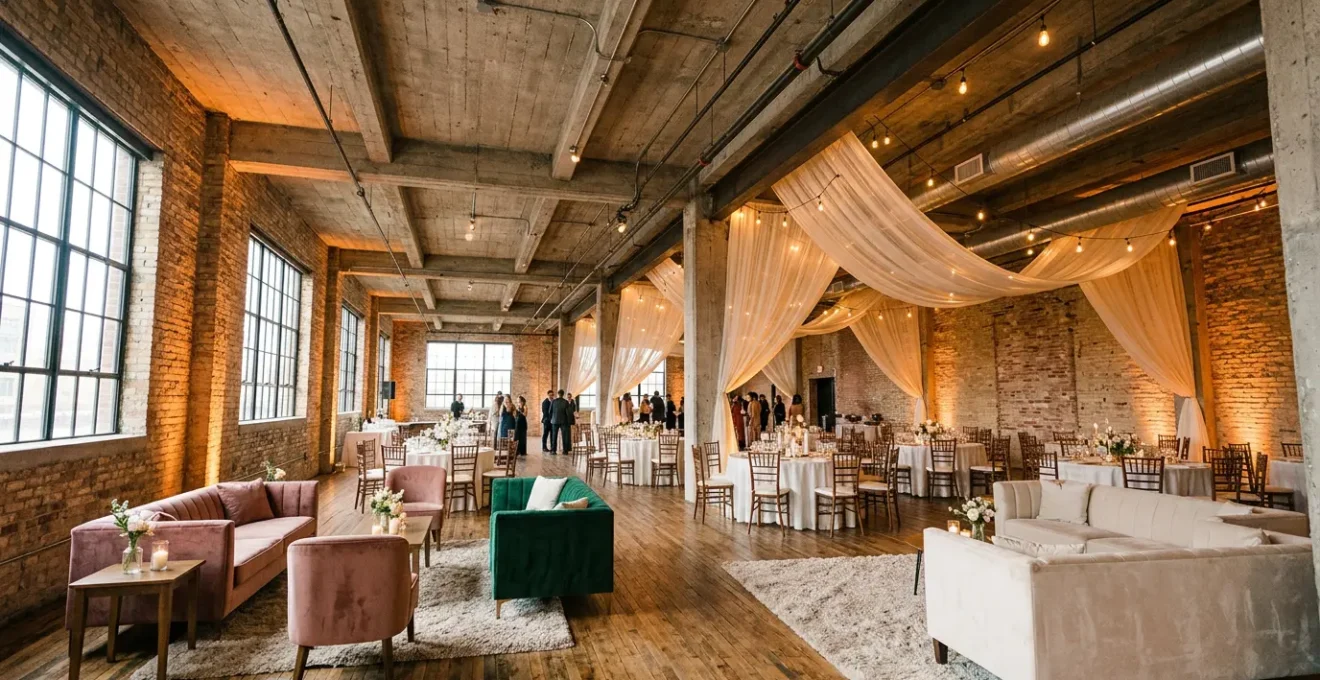
The secret to a perfect industrial loft wedding isn’t just embracing the aesthetic; it’s strategically defeating the echo by treating every design choice as an acoustic tool.
- Raw, “blank canvas” venues often hide significant acoustic costs that surpass all-inclusive hotels, requiring a budget for sound-absorbing rentals.
- Effective acoustic control is a system: furniture layout, heating solutions, and even food service style must work together to absorb sound and create intimacy.
Recommendation: Stop thinking like a decorator and start planning like an acoustic designer. Evaluate every rental and layout decision for its dual impact on style and sound.
You’ve fallen for the industrial loft: the soaring ceilings, the exposed brick, the vast open floor plan. It’s the perfect raw, stylish backdrop for your wedding. But there’s a nagging problem that surfaces during your second visit—the echo. Every footstep clatters, voices become a cacophonous din, and the romantic, intimate vibe you envisioned feels a million miles away. You’re now facing the classic industrial wedding dilemma: how do you keep the chic, raw aesthetic without the cold, impersonal sound?
The common advice is often simplistic: “just add rugs and drapes.” While not entirely wrong, this view misses the bigger picture. It treats acoustics as a decorative afterthought, a problem to be covered up. This approach often leads to frustration and spiraling costs, as you try to patch sonic holes in a fundamentally flawed setup. True mastery of the space requires a shift in perspective.
But what if the solution wasn’t just about adding soft things, but about a holistic design system? What if every single element—from the type of chairs you rent to the way you heat the space and serve the food—could be a deliberate tool to sculpt the sound? This guide is built on that very principle. We’ll move beyond the platitudes and give you a strategic framework, treating you like the savvy designer you are. You will learn to see the sonic potential in every logistical challenge, transforming your venue from an echo chamber into an elegant, acoustically balanced sanctuary.
This article breaks down the core challenges of an industrial venue, transforming each problem into a design opportunity. From budgeting for hidden acoustic costs to leveraging lighting for psychoacoustic effect, you’ll gain the expert insights needed to create a space that not only looks stunning but feels warm, inviting, and intimate.
Summary: From Echo to Elegance: An Acoustic Design Guide for Industrial Venues
- Why “Blank Canvas” Venues Often Cost More Than Hotels to Furnish?
- The Heating Challenge of High Ceilings in Winter Weddings
- Rigging from Beams: What You Need to Ask the Venue Manager?
- How to Use Furniture to Create “Rooms” in an Open Plan Loft?
- The Logistics of Flipping a Loft from Ceremony to Reception in 60 Minutes
- How to Manage Load-In Logistics for City Weddings with No Parking?
- How to Transformation a Dull Venue Using Only Lighting Techniques?
- Buffet vs. Plated: Which Service Style Actually Gets Guests Fed Faster?
Why “Blank Canvas” Venues Often Cost More Than Hotels to Furnish?
The term “blank canvas” evokes creative freedom, but in the world of venue acoustics, it translates to “acoustic void.” Hotels and all-inclusive venues come with built-in sound-dampening infrastructure: wall-to-wall carpeting, acoustic ceiling tiles, upholstered banquet chairs, and heavy drapery. An industrial loft, with its reflective concrete, glass, and steel surfaces, has none. This means you aren’t just renting furniture; you are renting an entire acoustic system from scratch. Every hard surface you add—from wooden cross-back chairs to a polished dance floor—multiplies the echo, requiring a soft, sound-absorbing counterbalance.
This is where budgets spiral. As wedding planning experts caution, couples often underestimate the sheer volume of rentals needed to make a bare room feel and sound comfortable. The cost isn’t just in the tables and chairs; it’s in the large area rugs, the plush lounge seating, the floor-length linens, and the extensive ceiling draping required to absorb the sonic chaos. Each “hard” rental necessitates a “soft” counterpart, effectively doubling up on furnishing costs that are invisible in an all-inclusive package.
To avoid sticker shock, you must budget with an acoustic mindset from day one. This means allocating funds specifically for sound-absorbing elements that go far beyond standard decor. Think of it as furnishing the air itself, not just the floor space. An initial audit of these hidden necessities is the first step toward a realistic budget.
Action Plan: Your Acoustic Furnishing Audit
- Budget for dedicated sound-absorbing rentals: Go beyond standard furniture. Price out plush lounge sets, thick area rugs (minimum 8×10 for dining zones), and heavy drapes with acoustic backing. These are not optional decor but essential infrastructure.
- Calculate the cost of “built-in” elements: Get quotes for items hotels provide for free. This includes wall coverings, temporary carpeting for aisles, and sufficient draping to cover large, reflective walls. This reveals the true cost of the “blank canvas.”
- Source dual-purpose furniture: Prioritize rentals that serve both aesthetics and acoustics. This means upholstered dining chairs over wood, sofas with dense foam, and floor-length linens on every single table to absorb sound.
- Factor in the domino effect: Understand that every hard rental (chairs, tables, dance floor) requires an acoustic counterbalance. Add a line item for cushions, runners, or ceiling treatments for each hard surface added.
- Create an acoustic contingency fund: Allocate an additional 5-8% of your rental budget specifically for unforeseen acoustic needs. This could be extra draping or a last-minute rug identified during setup when the room’s echo becomes apparent.
The Heating Challenge of High Ceilings in Winter Weddings
In a lofty industrial space during winter, heat behaves like sound: it rises and dissipates into the vast emptiness above, leaving your guests shivering below. The sheer volume of air in a venue with 20-foot ceilings makes traditional heating incredibly inefficient and expensive. Worse, the most common solutions—loud, forced-air “torpedo” heaters—introduce a constant, disruptive roar that competes with your ceremony vows and dinner conversations, creating a new acoustic problem while attempting to solve a thermal one.
A design-savvy approach tackles both issues simultaneously through dual-purpose strategies. Instead of trying to heat the entire cavernous space, the goal is to create warm, acoustically pleasant pockets where guests will spend most of their time. This is about managing perception and comfort on a human scale. Strategic use of fabric is key; ceiling sails or draping installed at a lower height (e.g., 12-14 feet) can trap rising heat before it’s lost, while also capturing and breaking up sound reflections from the high ceiling.
This thinking extends to the ground level. Creating intimate lounge areas with plush, upholstered seating and thick area rugs doesn’t just offer a stylish escape; it creates an acoustic and thermal sanctuary. The dense fabrics of the furniture absorb sound, allowing for easy conversation, while the rug provides a thermal break from the cold concrete floor, making the entire zone feel significantly warmer and cozier.

As the image demonstrates, layering textures like velvet, faux fur, and wool not only contributes to a feeling of warmth but also provides excellent sound absorption. Combining these tactile elements with warm-temperature lighting (soft amber uplights) enhances the psychological perception of warmth, making the space feel more comfortable than the thermostat might suggest. This is psycho-sensory design in action, where light, texture, and acoustics work in harmony.
Rigging from Beams: What You Need to Ask the Venue Manager?
The exposed beams and high ceilings of an industrial loft are a rigger’s dream, offering endless possibilities for dramatic lighting, floral installations, and crucial acoustic treatments like ceiling draping. However, assuming you can hang anything anywhere is a dangerous and costly mistake. Rigging is a highly specialized field governed by strict safety protocols, structural engineering, and venue-specific rules. The weight of heavy, fire-retardant acoustic drapes is vastly different from a few lightweight string lights, and venues are rightly protective of their structural integrity and liability.
Before you sign a contract with a decorator or A/V company, you must have a detailed conversation with the venue manager, armed with specific, technical questions. This is not the time for vague inquiries. You need to understand the venue’s load capacities, approved vendors, and documentation requirements. Many venues maintain a list of pre-approved rigging companies who are already insured, certified, and familiar with the building’s unique structural points. Straying from this list can lead to denial of access on your wedding day.
Furthermore, fire safety is paramount. Any fabric hung from the ceiling, especially for acoustic purposes, must meet stringent fire-retardant certification standards. Your venue will have a specific requirement (e.g., IFR – Inherently Flame Retardant), and you must provide the certification tag or paperwork for inspection. Failing to do so can result in the fire marshal ordering everything to be taken down. Your beautiful acoustic solution becomes a useless pile of fabric on the floor.
Your Rigging Pre-Flight Checklist: Questions for the Venue
- Load Capacity: Are your beams rated for dynamic or static loads? What is the maximum weight capacity per rigging point? (Crucial for heavy acoustic drapes).
- Vendor Approval: Do you have a list of pre-approved, insured rigging vendors? Are we required to use them?
- Fire Safety: What are your specific fire-retardant fabric requirements and certification standards for any ceiling draping?
- Layered Rigging: Can we use different beam heights to create layered designs (e.g., lighting high, acoustic fabric mid-level)?
- Logistics & Power: What are the access times for rigging? What are the costs and availability of scissor lifts? Can your power grid handle complex lighting and A/V systems simultaneously?
- Fees & Paperwork: Is there a fee per rigging point? What documentation (like CAD plots and weight calculations) and insurance certificates must be submitted, and what is the deadline for approval? You can find examples of such requirements from professional event rigging guides.
How to Use Furniture to Create “Rooms” in an Open Plan Loft?
In a vast, open-plan loft, sound travels unimpeded, bouncing off hard walls and creating a single, overwhelming ambient noise level. The key to taming this environment is to stop thinking of it as one big room. Instead, you must use furniture and decor as architectural tools to create smaller, visually distinct, and acoustically isolated “rooms” within the larger space. This strategic division breaks up long sound waves and provides guests with much-needed refuge from the overall din.
The most effective way to do this is by creating what we call “Acoustic Sanctuaries.” These are designated lounge areas, anchored by large, thick area rugs and furnished with plush, upholstered sofas and armchairs. The combination of the rug on the floor and the soft, deep seating acts as a massive sound absorber, creating a bubble of relative quiet where guests can comfortably hold a conversation without shouting. Placing these sanctuaries strategically—away from the DJ speakers and high-traffic bar area—is essential.
Vertical elements are your best friend for blocking sound travel. Don’t just think horizontally. Use tall, fabric-covered partitions, portable bookshelves filled with decor, or even dense, tall floral arrangements as sonic barriers between different zones like the dining area and the dance floor. These elements physically interrupt the path of sound waves, preventing the noise from one activity from bleeding excessively into another. Even the placement of the bar can be strategic; a large, central, double-sided bar acts as a natural hub, and the crowd of people gathered around it becomes a surprisingly effective, organic sound absorber.
Blueprint for Acoustic Room Design
- Layout Strategy 1: Designate Acoustic Sanctuaries. Position plush lounge areas with large rugs (8×10 minimum) and upholstered sofas to create zones where guests can escape ambient noise and converse clearly.
- Layout Strategy 2: Use Vertical Sonic Barriers. Employ tall bookshelves, portable fabric screens (minimum 6ft high), or large floral arrangements to physically block and absorb sound between zones.
- Layout Strategy 3: Apply ‘Flow & Dwell’ Principles. Arrange furniture to guide guest movement (flow) while creating acoustically comfortable ‘dwell zones’ (like lounges or a cozy bar corner) that encourage lingering.
- Layout Strategy 4: The Bar as an Architectural Divider. Use a large, central bar configuration as a spatial ‘hub.’ The surrounding crowd of guests will act as a massive, organic sound-absorbing mass.
- Layout Strategy 5: Layer Soft Materials Cumulatively. Combine floor-length linens on all tables, upholstered seating, and fabric wall hangings to create a cumulative acoustic dampening effect throughout the entire space.
The Logistics of Flipping a Loft from Ceremony to Reception in 60 Minutes
The “room flip” is one of the most stressful moments in a blank canvas wedding. In just 60 minutes, a serene ceremony space must transform into a lively reception hall. This transition is a logistical ballet of moving tables, chairs, and decor, but it’s also an acoustic nightmare. The scraping of chairs, the clatter of tables, and the chatter of a dozen vendors creates a chaotic and unpleasant soundscape for guests who are often waiting in an adjacent (and equally echoey) space for cocktail hour.
A smart flip strategy is as much about managing the sonic footprint of the transition as it is about moving furniture. The first rule is to manage the soundscape for waiting guests. A curated music playlist for the cocktail hour and flip period is non-negotiable; it masks the unavoidable noise of the flip and prevents the jarring sounds of labor from ruining the ambiance. The holding area itself must be made acoustically pleasant with its own rugs and soft seating to prevent guest fatigue before the reception even begins.
The most elegant solution is to minimize the amount of physical movement required. A “Pre-Set & Reveal” strategy is brilliant for this. Instead of moving everything in, you set up the reception layout (dining tables, lounges) as part of the ceremony’s backdrop, hidden behind elegant, heavy drapes. After the ceremony, guests move to cocktail hour, and the drapes are dramatically pulled back to reveal the reception space, fully formed. This minimizes noise and adds a “wow” moment. For elements that must be moved, like rugs, have them pre-rolled and staged at the perimeter, ready for instant deployment to quickly restore the room’s acoustic dampening.
We hired a day-of coordinator to handle vendor arrival and overall flow. It helped me create what I was envisioning. If I didn’t have the DOC I would be freaking out – there’s too many logistical things to deal with, and I don’t want my family or friends to have anything to do the day of the wedding other than hang out and enjoy.
– A Wedding Coordinator
How to Manage Load-In Logistics for City Weddings with No Parking?
Managing the load-in for a city wedding, especially at a venue with no dedicated parking or loading dock, is a high-stress puzzle. You have multiple vendors—rentals, catering, florals, A/V—all converging on a single point of entry within a tight time window. The result can be chaos: double-parked trucks, frustrated vendors, and a rushed, noisy setup that amplifies the room’s natural echo. A strategic load-in, however, can be your first opportunity to implement acoustic control.
The solution is a Phased Load-In Strategy based on Acoustic Impact. Instead of a free-for-all, you create a detailed schedule that dictates the order of arrival based on the sonic properties of the items being delivered. This isn’t just about efficiency; it’s about building the room’s acoustic environment in a logical sequence. You don’t want the delicate work of florists or the precise tuning of sound systems to be disturbed by the deafening clatter of tables and chairs being unloaded.
The process should be structured as follows:
- Phase 1: Hard & Loud. The first items to be loaded in are the loudest and most echo-creating: tables, chairs, the dance floor, and the bar structure. This happens during the earliest access window when the space is empty and noise is less disruptive.
- Phase 2: Mid-Weight & Quiet. The next phase includes items like linens, tableware, and catering equipment. These can be set up in a progressively quieter environment now that the main furniture framework is in place.
- Phase 3: Soft & Silent. The final and most crucial phase is the delivery of the sound-absorbing materials. Heavy drapes, plush lounge furniture, area rugs, and cushions should arrive last. They are installed when most other work is complete, immediately taming the room’s echo and creating a pleasant acoustic environment for the final vendor touches.
This phased approach transforms a logistical nightmare into a controlled, acoustically-minded process. Consolidating rentals from one or two full-service vendors can further simplify this, reducing the number of trucks and vendors you need to coordinate in a tight urban space.
How to Transformation a Dull Venue Using Only Lighting Techniques?
Lighting is often seen as a purely aesthetic element, but in an acoustically challenging space, it becomes a powerful psychoacoustic tool. When you can’t physically alter the vastness of a room, you can manipulate your guests’ perception of it. Our brains are wired to connect visual cues with auditory experience; a space that looks warm and intimate will automatically feel quieter and more comfortable. This is the art of using light to shape the soundscape.
The goal in a reverberant space is to reduce the perceived volume of the room. According to experts, an optimal reverberation time for speech is 0.8 to 1.2 seconds; industrial lofts can easily exceed 2-3 seconds. While lighting can’t change this physical property, it can make it less noticeable. The key technique is focused intimacy. By using pin-spotting to illuminate only the center of each dining table and leaving the surrounding space in relative darkness, you visually shrink the room. The soaring ceilings and distant walls “disappear,” psychologically forcing guests to focus their attention on their immediate, well-lit conversation zone. The ambient echo becomes part of a forgotten background.
Another powerful technique is using light to celebrate, rather than hide, your acoustic treatments. Backlighting heavy, sound-absorbing drapes can transform them from a functional necessity into a stunning architectural feature. The fabric catches the light, creating a soft, ethereal glow that becomes a centerpiece of the decor. Similarly, using uplighting on textured walls like brick or concrete creates dramatic shadows and visual depth, distracting the eye from the room’s sheer size and complementing the soft textures you’ve added for sound control. Using a warm light temperature (around 2700K) consistently will enhance feelings of intimacy and make even the most cavernous space feel less vast.
Psychoacoustic Lighting Design Toolkit
- Technique 1: Focused Intimacy. Use pin-spotting on tables to make the wider, echoey space visually ‘disappear’, focusing attention on immediate conversation zones.
- Technique 2: Textural Uplighting. Uplight brick or concrete walls to create dramatic shadows and visual depth, distracting from the room’s vastness.
- Technique 3: Backlit Acoustic Elements. Light heavy drapes from behind to turn them into glowing, architectural features, making your acoustic solution a visual centerpiece.
- Technique 4: Dynamic Lighting Zones. Map lighting changes to the event’s flow: brighter for ceremony, warm and focused for dinner, and colorful moving lights for dancing to energize the space and mask ambient noise.
- Technique 5: Use Gobos and Warm Temperatures. Project patterns (gobos) on floors or ceilings to visually break up large reflective surfaces, and stick to warm 2700K lighting to create intimacy.
Key Takeaways
- Acoustic control in a loft is a design system, not a decorative add-on. Every choice, from furniture to heating, has a sonic consequence.
- The “blank canvas” is an acoustic void. Budgeting must account for renting an entire sound-dampening system (rugs, drapes, soft seating) that hotels provide for free.
- Logistics are acoustic tools. A phased load-in, a “reveal” room flip, and even your food service style directly shape the soundscape and guest experience.
Buffet vs. Plated: Which Service Style Actually Gets Guests Fed Faster?
Guests should be able to hear clearly without echo, distortion, or shouting across tables. Acoustic treatment for wedding venues ensures that every toast, laugh, and lyric carries clearly throughout the room.
– Commercial Acoustics, Acoustic Treatment for Wedding Venues
The choice between a buffet and a plated dinner is often framed by guest experience, speed, and cost. But in an industrial loft, this decision has a profound and often overlooked impact on the room’s acoustics. Each service style has a unique sonic footprint that can either exacerbate or help mitigate the venue’s echo. The question isn’t just about feeding guests faster; it’s about how the process of feeding them affects the entire auditory environment of the reception.
A plated service creates a predictable, controlled acoustic environment. With guests seated for the majority of the meal, there is less ambient movement and chatter. This creates moments of punctuated silence that are ideal for speeches, toasts, or musical performances. However, in this relative quiet, isolated sounds—like a server dropping a tray of cutlery—are amplified and can be jarring. The rigid grid of tables required for plated service can also create consistent sound reflection patterns throughout the space.
A buffet, by contrast, generates a constant, energetic hum. The movement of guests, the clatter of serving utensils, and the continuous conversation create a high level of ambient noise. While this makes it challenging to hold for speeches without a robust sound system, this energetic buzz can be an acoustic blessing in disguise. The constant, diffused noise helps to mask the room’s natural echo and can make a large, reverberant space feel more lively and less empty. The flow of people moving to and from the buffet stations also helps to break up sound waves in a way that static, seated guests cannot.
The following table breaks down the acoustic profile of each service style, helping you make a choice that aligns with your reception’s vibe and your venue’s challenges.
| Criterion | Plated Service | Buffet Service |
|---|---|---|
| Acoustic Profile | Moments of punctuated silence ideal for toasts and speeches; amplifies isolated sounds like dropped cutlery | Constant energetic hum that masks room echo but makes speeches difficult without robust sound system |
| Guest Flow & Noise | Static seating creates predictable sound-reflection paths; lower ambient movement noise | High movement and ambient noise; double-sided buffets faster but louder; multi-station setups slower but break crowd into smaller, quieter groups |
| Layout Impact | Requires rigid table grid that can create consistent sound reflection patterns throughout space | Allows organic layout with varied table shapes and integrated lounge areas, better for breaking up sound waves |
| Service Sound | Concentrates cutlery/plate clatter into specific courses (soup, main, dessert); creates sonic punctuation marks | Spreads plate and utensil noise throughout meal period; constant low-level service sound |
| Best Acoustic Use Case | Events prioritizing speeches, toasts, or announcements during dinner; venues with good built-in acoustic treatment | High-energy receptions where conversation is priority; helps mask echo in acoustically-challenging industrial spaces |
By adopting this acoustic-first mindset, you transform every logistical challenge into a creative opportunity. You’re no longer just picking out pretty things; you are composing an experience, ensuring your wedding day not only looks beautiful but sounds and feels truly special. Start applying this framework to your planning today, and build a celebration that resonates in every sense of the word.