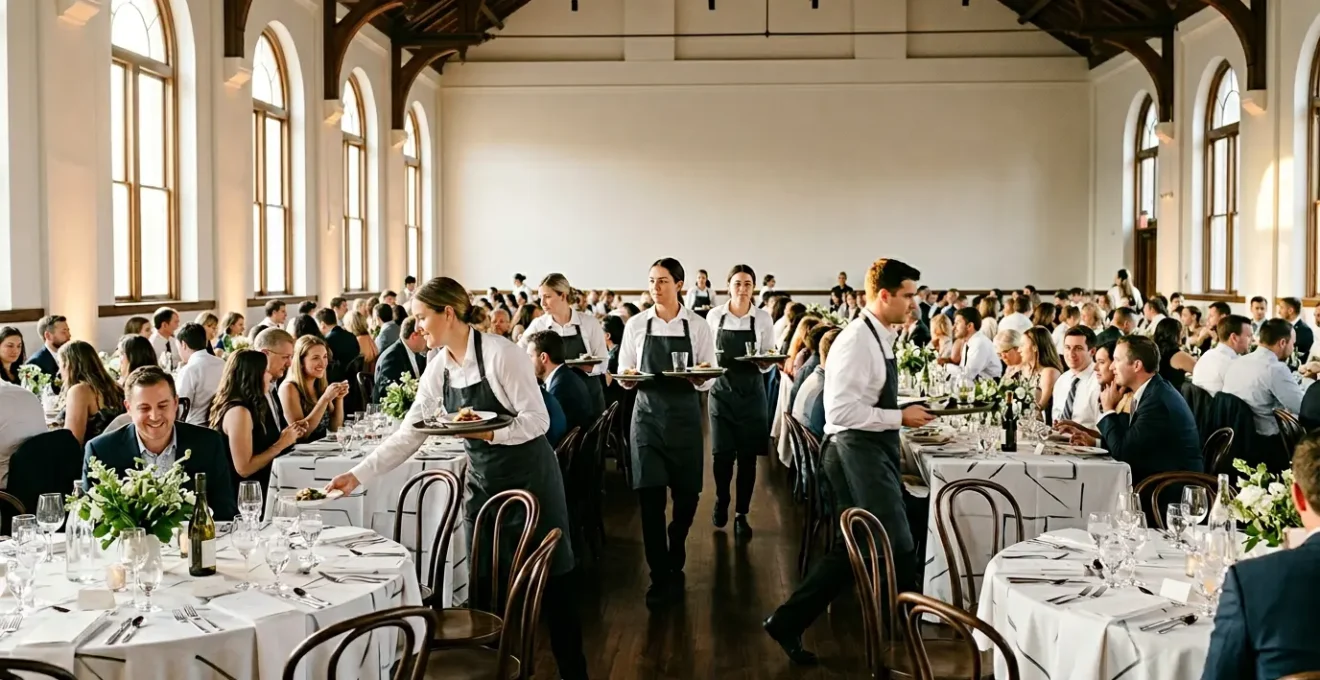
The speed of your wedding dinner doesn’t depend on choosing buffet vs. plated, but on mastering the hidden operational choke points that control the flow of your event.
- A properly staffed plated dinner (1 server per 10 guests) is consistently faster and more controlled than a buffet.
- Buffets often carry hidden costs in food waste and rental equipment, negating their perceived budget advantage.
Recommendation: Shift your focus from the service style debate to optimizing your timeline, staffing ratios, and pre-service setup. This is where you’ll find true speed.
The debate is a classic in wedding planning: buffet or plated? Couples often frame this choice around formality and guest experience, but for those fixated on the timeline, the core question is about speed. The common assumption is that a buffet, where guests serve themselves, must be quicker than the structured process of a plated dinner. It feels intuitive. Guests are in control, so the process must be more efficient, right?
As a banquet operations director, I’ve seen this assumption lead to countless timeline frustrations. The reality is that the “buffet vs. plated” question is a distraction from the real factors that dictate the pace of a meal service. The true speed isn’t in the style, but in the operational logistics that happen behind the scenes. It’s about staff leverage, the strategic placement of key event moments, and the meticulous planning of every single minute. The most significant delays I witness have little to do with whether guests are walking to a food station or waiting for a plate to be delivered.
This guide pulls back the curtain on wedding meal service. We are going to move beyond the surface-level debate and dive into the operational mechanics that truly determine whether your reception flows seamlessly or grinds to a halt. We’ll analyze the critical staffing ratios, the hidden costs that impact your budget and the environment, and the small, strategic setups that can save you precious minutes. Forget what you think you know about dinner service speed; it’s time to focus on what actually works.
This article breaks down the core logistical factors that determine the real speed of your dinner service. Explore the detailed analysis below to build a timeline that is efficient, elegant, and perfectly executed.
Summary: Decoding the Speed of Wedding Meal Service
- Why You Need 1 Waiter Per 10 Guests for a Seamless Plated Dinner?
- The “Speech Delay” Factor: How It Ruins Hot Main Courses?
- Is a Buffet Really Cheaper Than Plated Once You Factor in Waste?
- Why Pre-Setting Water and Bread Speed Up Service by 15 Minutes?
- When to Feed the Band: Before or During Guest Dinner?
- The Logistics of Flipping a Loft from Ceremony to Reception in 60 Minutes
- Resort Buyout or Private Estate: Which Offers Better Staffing Ratios?
- How to Build a Run of Show That Prevents the “Mid-Reception Slump”?
Why You Need 1 Waiter Per 10 Guests for a Seamless Plated Dinner?
The single most influential factor in the speed of a plated dinner isn’t the complexity of the menu; it’s the server-to-guest ratio. Many caterers default to a 1:15 or even 1:20 ratio to keep labor costs down, but this is a critical operational mistake. The ideal, time-efficient ratio is 1 server for every 10 to 12 guests. While this may seem like a minor adjustment, its impact on the service flow is monumental. With this ratio, a team can serve an entire table of 10 simultaneously, ensuring guests eat at the same time and plates are delivered hot.
This “staffing leverage” extends beyond just serving the main course. It dramatically accelerates clearing times between courses. A well-staffed team can clear a room efficiently, creating the necessary space for dessert, coffee service, or the transition to the dance floor. It prevents the awkward scenario where half the room has finished eating while the other half is still waiting, a common symptom of understaffing. The investment in a few extra servers is a direct investment in your event’s momentum and your guests’ experience.
Case Study: The 10-Minute Clearing Difference
The impact of staffing is quantifiable. Professional event managers have observed that maintaining a 1:10 server-to-guest ratio enables a 150-person room to be cleared in approximately 15 minutes. In contrast, an analysis of events with a 1:15 ratio shows that the same task extends clearing time to 25 minutes. This 10-minute differential creates a domino effect, pushing back dessert, coffee, and scheduled speeches, directly compromising the overall event flow and guest satisfaction.
Ultimately, when you’re discussing plated service with a caterer, your first question shouldn’t be about the food, but about their staffing plan. Insisting on the right ratio is the best guarantee for a seamless, fast-paced dinner service. Professional event staffing guidelines confirm a ratio of one server per 10-12 guests for high-end plated functions for this very reason.
The “Speech Delay” Factor: How It Ruins Hot Main Courses?
Here is an operational reality every banquet director knows: the kitchen works on a timeline measured in seconds, not minutes. When a plated main course is ready, it has a very short window—often just a few minutes—before its temperature, texture, and presentation begin to degrade. This is where the “Speech Delay” factor becomes the number one enemy of a hot meal. An unplanned or extended toast that begins just as the kitchen is “firing” the main course can be catastrophic for food quality.
This is what happens behind the scenes: the chef has timed the cooking of 150 steaks to be perfectly medium-rare at exactly 7:45 PM. At 7:43 PM, the father of the bride grabs the microphone for an “impromptu” 10-minute speech. The servers, ready to move, are forced to stand by. Meanwhile, under heat lamps, those 150 steaks continue to cook, turning from medium-rare to medium, and then to a disappointing medium-well. The sauces congeal, and the carefully crafted vegetables lose their crispness. This is the domino effect in action; a single, poorly timed speech creates a quality control nightmare.

To prevent this, your Run of Show must be communicated and strictly adhered to by your caterer, DJ, and anyone with a microphone. Speeches should be scheduled for specific times, such as immediately after the salad course is cleared or after the main course has been fully served and enjoyed. This gives the kitchen a clear, predictable window to execute service perfectly. A simple instruction—”all speeches must conclude by 7:40 PM”—can be the difference between a memorable meal and a lukewarm disappointment.
Is a Buffet Really Cheaper Than Plated Once You Factor in Waste?
The argument that a buffet is the budget-friendly option is one of the most persistent myths in wedding planning. While it’s true that you may hire fewer servers, this one-dimensional analysis ignores the significant hidden costs, with food waste being the most substantial. To ensure a buffet looks full and abundant for the last guest in line, caterers must overproduce food, often by a significant margin. This planned overage, combined with unpredictable guest serving sizes, leads to a staggering amount of waste.
In fact, research indicates that 20-40% of wedding catered food ends up as waste, with buffets being a major contributor. You are paying for every pound of that wasted food. In contrast, a plated dinner is portion-controlled down to the ounce. The chef knows exactly how many guests there are and prepares that exact number of plates. The waste is minimal, making it a far more efficient—and often more economical—model when you calculate the total cost of food, not just the initial quote.
Beyond the food itself, buffets require a larger inventory of rental equipment, another hidden cost. Chafing dishes, heat lamps, serving platters, and multiple serving utensils for each dish add up. This cost is passed on to you. A plated dinner, on the other hand, primarily requires plates and cutlery, which are already part of a standard rental package. When all factors are considered, the financial argument for buffets quickly weakens.
This comparative table breaks down the true cost drivers for each service style, moving beyond the simplistic labor cost argument. As the data from a professional catering cost analysis shows, the real expenses are often hidden in food production and equipment.
| Cost Factor | Buffet Service | Plated Service |
|---|---|---|
| Labor Requirements | Lower (fewer servers needed) | Higher (1 server per 10-12 guests) |
| Food Overproduction | 10-20% extra required for presentation | Minimal (exact portions) |
| Rental Equipment | Higher (chafing dishes, large platters) | Lower (standard plates only) |
| Food Waste | Higher (guest self-service variability) | Lower (controlled portions) |
| Best for Guest Count | Over 250 guests | Under 150 guests |
Why Pre-Setting Water and Bread Speed Up Service by 15 Minutes?
In banquet operations, efficiency is achieved through “front-loading” tasks—completing as much work as possible before guests even enter the room. One of the most effective front-loading techniques is the pre-setting of water and bread. Instead of servers spending the first 15-20 minutes of service attending to 150 individual requests for water, they can walk into a room where this initial step is already complete. This is not just a small convenience; it’s a massive time-saver.
When guests sit down to a table with water goblets already filled and bread baskets placed, the service team is immediately freed up to focus on the first critical task: taking drink orders for cocktails, wine, or other beverages. This single strategic move effectively eliminates an entire service step from the busiest part of the evening. It prevents the initial “service bottleneck” where guests are waiting for a simple glass of water while servers are overwhelmed with simultaneous requests. The perceived pace of the service instantly feels faster and more attentive.

This strategy is equally effective for both plated and buffet-style dinners. For a plated service, it allows servers to begin pouring wine and describing the first course sooner. For a buffet, it ensures guests have something to enjoy at their table before and after they go through the buffet line, reducing the perceived wait time. It’s a simple, elegant solution that costs nothing extra but pays significant dividends in your timeline. A pre-set table signals a well-organized event and sets a positive service flow from the moment guests are seated.
When to Feed the Band: Before or During Guest Dinner?
The question of when to feed your vendors—especially the band or DJ—is a crucial logistical detail that directly impacts your reception’s flow. There are two primary schools of thought, and the right choice depends on your timeline’s priorities. The first option is to feed them *before* guest service begins. This ensures your entertainment is fed, energized, and ready to perform the moment dinner concludes, eliminating any potential for a “dead air” gap while the band takes a dinner break.
The operational advantage here is a seamless transition from dinner to dancing. As soon as the last dessert plate is cleared, the band can hit the stage. This is the best approach for couples who want to maximize dance time and maintain high energy throughout the evening. However, it requires careful coordination with your caterer to have “vendor meals” ready about 30-45 minutes prior to guests being seated, and a designated, quiet space for them to eat.
The second option is to feed the band *during* the guest’s main course. This is often easier for the kitchen, as they can prepare vendor meals alongside guest meals. The band typically eats in shifts, ensuring music continues to play (often via a pre-made playlist) while they take their break. The downside is the potential for a “mid-reception slump.” If the band’s break aligns with the end of dinner, you can have a 20-30 minute lull before the live performance and dancing truly kicks off. This can drain the energy from the room. My professional recommendation is almost always to feed vendors *before* the event starts to ensure an uninterrupted flow of entertainment.
The Logistics of Flipping a Loft from Ceremony to Reception in 60 Minutes
For couples using a single, dynamic space like a loft or gallery, the “room flip”—transforming the venue from ceremony setup to reception-ready—is the most time-sensitive operation of the day. A 60-minute target is ambitious but achievable with military-like precision and, most importantly, adequate staffing. This is not a task for a skeleton crew. Successfully flipping a 150-guest space in an hour requires a dedicated team of at least 8-10 staff members whose sole focus is the flip.
The process is a choreographed sequence of events. While guests are enjoying a cocktail hour in a separate area or on a different floor, the team swarms in. The first 15 minutes are for deconstruction: ceremony chairs are stacked and removed, the altar or chuppah is disassembled, and the space is cleared. The next 30 minutes are for construction: reception tables and chairs are brought in and positioned according to the floor plan, linens are laid, and large floral centerpieces are placed. The final 15 minutes are for the detail work: pre-setting place settings, water goblets, and bread baskets, as discussed earlier. Every staff member has a designated role—some are on furniture, some on linens, some on place settings.
The biggest mistake couples make is underestimating the manpower required for this task. Relying on the standard catering staff, who are also trying to prep for dinner service, is a recipe for delays. A dedicated “flip crew” is a non-negotiable expense for an on-time reception. When vetting a venue that requires a flip, ask to see a video of a previous flip or demand a detailed staffing plan. Their answer will tell you everything you need to know about their ability to execute under pressure.
Resort Buyout or Private Estate: Which Offers Better Staffing Ratios?
The choice between an all-inclusive resort and a private estate has significant implications for one of the most critical factors in service speed: staffing. A resort buyout typically offers a major advantage in this department. Resorts have a large, in-house banquet team on payroll. They are experienced, work together regularly, and the venue can easily pull from other departments to increase staff levels for a large event. This provides incredible flexibility and reliability. If a server calls in sick, a replacement is readily available. You are tapping into an existing, well-oiled operational machine.
A private estate, while offering unmatched exclusivity and aesthetic control, presents a different staffing reality. Here, you are almost always hiring an outside catering company, which in turn brings in its own staff or hires them from a third-party agency. This introduces several variables. The team may not have worked together before, or be familiar with the estate’s unique layout, kitchen facilities, or “operational choke points.” While top-tier caterers have excellent teams, you are inherently relying on an external workforce. This requires more diligent vetting of your catering partner to ensure they provide not just great food, but also a seasoned and sufficient service team.
From a purely operational standpoint, a resort often provides better, more consistent staffing ratios. They have the resources and infrastructure to guarantee a high level of service without the logistical hurdles of coordinating an external team. However, if your heart is set on a private estate, the key is to over-invest in a premium caterer known for their impeccable service standards and to have a frank conversation about their staffing plan and contingency measures long before the wedding day.
Key Takeaways
- The speed of your dinner service is dictated by logistics like staffing ratios and timing, not just the choice between buffet and plated.
- A 1:10 server-to-guest ratio for plated dinners is the gold standard for efficient service and clearing.
- Hidden costs of buffets, particularly food overproduction and waste, can make them more expensive than portion-controlled plated meals.
How to Build a Run of Show That Prevents the “Mid-Reception Slump”?
The “Mid-Reception Slump” is that palpable drop in energy that happens after dinner, when guests are full and the transition to dancing or the next activity feels disjointed. This slump is not inevitable; it’s a failure of planning. The antidote is a meticulously detailed Run of Show, a document that serves as the master script for your entire event, timed down to five-minute increments. This is far more than a simple timeline; it’s an operational blueprint shared with every single vendor.
A strong Run of Show orchestrates the flow of the evening to build and maintain momentum. It schedules key moments to prevent dead air. For example, instead of having all speeches clumped together, you might place one between the salad and main course, and the final one just as dessert is served. This keeps guests engaged. It also directs the vendors. It tells the DJ precisely when to fade the dinner music and start the first dance song, it informs the photographer of the cake-cutting time, and, most critically, it gives the banquet captain clear markers for service execution. It turns a collection of independent vendors into a unified team working from the same playbook.
Building this document requires thinking like an event producer. You must anticipate the natural lulls and proactively schedule something to fill them. Your wedding planner or venue coordinator should lead this process, but you must be involved to ensure it reflects your priorities. The goal is to create a seamless guest experience where one event flows effortlessly into the next, carrying the energy forward until the very last song.
Your Action Plan: Building a Slump-Proof Run of Show
- List All Events: Itemize every single moment, from guest arrival and cocktail hour to speeches, special dances, cake cutting, and the final send-off. Be exhaustive.
- Assign Realistic Timings: Allocate a specific start and end time for each item. Consult your vendors—ask your caterer how long plated service for 150 truly takes. Don’t guess.
- Identify Transition Points: Pay close attention to the moments *between* events (e.g., end of dinner to start of dancing). Schedule music cues or emcee announcements to bridge these gaps.
- Orchestrate Key Personnel: For each timed item, note who is the lead person responsible (e.g., 8:15 PM – Cake Cutting – Lead: DJ/Emcee to announce, Photographer to be in position).
- Distribute and Confirm: Send the final Run of Show to ALL vendors (caterer, band/DJ, photographer, venue coordinator) one week prior and have a brief call to confirm they have read and understood it.
Ultimately, a flawless reception timeline is not a matter of chance, but of deliberate and detailed operational planning. By focusing on these core principles of staffing, timing, and coordination, you empower yourself to create an experience that is as seamless as it is memorable. To apply these strategies effectively, the next step is to work closely with a planner or venue coordinator who understands and prioritizes this level of logistical detail.