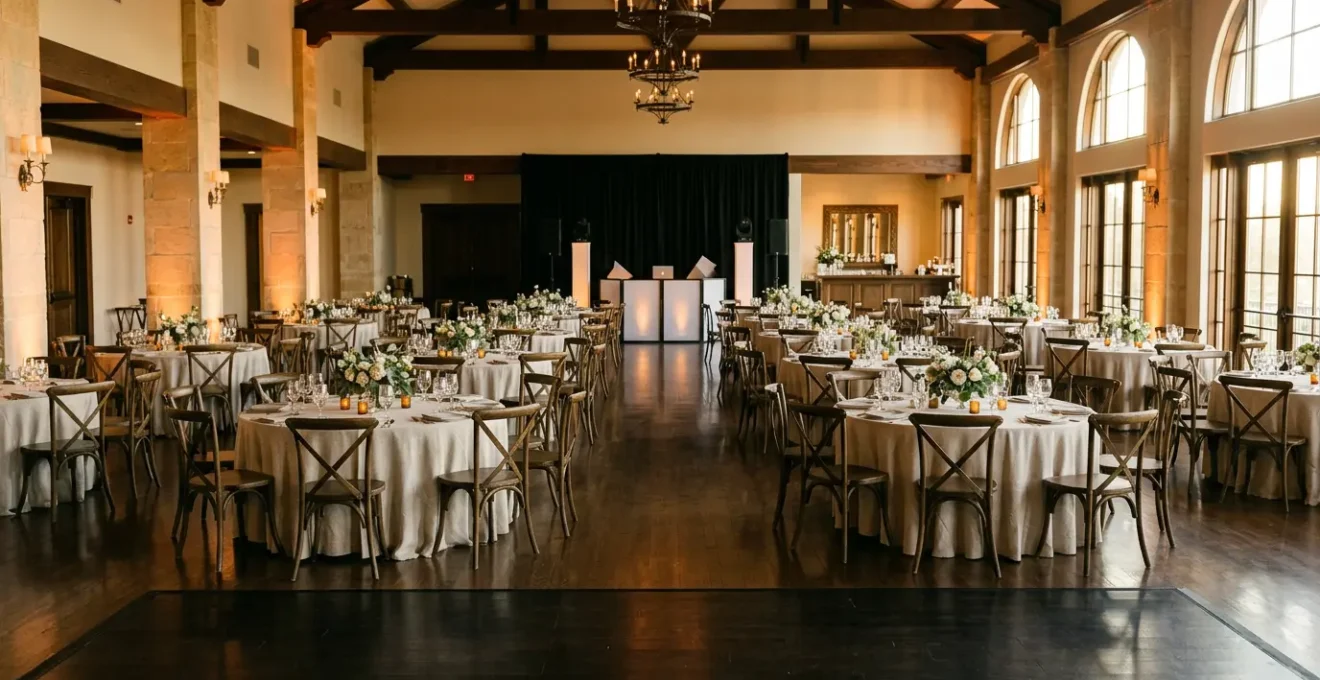
The dreaded “mid-reception slump” isn’t accidental; it’s a structural failure in your timeline’s energy architecture.
- Stacking more than three speeches creates cognitive fatigue, causing guests to tune out.
- An over-extended cocktail hour without enough food inverts the “intoxication-to-satiety ratio,” leading to tired, hungry guests.
- Strategic transitions, like inviting everyone to the dance floor for the last 30 seconds of the first dance, are critical “pacing levers.”
Recommendation: Stop thinking in checklists and start designing an experience. Treat guest energy as a resource to be managed with a structured run of show, building in buffers and moments of rest to maintain momentum all night.
You’ve seen it happen. The dinner plates are cleared, the initial excitement has worn off, and a palpable lull descends upon the room. Guests are checking their phones, others are stifling yawns, and the dance floor sits empty. This is the “mid-reception slump,” the number one fear for couples who want their wedding to be a vibrant, unforgettable party. The common advice—”play good music” or “have an open bar”—misses the point entirely. A great reception isn’t a collection of services; it’s a masterpiece of event flow and energy management.
As an event producer, I don’t just create timelines; I design an energy architecture. The secret isn’t about packing more activities in, but about understanding the rhythm of a crowd. It’s about treating your guests’ attention, appetite, and excitement as finite resources that need to be strategically managed. Forget the generic templates. The key to a high-energy reception lies in the structural details: the timing of speeches, the transition between courses, and the precise moment you trigger the first dance. We need to move beyond the ‘what’ and dissect the structural ‘how’.
This guide is your producer’s playbook. We will deconstruct the common timeline mistakes that kill a party’s momentum and provide you with a structural framework to prevent the slump by design, not by chance. By mastering these pacing levers, you can ensure your celebration builds energy progressively, culminating in a packed dance floor and an epic finale that everyone will remember.
To help you craft a flawless event, this article breaks down the core structural components of a high-energy reception timeline. We will explore each critical decision point, from managing speeches to executing the perfect grand exit, giving you the tools to build a truly dynamic celebration.
Contents: How to Engineer Your Wedding’s Energy Flow
- Why You Should Never Schedule More Than 3 Speeches Back-to-Back?
- Sunset Photos vs. Dinner Service: How to Not Delay the Food?
- The “First Dance” Timing Trick That Gets Everyone on the Floor Instantly
- The “Cocktail Hour Extension” Mistake That Makes Guests Drunk and Hangry
- Sparklers or Last Song: How to Execute a Grand Exit That Actually Works?
- How to Create a Balanced Itinerary That Allows for Downtime?
- The “Lull” Between Courses That Kills Party Energy
- Buffet vs. Plated: Which Service Style Actually Gets Guests Fed Faster?
Why You Should Never Schedule More Than 3 Speeches Back-to-Back?
The speech segment is often the first place a reception’s energy begins to drain. While heartfelt, a long, unbroken block of toasts forces guests into a passive listening mode for too long. The issue is one of cognitive load. Humans have a finite attention span for passive listening, and research confirms this. In fact, one analysis shows that by minute seven, you’ve lost about 40% of your listeners’ focused attention. When you stack four, five, or even more speeches together, you aren’t just testing patience; you’re actively creating listener fatigue.

A producer’s approach is to break this block up. Instead of a single “speech marathon,” think of it as a “Speech Sandwich.” You layer the speeches between other, more interactive moments. For example, have the welcome speech before the starter is served. Then, schedule the main toasts between the starter and the main course. This gives guests a natural mental break and something to do, resetting their attention clock. Each speech then feels like a distinct, important moment rather than another item in a long queue.
The golden rule is a maximum of three short speeches in any single block, with each speech ideally kept under ten minutes. A more effective strategy is to alternate speeches with other activities, such as a collective toast, a brief table interaction prompted by the MC, or even the wine service. This method maintains engagement, respects your guests’ attention, and ensures each speaker’s words have the impact they deserve.
Sunset Photos vs. Dinner Service: How to Not Delay the Food?
The “golden hour” is a non-negotiable for photographers, but it often clashes directly with the start of dinner service, creating a major timeline bottleneck. When the couple runs late from photos, it sends a ripple effect through the entire evening, starting with hungry, waiting guests. A professional event producer builds in structural solutions to prevent this. The first step is having the “Caterer’s Red Line” conversation. Don’t just ask when they need you back; ask for the precise point of no return for your dishes before quality degrades. This gives you a hard deadline, not a soft suggestion.
Next, build invisible buffers into your schedule. Treat the cocktail hour as your timeline’s safety valve. It’s designed to absorb minor delays. Experienced coordinators manage this by adjusting music, subtly communicating with catering to slow service, and preparing to abbreviate later elements if needed, all without guests noticing a thing. One effective tactic is the “Decoy Start Time” strategy: schedule your photo session to begin 20 minutes before the actual golden hour. This creates a natural buffer for gathering family and managing small, inevitable delays.
The ultimate safeguard is the “Appetizer Bridge” contingency. Pre-plan with your caterer to have a sophisticated bridge appetizer or amuse-bouche ready to be served to seated guests if you are running late. This small, elegant course of action prevents the “hangry” state from setting in and makes the wait feel intentional and luxurious, rather than like a delay. It’s a small investment that pays huge dividends in guest happiness and overall event flow.
The “First Dance” Timing Trick That Gets Everyone on the Floor Instantly
The transition from the first dance to an open dance floor is one of the most critical moments for setting the party’s energy. Too often, the song ends, the couple walks off, and an awkward void follows. A producer engineers this moment for momentum. The goal is to fill the dance floor *during* the first dance, not after it. The most effective method is “The Last 30 Seconds Invitation.”
Here’s how it works: with about 30 seconds left in the couple’s first dance song, the MC or DJ makes a clear, energetic announcement: “Let’s get everyone on the floor to join our happy couple for the grand finale of their first dance!” This simple invitation is a powerful call to action. It creates a packed, high-energy floor while the emotional peak of the first dance is still happening. As your song ends, the DJ can seamlessly transition into the first high-energy party track, and the party is already in full swing. There is no lull, no hesitation.
Another powerful technique is the “Dance Floor Hand-Off.” At the end of the song, the couple separates and each grabs a key person (a parent, sibling, or wedding party member) to bring onto the floor. These “deputies,” who should be pre-instructed, then pull others onto the floor, creating an organic chain reaction. To prime this moment, consider playing a “Unity Song”—one universally loved, mid-tempo track right before the first dance to get people singing and swaying in their seats, raising the collective energy before the main event even begins. Remember to keep the first dance itself concise, ideally 90 seconds to two minutes, to keep guests engaged as viewers before they become participants.
The “Cocktail Hour Extension” Mistake That Makes Guests Drunk and Hangry
While the cocktail hour is a useful buffer, letting it run too long without a clear strategy is a recipe for disaster. The core problem lies in the “Intoxication-to-Satiety Ratio.” In simple terms, you must ensure the rate of food consumption stays slightly ahead of alcohol consumption. A standard 60-minute cocktail hour with passed hors d’oeuvres is balanced. However, when you extend it to 90 minutes or more without proportionally increasing the food, this ratio inverts. Guests become over-served and under-fed, leading to a room full of people who are drunk, hungry, and tired before dinner even starts.
A skilled producer manages this ratio with precision. If an extension is unavoidable, you don’t just let the same service drag on; you escalate it. The “Substantial Last Pass” tactic is essential here. Instruct your caterer to serve a more significant, carb-or-protein-based item in the final 15-20 minutes. Think mini sliders, small pasta bowls, or chicken satays. This provides a base to absorb alcohol and bridges the gap to dinner.
Equally important is executing a “Forced Transition” to signal that the cocktail hour is definitively over. This shouldn’t be a weak announcement that people can ignore. Use clear, positive, and non-verbal cues. A dramatic dimming of the lights, a specific and well-known “call to dinner” song, or even a festive procession like a single drummer leading guests from one space to another. These signals create a sense of occasion and urgency, moving the crowd effectively and preventing the energy-killing stragglers.
Sparklers or Last Song: How to Execute a Grand Exit That Actually Works?
The grand exit is meant to be a climactic, photo-worthy moment. But by the actual end of the night, many guests—especially older relatives and those with children—have already departed, leaving you with a sparse, low-energy send-off line. To combat this, event producers use a powerful tool: The “Fake Exit.” This strategy involves executing the grand exit (with sparklers, bubbles, or whatever you’ve planned) about an hour *before* the reception officially ends.
This timing captures peak energy and maximum guest participation. You get the spectacular photos with a full, cheering crowd. After the “exit,” you and your most dedicated guests can re-enter the reception for a final, intimate hour of dancing. This creates the best of both worlds: the big photo opportunity and a relaxed, personal end to the night. It also solves the “sparklers vs. last song” dilemma—you get to have both. To pull this off, you must designate an “Exit Logistics Captain.” This is someone (not the planner, who is busy) whose sole job is to liaise with the MC, distribute the sparklers, and instruct guests on where and when to line up. This ensures the maneuver is swift and seamless.
Understanding guest departure patterns is key to all timeline planning. For instance, professional wedding coordinators note that the cake cutting acts as a social signal, giving older guests permission to leave without feeling rude. By scheduling the cake cutting earlier, around 8:30 or 9:00 PM, you acknowledge this and can then plan your “Fake Exit” for the moment of peak attendance that follows.
How to Create a Balanced Itinerary That Allows for Downtime?
One of the biggest mistakes couples make is creating a timeline that is packed back-to-back, leaving no room to breathe. The day becomes a frantic rush from one obligation to the next, leading to couple burnout and a stressed-out atmosphere. The solution is to intentionally schedule “Negative Space.” Just as in visual design, empty space in a timeline is not a void; it’s a feature. It provides crucial moments to recharge, connect, and actually experience your own wedding day.
For the couple, this means blocking out 15-20 minutes of absolute nothing post-ceremony or pre-reception. This is designated “recharge time” to be alone, have a bite to eat, drink some water, and simply be present with each other. For guests, downtime must be structured. The period between the ceremony and reception should feature a dedicated hospitality lounge with drinks and snacks, an engaging guest book activity, or a photo booth to prevent aimless waiting. It turns a lull into a pleasant, curated experience.
A useful mental model is the “Energy Budget” analogy. Assign “energy points” to different activities: photos might be -10 points, a quiet moment together +5 points, a long string of speeches -15 points. This visual metaphor helps you see where your timeline is too draining and where you need to build in recovery moments. The goal is to end the night with a positive energy balance, not in an energy deficit. Building 15-30 minute buffers throughout the reception timeline is also critical to absorb any delays from earlier in the day without impacting the celebration’s flow.
Your 5-Point Timeline Energy Audit
- Activity Inventory: List every single event, from photos to speeches to cake cutting, in your proposed timeline.
- Energy Point Assignment: Assign a positive (+5) or negative (-10) energy score to each activity based on whether it replenishes or drains energy for you and your guests.
- Negative Space Check: Identify any blocks of 90 minutes or more without at least one 15-minute scheduled break. This is a red flag for burnout.
- Buffer Analysis: Review transitions between major events (e.g., ceremony to cocktail, cocktail to dinner). Is there at least a 15-minute buffer built in to absorb potential delays?
- Structural Integrity Plan: Based on the audit, identify the top two energy-draining sequences and re-structure them by inserting a “Negative Space” block or a low-effort interactive element.
Key Takeaways
- A reception’s energy is a manageable resource, not a matter of luck. Your timeline is the primary tool for managing it.
- Incorporate “negative space” and buffers into your schedule. A packed agenda is a brittle agenda; breathing room creates resilience and prevents burnout.
- Use key moments as “pacing levers.” The end of the first dance, the transition between courses, and the grand exit are all opportunities to actively direct the party’s momentum.
The “Lull” Between Courses That Kills Party Energy
The 15-20 minute gap while guests wait for the main course to be served can be an energy black hole. Conversation at tables can die down, and the momentum built during the cocktail hour evaporates. A producer actively fills this dead air with low-effort, high-impact activations that don’t require guests to leave their seats. These are “Table-Top Activations.”
These can be simple and fun: place “Mad Libs” style stories about the couple on each table, provide a set of unique conversation starter cards, or create a “table selfie challenge” with a specific wedding hashtag. The MC’s role is crucial here; they don’t just announce the activity but “activate” it with a brief, energetic explanation. This transforms a passive wait into an interactive, shared experience. The role of the MC should be that of a host, not just an announcer. A great host works the room during these lulls, perhaps sharing a quick, funny anecdote about the couple or engaging a table in a light-hearted way.
Beyond activities, you can use sensory pacing with music and lighting. The music during these transitions should be upbeat but at a volume that still allows for easy conversation. The lighting can subtly shift to a warmer, more intimate setting to maintain an engaging atmosphere rather than a static, bright cafeteria feel. According to event professionals, dinner service pacing depends on catering style, with plated dinners running 45-60 minutes and buffets up to 75 minutes. These subtle changes guide the guest experience naturally, filling the gaps without pulling people out of the moment with constant announcements.
Buffet vs. Plated: Which Service Style Actually Gets Guests Fed Faster?
The choice between a buffet and a plated dinner has significant implications for your reception’s pacing. The common assumption is that a buffet is slower, but this isn’t always true. The speed of service is less about the style and more about its execution and the guest-to-server or guest-to-access-point ratio. A poorly managed plated service with insufficient staff can be far slower than a well-organized buffet.
A plated dinner is generally the fastest and most controlled option, taking 45-60 minutes, provided there are enough servers to deliver plates to all tables in parallel. The bottleneck is server staffing. A buffet can take 60-75 minutes, but its efficiency hinges on the setup. A single-sided buffet for 150 guests will create a massive queue. The optimization strategy is to use double-sided buffets, multiple stations for larger crowds (100+), and a strategic table release order managed by the DJ or MC to prevent a single massive rush.
The following table, based on a comparative analysis of meal options, breaks down the key variables:
| Factor | Buffet Service | Plated Service |
|---|---|---|
| Service Time | 60-75 minutes with proper staging | 45-60 minutes with adequate staff |
| Key Variable | Guest-to-Access-Point Ratio: single-sided buffet for 150 creates bottleneck | Server-to-Table Ratio: parallel operation with enough servers |
| Optimization Strategy | Double-sided setup + multiple stations for 100+ guests + strategic table release order | Adequate server staffing for simultaneous service to all tables |
| Guest Count Impact | Best for 250+ guests with multiple stations | Most efficient for groups under 150-200 |
| Food Quantity Needed | 20% more food than plated service to account for guest self-serving | Precise portions per guest with less waste |
| Formality Level | Casual to semi-formal atmosphere | Formal, elegant dining experience |
The Hybrid Speed Solution: Family-Style Service
There is a third option that often represents the best of both worlds: family-style service. As detailed in a guide to catering services, this model eliminates both individual plating time and buffet queues. Large platters are dropped at tables simultaneously, making the service as fast as a plated dinner but with the variety and communal feel of a buffet. It’s a highly efficient and convivial solution that maintains excellent pacing.
Ultimately, preventing the mid-reception slump is about intentional design. By applying this structural, producer’s mindset to your run of show, you move from merely hosting an event to engineering an experience. Build your celebration on a foundation of smart pacing, strategic transitions, and managed energy, and you will guarantee a celebration that flows, excites, and leaves every single guest energized until the very last song.