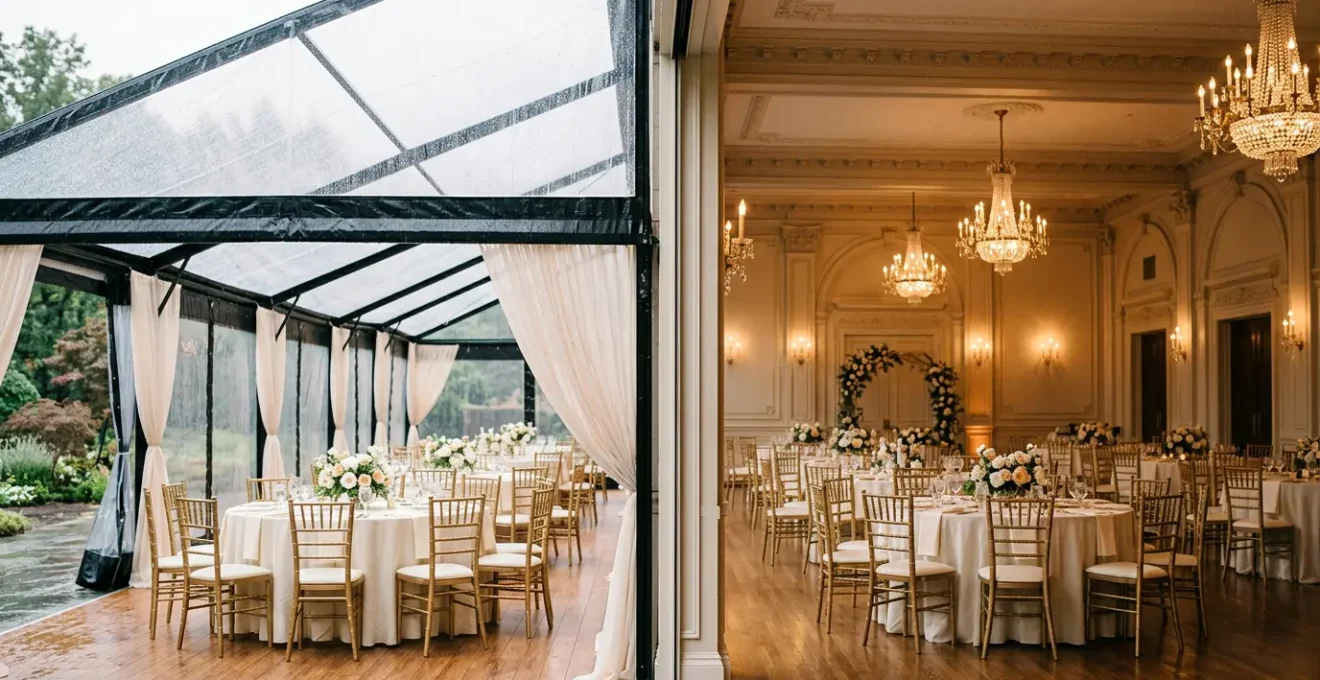
A tent is not a building; its safety in a storm is dictated by non-negotiable engineering specifications, not its aesthetic appeal.
- Non-engineered tents often require mandatory evacuation at sustained wind speeds as low as 36 mph, a common threshold in many storm systems.
- Permanent structures offer intrinsically superior thermal, acoustic, and moisture control, mitigating risks and hidden costs that plague temporary setups.
Recommendation: Prioritize venues with certified, permanent, or professionally engineered backup spaces over those relying on standard tent rentals to ensure guest safety and event integrity.
The specter of a storm on your wedding day is a common anxiety for any couple planning an outdoor ceremony or reception. The standard advice is to “have a Plan B,” which often materializes as a large, elegant tent. While visually appealing, this solution is frequently approached from a design perspective, focusing on drapery and lighting rather than structural integrity and climate control. This overlooks a critical reality: the choice between a temporary tent and a permanent ballroom is not merely aesthetic, but a significant engineering decision with direct implications for safety, comfort, and the overall success of your event.
Most wedding planning advice fails to address the fundamental physics at play. They don’t discuss the legal requirements of tenting in high winds, the science of thermal stratification in high-ceilinged rooms, or the phenomenon of condensation that can turn a beautiful tent into a dripping liability. The true measure of a backup plan is not how well it can be decorated, but how it performs under duress. Is the structure rated to withstand a sudden gust? Can the heating system manage a 30-degree temperature drop without creating pockets of frigid air? Will your guests remain dry, not just from rain, but from the structure itself?
This guide moves beyond the superficial and provides a technical framework for evaluating your bad-weather backup options. We will dissect the critical infrastructure considerations—from wind-load certifications and flooring safety to acoustic performance and lighting control—equipping you with the knowledge to ask venues the right questions and make a decision based on sound engineering principles, not just hopeful contingency planning.
To navigate these complex technical considerations, this article is structured to address the most critical safety and performance questions. The following sections will provide an in-depth analysis of each factor, empowering you to make a truly informed decision for your wedding day.
Summary: A Technical Comparison of Wedding Backup Venues
- Why Your “Plan B” Tent Might Be Illegal in High Winds?
- How to Hide Ugly Space Heaters in Your Backup Tent?
- Wood Floor vs. Carpet: Which Is Safer for a Wet Tent Interior?
- The “Weeping Tent” Phenomenon: Why Plastic Tents Drip in the Rain?
- How to Soundproof a Metal Barn During a Heavy Downpour?
- The Wind Rating Mistake That Can Collapse Your Reception
- The Heating Challenge of High Ceilings in Winter Weddings
- How to Transformation a Dull Venue Using Only Lighting Techniques?
Why Your “Plan B” Tent Might Be Illegal in High Winds?
The primary reason a standard “Plan B” tent may be illegal in high winds is that it is often a non-engineered structure lacking a formal wind-load certification. Local municipalities and fire marshals have specific codes governing temporary structures, especially those over a certain size (typically 400 square feet). These regulations are not suggestions; they are legal requirements designed to prevent catastrophic failure and ensure public safety. A tent erected without the proper permits or one that does not meet local wind-load requirements can be ordered to be taken down by authorities, even on the day of the event.
The critical distinction is between a “party tent” and a professionally “engineered” tent. Standard rental tents are not designed to withstand significant weather events. In fact, most industry safety guidelines recommend evacuating non-engineered tents at a 36 mph sustained wind speed. This is a crucial number, as many common thunderstorms can easily produce gusts exceeding this threshold. Relying on such a structure is not a plan; it is a gamble. A venue offering a tent as a backup must be able to provide engineer-stamped documentation certifying its wind rating. Without this proof, you are accepting a significant liability and the risk of a last-minute event cancellation or, worse, a dangerous structural failure.
Your Action Plan: Pre-Event Wind Rating Verification
- Request wind-load certifications and engineer-stamped structural documents from your tent supplier or venue.
- Verify whether your tent requires a permit based on its size and local municipal codes.
- Confirm the distinction between the ‘sustained wind’ rating and the ‘gust’ rating in your rental contract.
- Ask for specifics on the anchoring method: are they using deep-driven stakes (superior), water barrels (less effective), or concrete blocks?
- Establish a written evacuation protocol with defined wind-speed triggers and clearly assigned responsibilities.
How to Hide Ugly Space Heaters in Your Backup Tent?
Effectively managing temperature in a tent is a far greater challenge than in a permanent building due to poor insulation and high heat loss. The default solution is often to bring in portable space heaters, which are frequently industrial, unsightly, and can pose safety risks. The key to integrating heating is not just concealment, but strategic placement and management of airflow. A common mistake is simply adding more heat, which leads to hot and cold spots. As wedding venue heating specialists advise, “The solution isn’t just more heat, but strategic air circulation using silent, slow-moving ceiling fans to push warm air back down to guest level.” This principle, known as combating thermal stratification, is crucial for comfort.
To safely conceal heaters, they must be integrated into the decor while respecting mandatory safety clearances—typically a 3-foot radius free of flammable materials like linens or draping. Modern solutions include sleek heating towers that can be framed by non-flammable barriers or decorative screens. Fabric draping can be used to create “channels” in the ceiling that direct the eye away from equipment and guide airflow. The goal is to make the heating elements feel like a deliberate part of the design, rather than a last-minute addition.
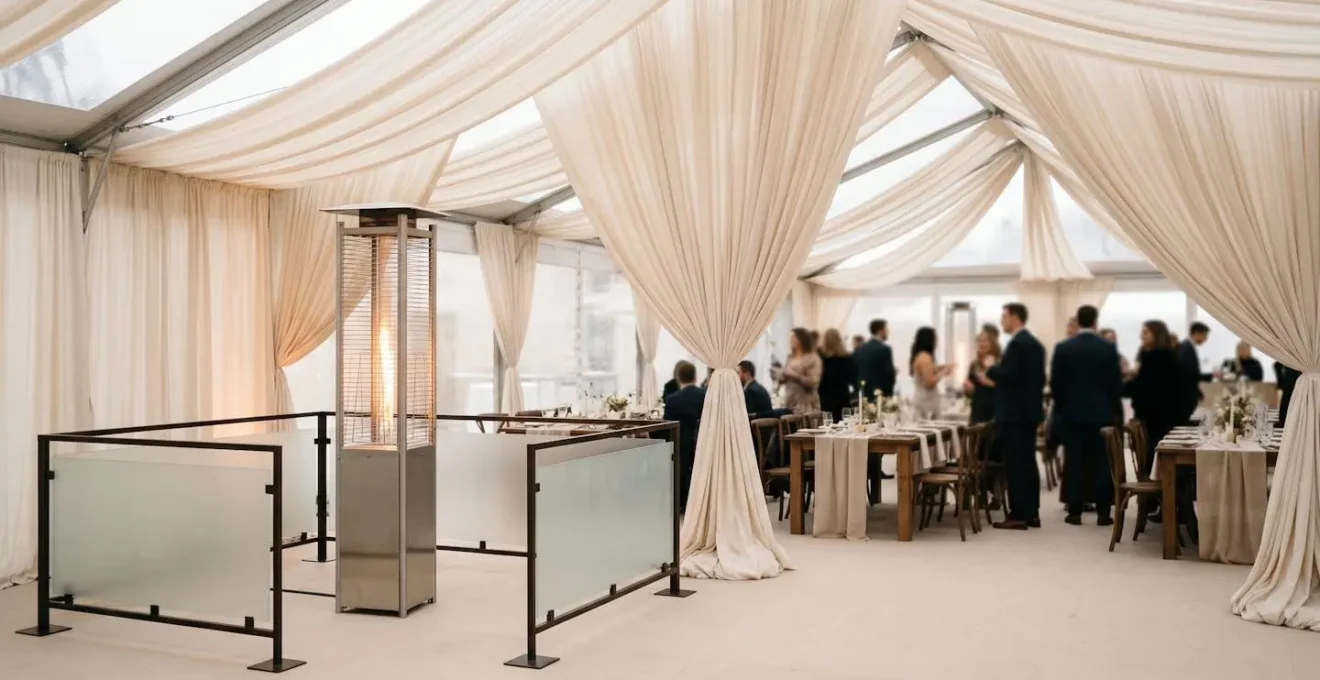
This image demonstrates how a contemporary heating tower can be positioned with proper clearance, using low, elegant barriers. The surrounding fabric draping creates visual flow, integrating the functional equipment into the sophisticated environment. This approach prioritizes both safety and aesthetic cohesion, turning a potential eyesore into a well-managed component of the overall design. Always confirm that any decorative solution has been approved by the rental company and meets fire code regulations.
Wood Floor vs. Carpet: Which Is Safer for a Wet Tent Interior?
When rain is a factor, the choice of flooring inside a tent becomes a critical safety decision, not an aesthetic one. Water doesn’t just come from leaks; it can be tracked in by guests, creating treacherous conditions. While carpet may seem like a cozy option, it is unequivocally the more dangerous choice in wet weather. Carpet absorbs and retains moisture, quickly becoming saturated. This leads to a soggy, unstable surface that can bunch up, creating significant trip hazards, and becomes extremely slippery. Furthermore, it provides no drainage, trapping water against the ground.
A raised wood or modular panel floor is structurally superior for wet conditions. By elevating guests off the ground, it allows water to pass underneath, keeping the walking surface dry. However, the surface material of the panels is critical. A smooth, varnished wood can become as slippery as ice when wet. The safest options are textured wood finishes or interlocking modular plastic tiles that have built-in traction and drainage channels. It is also vital to plan for a multi-stage entryway, creating an “airlock” with a series of coarse, water-absorbing mats to remove as much moisture as possible from shoes before guests step onto the main floor.
The following table, based on data from professional event suppliers, outlines the key differences in flooring performance under wet conditions. This data is critical for any couple weighing the costs and risks, as seen in an analysis of tent flooring options.
| Factor | Wood/Modular Panels | Carpet Overlay |
|---|---|---|
| Water Resistance | High – raised surface keeps guests dry | Low – absorbs water, creates soggy surface |
| Slip Risk When Wet | Moderate – textured surfaces needed | High – bunching and trip hazards when saturated |
| High Heel Safety | Risk of heels punching through subflooring | Softer surface but unstable when wet |
| Drainage Capability | Excellent with proper subflooring channels | None – retains moisture |
| Post-Event Damage Fees | Scratches, warping: variable | Water stains: often non-refundable deposit loss |
| Setup Requirement | Multi-stage entryway ‘airlock’ with coarse mats | Same + waterproof ground tarp underneath |
Case Study: Interlocking Plastic Tiles in a Rainy Outdoor Wedding
An outdoor tent wedding on a grass field experienced sustained light rain during setup and the initial reception hours. The event planners had specified interlocking plastic tile flooring with a professional subflooring system. The result was a completely dry and stable floor throughout the event. The modular system’s built-in drainage channels effectively allowed rainwater to pass underneath the primary surface, maintaining a firm and safe walking area. Guests in high heels reported no issues, and there were no slip-related incidents or costly post-event fees for carpet water damage.
The “Weeping Tent” Phenomenon: Why Plastic Tents Drip in the Rain?
One of the most unpleasant surprises in a “rain plan” tent is when it starts “raining” inside, even if the tent isn’t leaking. This phenomenon, known as the “weeping tent,” is caused by condensation. The physics are simple: a tent full of guests generates a significant amount of heat and humidity. The warm, moist air inside rises and hits the cold, impermeable vinyl or plastic surface of the tent roof, which has been cooled by the outside rain and air. When the warm air touches the cold surface, it rapidly cools, and the water vapor it holds condenses into liquid droplets on the ceiling, eventually dripping down on guests, decor, and expensive vendor equipment.
The amount of moisture generated is staggering. While it’s a camping metric, it’s illustrative to note that over a night, campers exhale upwards of one liter of moisture per person. In a wedding with 150 dancing guests, the collective output of breath and perspiration creates a micro-jungle environment. Without proper management, condensation is not a possibility; it is a certainty. A permanent ballroom, with its integrated HVAC system, insulation, and vapor barriers, is designed to handle this moisture load. A standard tent is not.
Preventing this requires a professional, multi-pronged approach that goes far beyond simply setting up a tent. These are industrial-level climate control tactics:
- Tent Liners: Installing fabric liners creates an air gap. This interior shield insulates the main tent, keeps the interior surface warmer, and catches any drips that do form, directing them away from the main space.
- Active Air Circulation: Strategic placement of vents at the top (to release hot, moist air) and bottom of the tent walls is essential. Fans should be used to circulate air, not just to cool people.
- Dehumidification: For multi-day installations or in extremely humid climates, commercial-grade dehumidifiers are often necessary to physically pull moisture from the air.
- Physical Barriers: It is critical to create a plan that places sensitive electronics (DJ equipment, lighting rigs) away from condensation-prone areas, like the edges of the tent.
How to Soundproof a Metal Barn During a Heavy Downpour?
A metal barn, while offering a desirable rustic aesthetic, presents a significant acoustic challenge during a rainstorm. The sound of heavy rain on a large, uninsulated metal roof is not a gentle pitter-patter; it is a deafening roar that can completely overpower conversation, music, and wedding vows. The issue is twofold: the impact noise of the raindrops and the high reverberation caused by the hard, reflective surfaces (metal walls, concrete floors) inside the barn. The space acts like a drum, amplifying the sound to uncomfortable levels.
This is a stark contrast to a purpose-built event space or a traditional wood-and-stone barn, where materials have different properties. As noted in an acoustic guide, in a well-constructed venue, “The stone walls and timber beams actually enhance voice projection.” In a metal barn, those same sound waves bounce uncontrollably. Effective soundproofing requires introducing soft, sound-absorbing materials to dampen the noise. This is achieved through a combination of techniques:
The most effective solution is the strategic installation of acoustic treatments. This doesn’t mean stapling blankets to the walls. Professional solutions involve hanging heavy fabric draping from the ceiling and along walls, or installing temporary, decor-friendly acoustic panels. These materials absorb sound energy rather than reflecting it, dramatically reducing both the impact noise from the rain and the echo within the space.

As shown, layers of elegant fabric can be artfully draped below the metal roof. This not only conceals the industrial ceiling but, more importantly, creates a large surface area of sound-absorbing material. This textural addition traps sound waves, preventing them from reverberating throughout the venue. The result is a space that remains intimate and allows for clear communication, even during a downpour.
The Wind Rating Mistake That Can Collapse Your Reception
The single most dangerous mistake a couple can make is assuming all tents are created equal. As established, a standard party tent offers minimal protection. However, a true “engineered” structure is a different class of equipment entirely. These are temporary buildings, not tents, designed and certified by engineers to withstand specific environmental forces. The key difference lies in the documentation: an engineered tent comes with stamped structural drawings and a certified wind load capacity. This is not a marketing claim; it is a legally binding specification.
While a standard tent may need to be evacuated at 36 mph, professionally engineered tents with stamped structural drawings can withstand 70-90+ mph with proper installation. The “proper installation” clause is critical. This involves a specific anchoring plan, often with stakes driven deep into the ground, and a tensioning system that maintains the structure’s rigidity. Simply renting an engineered tent is not enough; it must be installed precisely to its engineering specifications by a certified team. Asking a venue “Is the tent safe in the wind?” is the wrong question. The right question is: “Can you provide the engineer-stamped wind-load certification for the specific tent and anchoring plan you intend to use for my event?”
Furthermore, even with an engineered tent, a professional plan includes clear triggers for action. A “Tent Captain”—a designated individual with the absolute authority to order an evacuation—must be assigned. This person’s decision should be based on real-time data from weather apps with wind gust alerts, not a general forecast. A comprehensive protocol will include:
- A defined wind speed threshold for evacuation, even for an engineered tent.
- A clear chain of command (e.g., Fire Marshal > Venue Manager > Tent Captain).
- Mapped and communicated egress routes to a permanent backup structure.
- A pre-event walkthrough with all vendors to familiarize them with the evacuation plan.
Key Takeaways
- A tent’s safety is defined by its engineering certificate and wind rating, not its appearance.
- Permanent structures offer inherently better control over temperature, moisture, and acoustics than temporary tents.
- A true “Plan B” requires a detailed, pre-agreed protocol covering everything from wind-speed triggers for evacuation to flooring safety in wet conditions.
The Heating Challenge of High Ceilings in Winter Weddings
While a tent’s primary heating challenge is a lack of insulation, a grand ballroom or historic venue with high ceilings faces a different but equally significant problem: thermal stratification. This is the natural tendency for hot air to rise. In a room with 20-foot or 30-foot ceilings, a venue’s heating system can pump out enormous amounts of heat, only for it all to collect uselessly at the ceiling, leaving guests at floor level feeling cold and drafty. The thermostats may read a comfortable temperature, but the lived experience for your guests is entirely different.
This issue can also lead to unpleasant financial surprises. As one couple noted in a wedding forum, “Some venues with massive, hard-to-heat spaces pass on exorbitant heating/fuel costs as a separate line item’ that wasn’t disclosed until final invoice review.” The venue has to burn an incredible amount of fuel to try and overcome the physics of stratification, and that cost is often passed directly to the client. A well-managed venue will have systems in place to combat this, such as large, slow-moving ceiling fans (destratification fans) that gently push the warm air from the ceiling back down to the occupied space below.
Couples report being shocked by utility surcharge line items for winter events in high-ceiling venues. One bride noted: ‘Some venues with massive, hard-to-heat spaces pass on exorbitant heating/fuel costs as a separate line item’ that wasn’t disclosed until final invoice review.
– WeddingWire Forum Contributor, Outdoor Wedding Tent Back Up
Improperly managed heating in these spaces also poses a risk to other elements of your wedding. As heating specialists point out, the placement of vents is crucial. They warn, “A blast of dry heat aimed at the cake table can cause buttercream to melt or crack, while delicate florals can wilt prematurely.” When evaluating a high-ceilinged venue, asking to see the utility surcharge policy and inquiring about their specific methods for managing thermal stratification are essential due diligence steps.
How to Transformation a Dull Venue Using Only Lighting Techniques?
A common concern with choosing a permanent ballroom over a scenic outdoor location is that it might feel “dull” or “corporate.” However, from an infrastructure perspective, this “dullness” is actually its greatest strength: it is a controlled environment, a blank canvas. Unlike a tent or outdoor setting where you are constantly fighting environmental variables, a ballroom offers complete control over the single most transformative element of decor: lighting. Professional lighting can completely reshape a space, create mood, hide imperfections, and direct guests’ attention, turning a simple room into a breathtaking experience.
Transforming a space with light relies on a layered approach using several professional techniques. The goal is to create depth, texture, and ambiance, which has the side effect of producing stunning photographs because the environment is perfectly tailored for the camera. Understanding the terminology allows you to have a much more productive conversation with a lighting designer or AV-savvy DJ.
- Pin-spotting: Using a very narrow, focused beam of light to highlight a specific element, such as the floral centerpiece on each table or the wedding cake. This makes these items “pop” from the background and creates visual anchors.
- Gobos: These are metal or glass stencils placed inside a lighting fixture to project a pattern onto a surface like a wall or dance floor. This can range from a simple monogram to complex, elegant patterns like leaves or geometric shapes that add texture to the entire room.
- Color Washing / Uplighting: This involves placing lighting fixtures on the floor and aiming them up the walls, “washing” them in a specific color. This is the most effective way to change the entire mood of a room, for example, using a soft amber for dinner and shifting to a vibrant blue for dancing.
- Consistent Color Temperature: A key technical aspect for photography is ensuring all light sources (uplights, candles, pin-spots) are set to a similar color temperature. This prevents the “mixed lighting” problem that can confuse camera sensors and make photos look strange.
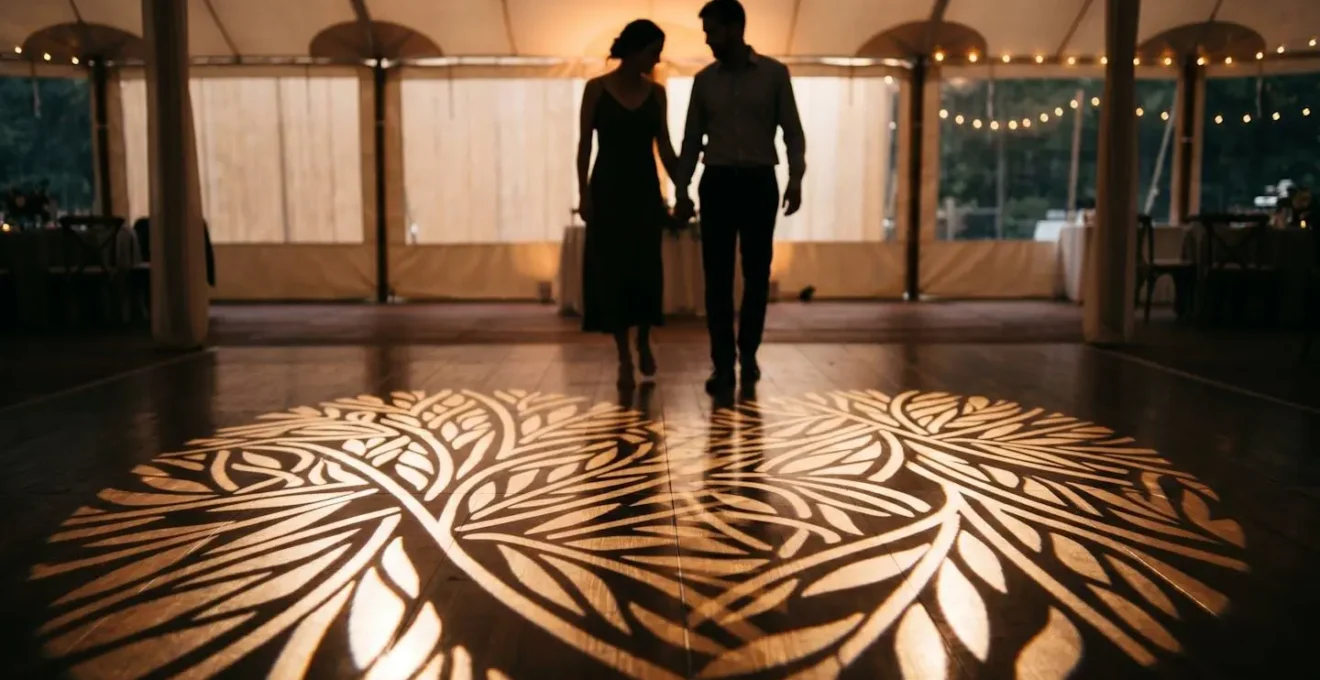
This image perfectly illustrates the power of a gobo. An otherwise plain dance floor is transformed into a captivating focal point with a projected pattern. This technique adds immense visual interest and sophistication without adding a single physical object to the room. It is a prime example of how the control offered by an indoor space allows for creative possibilities that are difficult, if not impossible, to achieve outdoors or in a standard tent.
Ultimately, the choice between a tent and a ballroom is a risk assessment. Armed with this technical knowledge, you can now move beyond aesthetic preferences and demand clear, verifiable answers from potential venues. Ask for the engineering documents, question the heating strategy, and insist on seeing a detailed rain plan that addresses flooring, condensation, and acoustics. A truly professional venue will welcome these questions as an opportunity to demonstrate their competence. Making a safe, informed decision is the most secure foundation you can build for your wedding day.