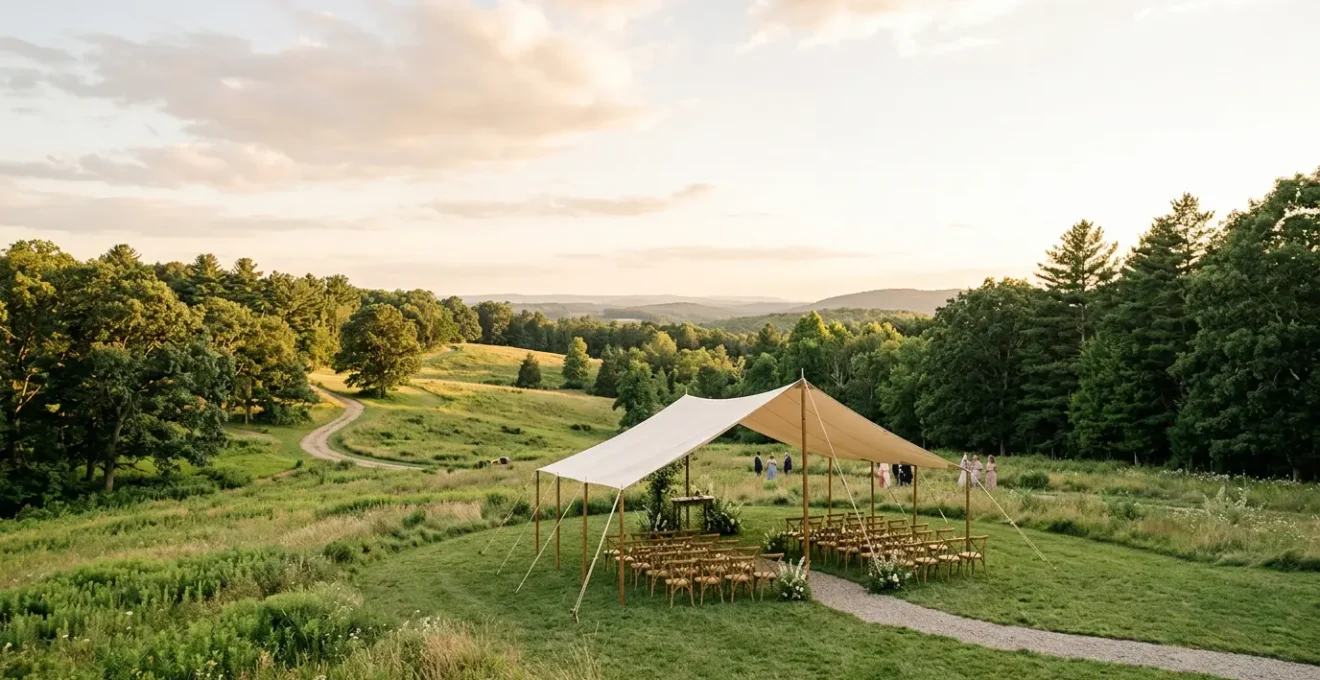
The choice between a pole and a frame tent is fundamentally a structural and logistical decision, not an aesthetic one.
- A pole tent’s stability is integral to the ground itself, requiring deep staking and making it suitable only for penetrable surfaces like grass.
- A frame tent is a self-supporting structure that can be placed on any surface and weighted, offering more flexibility but demanding a different approach to stability and cost.
Recommendation: First, analyze your land’s soil composition, accessibility, and wind exposure. This site survey, not a style preference, will dictate the only viable and safe tent structure for your wedding.
For couples planning a wedding on private land, selecting a tent often starts with a visual preference: the classic, sweeping peaks of a pole tent versus the modern, unobstructed interior of a frame tent. This focus on aesthetics, however, overlooks the most critical factor: the land itself. The decision is not merely about style; it is an engineering choice with profound implications for safety, logistics, and budget. The structural integrity of a pole tent is derived directly from its tensioned anchors in the ground, making soil quality non-negotiable. A frame tent, by contrast, is a freestanding system, offering surface versatility but introducing its own set of complexities regarding ballasting and infrastructure.
This guide moves beyond the surface-level debate of looks. We will deconstruct the choice from a specialist’s perspective, focusing on the physics of your venue. We will explore the non-obvious engineering challenges, from wind load ratings and climate control mechanics to the “invisible infrastructure” of power, flooring, and permits. The goal is to reframe your thinking away from “which tent looks better?” to “which structure is engineered to perform safely and effectively on my specific property?” By understanding the logistical sequencing and structural contingencies required for each, you can make an informed decision that ensures your wedding venue is not only beautiful but also fundamentally sound.
To help you navigate these critical structural decisions, this article breaks down the essential factors you must consider. We will cover everything from calculating the necessary space per guest to understanding the hidden costs and logistical timelines that define a successful tented event.
Summary: A Structural Comparison of Wedding Tent Options
- How Many Square Meters Per Guest Do You Really Need Under Canvas?
- The Wind Rating Mistake That Can Collapse Your Reception
- Why You Need to Start Tent Setup 3 Days Before the Wedding?
- AC Units or Open Walls: How to Cool a Tent in July?
- Flooring, Lighting, Power: The “Invisible” Costs of Marquee Weddings
- Tent or Ballroom: Which Indoor Backup Option Saves Your Photos in a Storm?
- Plan B Logic: How to Make a Rain Plan That Doesn’t Feel Like a Compromise?
- How to Style a Venue That Clashes with Your Color Palette?
How Many Square Meters Per Guest Do You Really Need Under Canvas?
Calculating the required tent size is the first step in logistical planning, and it extends beyond a simple headcount. The foundational rule is to allocate sufficient space for your primary function. For a seated dinner, industry guidelines recommend that 10 to 12 square feet per guest is the minimum. However, this figure only accounts for tables and chairs. A successful event space is not a monolith; it’s a collection of functional zones. Thinking in terms of “zoning” is crucial for a comfortable and dynamic guest experience.
For example, a wedding for 150 guests requires more than just the 1,800 square feet for dining. You must allocate dedicated, separate square footage for other key activities. A dance floor, a bar area, a station for the DJ or band, a lounge with soft seating, and gift or cake tables all demand their own footprint. As a case study for 150 guests shows, planners must factor in space not only for the furniture itself but for the critical pathways for servers and guests. This “circulation space” is what prevents bottlenecks and allows for a smooth flow throughout the event. Overlooking it leads to a cramped environment where guests feel confined and staff cannot operate efficiently.
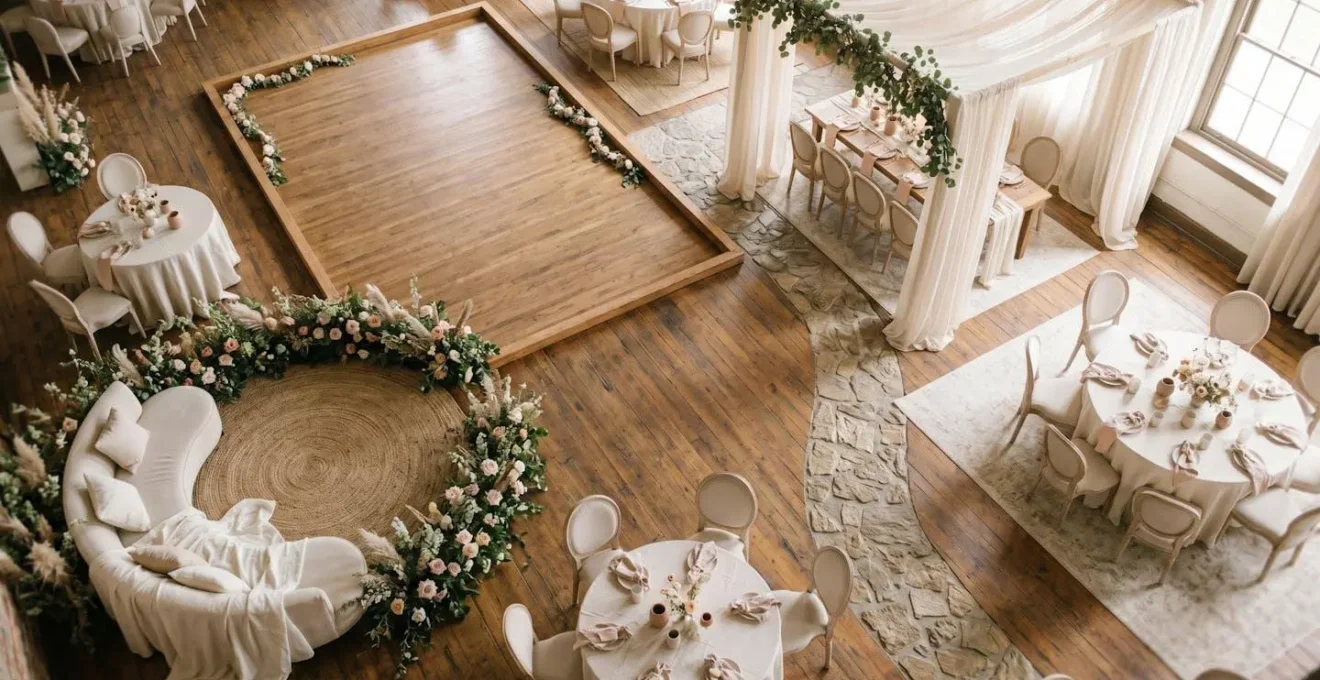
The layout must therefore be a strategic map of activity. The high-traffic areas, like the bar and dance floor, should be positioned to draw guests through the space without creating congestion. Quieter lounge zones can be set apart to offer a retreat. A pole tent’s center poles can even be used as natural dividers to help define these zones, while a frame tent’s clear-span interior offers a blank canvas for you to design your layout from scratch. Ultimately, the total square footage is a sum of these purpose-driven zones, not a simple multiplication of guests by a standard number.
The Wind Rating Mistake That Can Collapse Your Reception
A tent’s stability is not an abstract guarantee; it’s a calculated rating based on its engineering and, most importantly, its anchoring. Many couples assume any professionally installed tent is impervious to weather, but this is a dangerous misconception. The critical factor is the wind rating, which specifies the maximum wind speed a structure is designed to endure. While many professionally engineered tents are built to withstand 60 mph continuous winds with 80 mph gusts, this capacity is only achieved if the tent is anchored correctly according to manufacturer specifications.
This is where the distinction between tent types becomes a crucial matter of physics. A pole tent relies entirely on the load-bearing integrity of the soil. Its stability comes from the tension created by stakes driven deep into the ground. If the soil is loose, sandy, or overly saturated, the stakes can fail, and the tent’s wind rating becomes meaningless. A frame tent, on the other hand, is a self-supporting structure. It can be secured with stakes on grass or with heavy ballasts (like concrete blocks or water barrels) on surfaces like asphalt or patios where staking is impossible. While this offers versatility, the sheer weight required for proper ballasting is a significant logistical consideration. In either case, improper anchoring is the single biggest point of failure.
You are not just a client; you are the site manager. It is your responsibility to understand the safety limits and have a structural contingency plan. This involves a frank discussion with your rental company before signing any contract. You need to know their protocol for extreme weather and at what sustained wind speed an evacuation becomes mandatory.
Your Pre-Rental Wind Safety Audit
- Confirm the sustained wind speed threshold for evacuation (industry standard: evacuate at 35-38 mph sustained winds).
- Verify that the company follows proper staking and ballasting procedures for your specific site conditions; this is critical for the tent to meet its rated wind capacity.
- Establish a weather monitoring plan using reliable apps for real-time wind speed data on the day of the event.
- Create a clear evacuation plan to move guests to a designated indoor safe zone quickly if wind speeds approach the safety threshold.
- Request engineering documentation or product testing reports from the manufacturer to verify the tent’s certified wind rating.
Why You Need to Start Tent Setup 3 Days Before the Wedding?
The timeline for setting up a wedding tent is frequently underestimated. Couples often picture a single-day installation, but the reality is a multi-day process driven by complex logistical sequencing. Professional tent companies typically begin the core installation one to three days before the event. This initial phase involves far more than just raising the canvas; it includes site preparation, precise measurement, the physical erection of the frame or poles, and meticulous stabilization and anchoring. This process itself requires clear vehicle access directly to the setup location, a factor that must be planned for on private land.
However, the tent structure itself is only the first layer. The extended timeline is primarily necessary to accommodate the succession of other vendors who build out the interior. As one wedding planning guide notes, “If your wedding involves extensive décor or additional rentals, plan to have the tent set up four to five days in advance.” This is the core of logistical sequencing: once the tent shell is up, other specialist teams must come in a specific order. The flooring company might come next, followed by electricians to run power for lighting and sound, and then the HVAC technicians to install climate control.
Only after this “invisible infrastructure” is in place can the aesthetic vendors—florists, rental companies with tables and chairs, and décor specialists—begin their work. Attempting to compress this timeline creates a chaotic work environment where vendors are tripping over each other, risking damage and compromising the quality of the final result. A three-day-plus timeline provides the necessary buffer, allowing each team to work in a clear, safe space without time pressure. This ensures that every element, from the structural foundation to the final floral centerpiece, integrates seamlessly and correctly.
AC Units or Open Walls: How to Cool a Tent in July?
Managing the temperature inside a tent during a summer wedding is an exercise in environmental engineering, not just a matter of comfort. The most common mistake is underestimating the immense heat gain from sunlight on the canvas and the body heat of guests. Simply opening the walls may be sufficient in mild, breezy conditions, but in the heat and humidity of July, it’s often ineffective. For true cooling, mechanical air conditioning is required, and its needs are technical. The standard rule for cooling requirements dictates one ton of air conditioning for every 100 square feet of tent space.
This calculation immediately highlights the scale of the challenge. A 40’x80′ tent (3,200 sq ft) would require approximately 32 tons of AC capacity, a significant industrial load. This level of cooling cannot be achieved with small, portable units you might rent from a home improvement store. It demands large, trailer-mounted HVAC units that are diesel-powered and positioned outside the tent, with cool air ducted in. This introduces further logistical needs: vehicle access for the HVAC trailer and managing the generator’s noise, which must be placed far enough away not to disturb the event.
Furthermore, for any AC system to be effective, the tent must be a fully enclosed environment. This means all sidewalls, solid or clear, must be down to trap the cooled air. An “open-air” concept is fundamentally incompatible with mechanical air conditioning. The choice is therefore binary: a completely enclosed and climate-controlled space, or a passively ventilated one that relies on ambient temperature and airflow. Mixing the two strategies results in wasted energy and ineffective cooling.
To make an informed decision, it’s essential to compare the different strategies based on their effectiveness, power needs, and ideal use cases. This comparison highlights the trade-offs between cost, comfort, and the desired atmosphere for your event.
| Cooling Method | Effectiveness | Power Requirements | Best Use Case | Limitations |
|---|---|---|---|---|
| Portable AC Units | High (can lower temp 10-25°F) | Standard 115v outlet or diesel generator | Fully enclosed tents with sidewalls in humid climates | Requires complete tent enclosure; significant energy consumption |
| Trailer-Mounted HVAC | Very High (large capacity) | Diesel-powered (8-hour runtime average) | Large weddings 200+ guests in extreme heat | Requires vehicle access to site; noise considerations |
| Open Walls + Fans | Moderate (airflow only, no cooling) | Minimal (fan power only) | Mild temperatures with natural breeze; lower humidity | Does not lower temperature; ineffective in high humidity |
| Strategic Tent Positioning | Moderate (passive heat reduction) | None | Sites with natural shade, favorable wind direction | Site-dependent; limited control |
Flooring, Lighting, Power: The “Invisible” Costs of Marquee Weddings
The quoted price for the tent canvas and frame is merely the starting point. The true cost of creating a wedding venue from scratch on private land lies in the “invisible infrastructure”—the essential systems of flooring, power, and lighting that are typically included in a traditional venue but must be sourced and paid for separately in a tented setup. Flooring is arguably the most critical. It does more than provide a clean surface; it creates a level and safe foundation on uneven ground. A simple dance floor might suffice for some, but for a truly polished event on a lawn, a full sub-floor is often necessary to prevent tables from wobbling and heels from sinking into the grass, especially after rain.
Power is the next major hidden cost. A tent has no outlets. Lighting, sound systems, catering equipment, and HVAC units all require substantial electricity. This almost always necessitates renting a powerful diesel generator. The generator’s capacity, fuel consumption, and placement (far enough away to mitigate noise) are all critical logistical and budgetary considerations. Lighting itself goes beyond simple illumination; it creates the ambiance. String lights, uplighting, and chandeliers all require professional installation and add to the complexity and cost.
Finally, the most overlooked cost is regulatory compliance. Building a temporary structure is often a permitted activity. As experts from CELINA Tent Company point out, the legal requirements are strict:
In many jurisdictions, a permit is required for any temporary structure over 400 square feet. We provide flame-retardant certificates (NFPA 701 compliant) and engineering data to help you satisfy local fire marshal and building code requirements.
– CELINA Tent Company, Wedding Tents for Sale – Outdoor Pole & Frame Event Tents
Case Study: The Real Timeline of Tent Permitting
The permitting process for a large wedding tent is a formal procedure that cannot be rushed. For a smooth approval, event planners must initiate the application 2-3 months prior to the event date. This application must include detailed schematics of the tent’s size, its exact location on the property, the projected guest count, and specifications for all attached systems like lighting or climate control. Fire marshals have been known to decline requests submitted only 30-45 days before an event, as it leaves insufficient time for review and inspection. Attempting to expedite the process often results in significant rush fees and after-hours charges from the municipality, making early and diligent planning a non-negotiable part of budget management.
Tent or Ballroom: Which Indoor Backup Option Saves Your Photos in a Storm?
When bad weather forces your wedding indoors, the immediate concern is shelter. But for your photography, the nature of that shelter is paramount. The choice between a tent and a traditional ballroom as a rain plan has a dramatic and often overlooked impact on the final images. The key difference lies in the quality of light. A tent, even on the darkest, stormiest day, acts as a massive softbox. The white or translucent canvas diffuses the available ambient light, creating soft, flattering, and multi-directional illumination. This quality of light is forgiving and allows photographers to create beautiful, naturally-lit portraits without resorting to harsh, artificial flashes.
A ballroom, by contrast, presents a far more challenging lighting environment. Most are lit by a mixture of sources: chandeliers with warm tungsten bulbs, recessed ceiling lights, and whatever little natural light comes through windows, which may be tinted or obstructed. This creates what photographers call “mixed lighting,” a combination of different color temperatures and light qualities that can be unflattering and difficult to correct. The result is often a heavier reliance on on-camera or off-camera flash to overpower the ambient light, which can lead to a more “produced” and less organic look in the photos.
As one tent specialist firm explains, the distinction is fundamental: “The quality of light (natural light in a tent vs. often mixed/artificial light in a ballroom) dramatically impacts photography style and mood, even on a cloudy day.” Therefore, when evaluating your Plan B, consider it not just as a roof over your head, but as the photographic studio for the most important day of your life. A tent preserves a soft, romantic, and natural aesthetic in your photos, regardless of the weather outside. A ballroom may offer more amenities, but it forces a compromise on the one element that defines the look and feel of your visual memories: the light.
Key takeaways
- Structural Choice First: The land’s condition (soil, slope, access) dictates the tent type, not aesthetics.
- Plan for Infrastructure: A tent is an empty shell. Budget for flooring, power, HVAC, and permits as separate, essential costs.
- Safety is Non-Negotiable: Understand the wind rating and have a firm evacuation plan based on certified limits, not guesswork.
Plan B Logic: How to Make a Rain Plan That Doesn’t Feel Like a Compromise?
A successful rain plan for a tented wedding is not a last-minute scramble; it is a pre-designed structural contingency that feels just as intentional and beautiful as the original open-air vision. The goal is to create a Plan B that doesn’t feel like a compromise. This requires proactive planning with your tent vendor well in advance. The most crucial element is reserving sidewalls. Opting for completely clear vinyl sidewalls is an excellent strategy, as they provide full protection from wind and rain while maintaining the feeling of being outdoors and preserving the view.
The logic must extend beyond the main tent. What happens when guests need to move from the reception tent to the restroom trailers or from the ceremony space to the cocktail hour? Walking across a wet, muddy lawn is the fastest way to ruin the guest experience. The solution is to plan for covered walkways. This is typically achieved by renting smaller, narrow marquee-style frame tents (often 10 feet wide) to create sheltered corridors connecting all key event locations. This transforms a logistical problem into a design feature, creating a sense of a cohesive, multi-room venue.
Flooring becomes even more critical in a rain scenario. A simple patch of dance floor is insufficient. To prevent mud and ensure safety, you must account for additional flooring under the entire tent and the connecting walkways. For particularly uneven or flood-prone land, an elevated sub-flooring system is the only reliable solution. Finally, consider the acoustics. The sound of heavy rain on a tent roof can be deafening, making speeches and music inaudible. Discuss options like tent liners, which can help dampen the noise, or ensure your sound system budget includes speakers powerful enough to compensate. By designing these elements from the start, rain becomes a non-issue, an atmospheric backdrop to a flawless event rather than a catastrophic failure.
How to Style a Venue That Clashes with Your Color Palette?
One of the supreme advantages of a tented wedding, particularly with a frame tent, is that you are starting with a completely neutral canvas. Unlike a ballroom with its permanent carpets, drapes, and wall colors, a tent has no pre-existing aesthetic to fight against. This makes it the ideal solution when you have a specific color palette in mind that might clash with a traditional venue’s decor. The tent becomes a blank slate, allowing your design vision to be the primary focus without compromise.
The transformation is achieved through strategic layering of textiles, lighting, and florals. Fabric draping is the most powerful tool for altering the interior. Swags of fabric can soften the structural lines of a frame tent, hide the metal framework, and introduce color and texture. As tent experts note, the choice of material has a profound effect on the mood: “Light-colored materials brighten the space and emphasize openness, while darker shades can create a cozier, more intimate setting.” By draping the ceiling and walls, you are essentially building a new room inside the tent that perfectly matches your color scheme.

Lighting works in concert with fabric to complete the transformation. Uplighting can wash the draped walls in any color you choose, instantly setting the mood. The choice between a pole tent and a frame tent does have styling implications. The center poles of a pole tent are a dominant vertical element that must be incorporated into the design, often decorated with florals or fabric wraps. A frame tent’s unobstructed clear-span ceiling offers more versatility for hanging installations, such as elaborate floral chandeliers or complex lighting rigs, without any structural interference. Ultimately, the tent structure provides the freedom to impose your style, rather than adapt to someone else’s.
Choosing the right tent is the single most important structural decision you will make for your wedding. By approaching it as an engineering and logistical challenge first, you ensure a foundation of safety and functionality upon which you can build your perfect aesthetic vision. For personalized guidance and to analyze your specific land requirements, securing an expert site survey is the definitive next step.