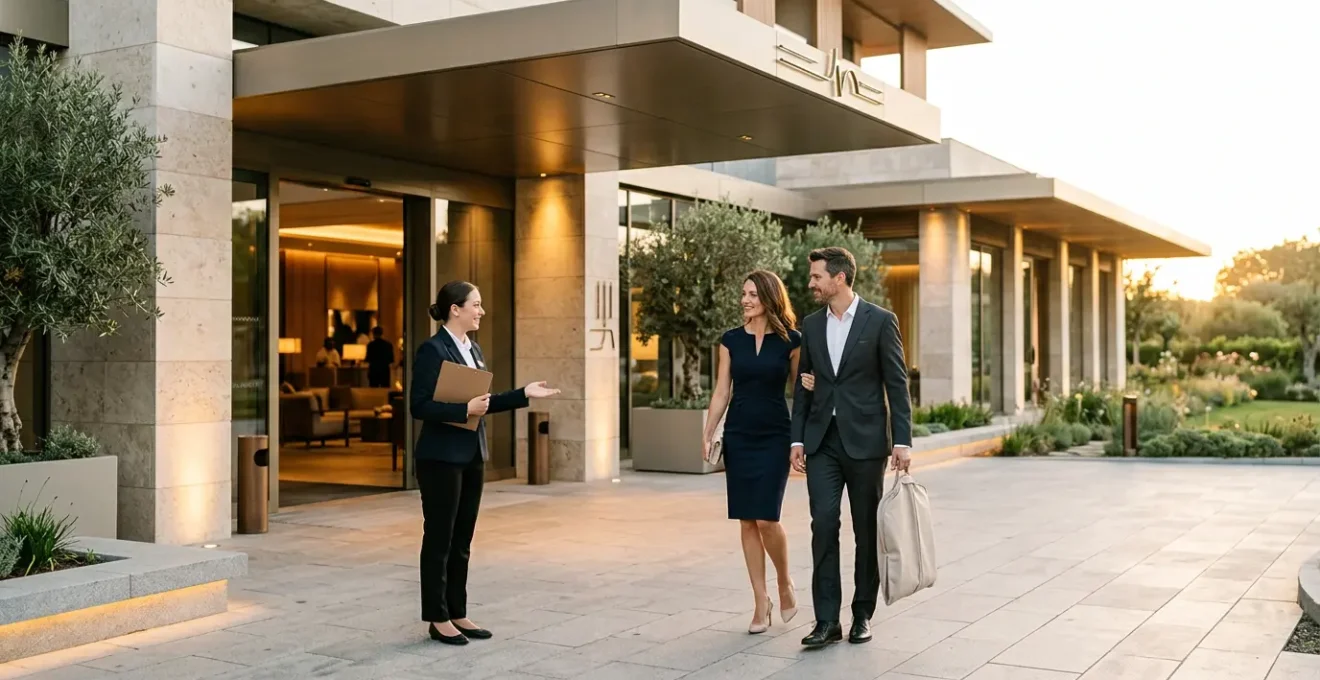
A chaotic guest arrival is not a hospitality failure; it’s an operational one caused by treating a large-scale logistical problem like a small welcome party.
- Early arrivals, luggage transport, and key distribution are the three primary friction points that must be managed with dedicated systems.
- Effective guest communication isn’t about one big speech, but about strategically paced information delivered across multiple channels.
Recommendation: Shift your focus from simple ‘welcome’ gestures to designing a robust, scalable guest flow management system with your venue director.
The moment arrives. After months of planning, a coach carrying half your wedding guests pulls up to the resort. Another follows twenty minutes later. Suddenly, one hundred people, tired from travel and laden with luggage, converge on a single front desk. The vision of a serene, welcoming start dissolves into a reality of queues, confusion, and mounting stress. This is the check-in bottleneck, and it’s the first major test of your wedding weekend’s success.
Many couples plan for welcome drinks or thoughtful welcome bags, believing these gestures are the key to a great first impression. While appreciated, these are hospitality tactics, not operational solutions. They don’t solve the fundamental problem of processing a large volume of people efficiently. The real friction points—guests arriving hours before check-in, a mountain of luggage needing delivery, and the slow-drip of room key distribution—are logistical challenges that can undermine the entire guest experience before it even begins.
But what if the solution wasn’t just to be a better host, but to think like an operations director? The true key to a seamless arrival is to stop viewing it as a single ‘welcome moment’ and start treating it as a meticulously planned logistical operation. It’s about designing a system—a predictable, scalable process that manages guest flow, eliminates friction, and ensures that every single guest feels personally and efficiently cared for, even when they are one of a hundred.
This guide will deconstruct the arrival process into its core operational components. We will move beyond generic advice and provide you with the systems and strategies to manage early arrivals, streamline refreshments, solve the room key dilemma, perfect your communication, and turn potential chaos into a flawlessly executed welcome.
To help you navigate this operational challenge, we’ve broken down the key systems you’ll need to implement. Explore the components of a truly seamless guest arrival in the sections below.
Summary: A Systems-Based Approach to Guest Arrival
- What to Do With Guests Who Arrive 4 Hours Before Check-In?
- Signature Drink or Cold Towel: What Guests Really Want After a Long Flight?
- Digital Keys vs. Cards: Which System fails Less for Large Groups?
- When to Give the “Weekend Itinerary” Speech so Guests Actually Listen?
- How to Pre-Tag Luggage to Speed Up Delivery to Rooms?
- How to Use the Hotel Lobby for Welcome Drinks Without It Feeling Public?
- Coordinating Boat Transfers: The Secret to a Seamless Guest Arrival
- How to Structure a 3-Day Wedding Weekend Without Exhausting Your Guests?
What to Do With Guests Who Arrive 4 Hours Before Check-In?
The most common friction point in any large group arrival is the “early bird” dilemma. Official check-in is at 3:00 PM, but guests, eager to start their holiday, begin arriving before noon. Leaving them to mill about the lobby, tired and encumbered with luggage, is a recipe for a poor first impression. The solution is not to simply ask the hotel to “try” for early check-in, which is rarely feasible for a large group. The professional solution is to establish a designated, comfortable, and functional holding area: the Hospitality Suite.
This isn’t just an empty conference room. A well-executed hospitality suite is a strategic asset. It acts as a transitional lounge, giving guests a comfortable ‘home base’ where they can relax, recharge, and securely store their belongings until their rooms are ready. It’s a system that absorbs the pressure of early arrivals and transforms a potential negative experience into a thoughtful, controlled welcome. By centralizing these guests, you also make it easier for hotel staff to manage their check-in process in efficient batches rather than a chaotic trickle.
Case Study: The Hospitality Suite Solution
To manage early arrivals for a destination wedding, a planner secured a hotel conference room to act as a dedicated Hospitality Suite. This space was equipped with comfortable seating, charging stations for electronics, and a self-serve refreshment bar. Upon arrival, guests were directed to the suite where they could safely leave their luggage, change into more comfortable attire, and grab a snack. It featured board games and a screen displaying the weekend’s itinerary, turning a frustrating wait into a relaxed, social prelude to the main events.
Action Plan: Auditing Your Guest Arrival System
- Points of Contact: List every single point where a guest interacts with the arrival process. This includes the airport transfer rep, the hotel doorman, the bell staff, the front desk, and the hospitality suite host.
- Resource Inventory: Collect all existing materials provided to guests upon arrival. This includes welcome letters, key card holders, itineraries, and maps. Are they consistent?
- Friction Point Analysis: Walk through the arrival path as a guest. Where are the potential delays? The luggage drop-off? The queue for the front desk? The elevator bank? Identify the top three bottlenecks.
- Information Coherence: Compare the information on the wedding website, the welcome letter, and any verbal instructions. Is the check-in time, welcome event location, and dress code identical across all platforms?
- Contingency Plan: What is the exact, pre-agreed plan if 50% of guests arrive and their rooms aren’t ready? Who communicates this, and what services are offered? Define the protocol.
Signature Drink or Cold Towel: What Guests Really Want After a Long Flight?
The debate between a signature cocktail and a chilled towel is a false choice. After a long journey, what guests truly want is immediate refreshment and a sense of being cared for. From an operational perspective, the question isn’t *what* to offer, but *how* to deliver it at scale without creating another bottleneck. Relying on a single bartender to mix 100 signature cocktails on demand is inefficient. The key is a self-serve, high-impact refreshment station.
This system prioritizes speed and accessibility while still feeling luxurious. Think beyond a simple water cooler. A well-designed station removes the need for staff interaction for the initial welcome, freeing them up to handle more complex tasks like check-in and luggage. It allows guests to serve themselves immediately upon arrival, satisfying their primary need for hydration and refreshment without delay. The goal is to provide an elegant, scalable solution that feels personal but functions systematically. The visual appeal of such a station sets an immediate tone of premium hospitality.

As the image demonstrates, the impact comes from the details: elegant dispensers, fresh ingredients, and readily available chilled towels. This setup offers two tiers of refreshment: basic hydration (infused water) and a moment of revitalization (the towels). It’s a system that caters to everyone simultaneously. It’s a perfect example of scalable hospitality, delivering a thoughtful touch that works for a group of 100 as seamlessly as it does for a group of 10.
Digital Keys vs. Cards: Which System fails Less for Large Groups?
The front desk is the most notorious bottleneck during a group check-in. The process of verifying identity, assigning a room, and encoding a physical key card for 100 guests is painfully slow. The promise of digital keys—delivered directly to a guest’s smartphone—seems like the ultimate solution. However, a hospitality director must plan for reality, not just potential. While guests rate hotels with digital keys higher for safety, real-world adoption and technical reliability are critical factors.
The reality is that a significant portion of guests still rely on traditional methods. In fact, an analysis of hotel guest behavior found that even when the option is available, only 30% of guests with the hotel app use digital keys, with the other 70% still opting for plastic cards. For a large wedding group with diverse ages and technical comfort levels, you must assume a similar or even lower adoption rate. Relying solely on a digital system invites failure when faced with dead phone batteries, poor connectivity, or user error.
The most robust system is a hybrid approach. The ideal scenario involves pre-registering all guests and having their physical key cards encoded and pre-packaged with their name and room number before arrival. These can be handed out at a dedicated welcome desk, bypassing the front desk entirely. The digital key then becomes a convenient backup or a ‘plus-one’ feature, not the mission-critical path.
The following comparison breaks down the operational realities of each system when dealing with a large, simultaneous arrival.
| Feature | Digital Keys | Physical Key Cards (RFID) |
|---|---|---|
| Distribution Method | Delivered to guest’s phone after digital check-in via app | Issued at front desk or self-service kiosk |
| Common Failure Point | Dead phone battery, WiFi/cellular congestion during simultaneous check-ins | Batch demagnetization (older magstripe), can be lost or left in room |
| Scalability for Large Groups | Excellent if infrastructure supports it; no physical inventory needed | Reliable but requires sufficient card stock and encoding equipment |
| Guest Convenience | No front desk stop required; bypass traditional check-in | Quick issuance; familiar to all age groups |
| Security Perception | Guests rate hotels with digital keys higher for safety | Secure when using encrypted RFID; less secure with older magstripe |
| Backup Plan | Physical cards must be available as fallback | Can be replaced instantly if lost; no phone dependency |
When to Give the “Weekend Itinerary” Speech so Guests Actually Listen?
The idea of gathering 100 travel-weary guests to deliver a “weekend itinerary” speech is an operational fantasy. By the time they arrive, guests are overwhelmed, tired, and have a low capacity for retaining detailed information. An operations director knows that relying on a single point of information delivery is a guaranteed failure. The key is not a speech, but a strategy of multi-channel information pacing.
You must assume that any single piece of communication will be missed by at least 30% of your guests. Therefore, the itinerary must be delivered repeatedly, in various formats, at strategic intervals. This redundancy is not annoying; it’s a service. It ensures everyone from your tech-savvy cousin to your great-aunt has easy access to the ‘what, where, and when’ at the moment they need it. This approach also dramatically reduces the number of questions directed at the couple, which, as wedding planner Jamie Chang of Mango Muse Events notes, is a significant benefit.
The easier you can make it on your guests to both plan and attend your wedding, the happier your guests will be. It also means that you’ll get fewer questions, which is a nice bonus.
– Jamie Chang, Mango Muse Events, Guest Communication Best Practices
An effective communication system anticipates guest needs and provides information proactively. The goal is to make the schedule feel intuitive and effortless. Here is a multi-channel strategy to ensure your itinerary is actually used:
- Pre-Arrival (Digital): A dedicated page on the wedding website and a final reminder email/text sent a week prior establishes the foundational knowledge.
- At Arrival (Physical): A beautifully printed, concise copy should be included in the welcome bag or placed prominently in the guest’s room. This is the primary reference tool.
- In-Event (Contextual): Printed programs for the ceremony or small cards for each event (e.g., a brunch menu with the time and location of the afternoon’s activity) provide just-in-time reminders.
- Human Redundancy: Designate a specific point of contact—a planner or a trusted friend, never the couple—to handle questions. This “information concierge” is the final, crucial layer of the system.
How to Pre-Tag Luggage to Speed Up Delivery to Rooms?
After check-in, the second major delay is often luggage delivery. A bell desk faced with 150 unsorted bags for 100 guests is an efficiency nightmare. The staff must individually check the name on each tag and cross-reference it with a room number, a process that can take hours. The operational solution is to create a visual sorting system before the luggage even enters the hotel: a pre-tagged, color-coded luggage system.
This system shifts the work of identification from the hotel staff to a pre-planned organizational structure. By sending guests custom luggage tags with their welcome information, you achieve several goals. First, it ensures all bags are clearly marked. Second, by incorporating a simple color-code or symbol into the tag design (e.g., blue for guests on the 3rd floor, green for the 4th; or a different icon for each wing of the resort), you provide the bell staff with an at-a-glance sorting mechanism.

Instead of reading names, staff can immediately group bags by color or symbol, corresponding to specific floors or zones. This visual shortcut dramatically accelerates the sorting process. A cart of “blue” bags can be taken directly to the third floor, where staff can then handle the final room-by-room distribution. This seemingly small detail—a colored ribbon or an embossed icon—transforms a chaotic pile of luggage into an organized, manageable inventory, cutting down delivery time and improving guest satisfaction.
How to Use the Hotel Lobby for Welcome Drinks Without It Feeling Public?
Hosting your welcome reception in a semi-public space like a hotel lobby presents a unique challenge: how to create a sense of exclusivity and intimacy for your guests amidst the normal flow of hotel traffic. The goal is to make your event feel like a private enclave, not an afterthought in a busy thoroughfare. This is achieved through “soft privatization”—using subtle cues to define your event space without building physical walls.
The key is to create a distinct sensory bubble. This involves layering visual, auditory, and even olfactory elements to signal to your guests (and others) where your private event begins and ends. Instead of harsh velvet ropes, use elegant stanchions with lush floral arrangements. Rather than relying on the hotel’s generic background music, use a dedicated sound system with a curated playlist or a live acoustic musician. These elements work together to create a defined, immersive atmosphere that feels separate and special.
Here are several professional techniques for achieving effective soft privatization:
- Visual Barriers: Use elegant stanchions with floral arrangements or tall, potted plants to create a visual perimeter. This is more welcoming than a simple rope line.
- Lighting Definition: Employ focused, warm uplighting on your designated area. This makes your space feel intimate and causes the rest of the lobby to visually recede.
- Acoustic Separation: A dedicated, high-quality portable sound system with a curated playlist or a live musician creates a “sound bubble” that overpowers the ambient noise of the lobby.
- Staff Branding: Have your dedicated bartenders and servers wear a unifying element—a custom lapel pin, a specific color tie, or a boutonnière matching the wedding flowers—to visually identify them as part of your event.
- Scent Branding: Use subtle diffusers with a unique, pleasant scent only within your designated welcome area to create a memorable, subconscious boundary.
Coordinating Boat Transfers: The Secret to a Seamless Guest Arrival
For waterfront venues, arrival by boat is the pinnacle of dramatic and memorable entrances. However, this unique experience comes with a unique set of logistical challenges. Unlike a bus, a boat has a fixed capacity, is subject to weather, and requires precise coordination between the dock, the captain, and your guest list. The secret to a seamless boat transfer is not just booking the charter, but managing the guest manifest and communication flow with military precision.
The process begins long before guests step aboard. You need a confirmed list of all guests requiring transfer, assigned to specific, timed departures. This avoids the chaos of 100 people showing up for a 50-person boat. Each boat should have a designated host—a planner or a trusted friend—armed with a manifest (a simple checklist of names). This person’s role is critical: they are the point of contact, the timekeeper, and the communication link back to the venue.
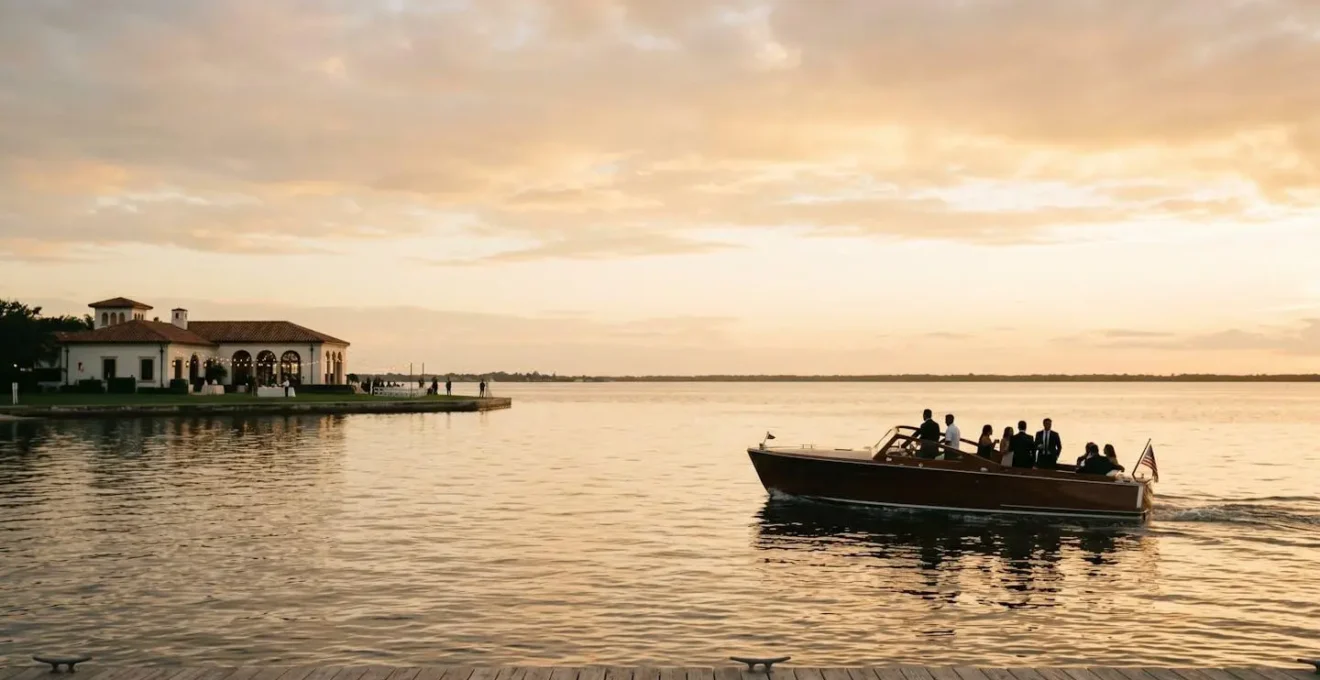
Buffer time is your most valuable asset. The schedule must account for guests running late, unexpected water traffic, and disembarking time. As the boat approaches the venue, the host should communicate the exact arrival time and guest count to the ground team. This allows the welcome party to be in position, ready with drinks or towels, creating a flawless transition from journey to celebration. Without this system of manifests, hosts, and communication, the grand arrival can quickly descend into a disorganized and stressful wait on a hot dock.
Key takeaways
- Guest arrival is a logistical operation, not just a welcome moment; success depends on systems, not just smiles.
- Eliminate friction by creating dedicated solutions for the three main bottlenecks: early arrivals, key distribution, and luggage transport.
- Effective communication is not a single speech but a multi-channel, paced strategy that delivers information where and when guests need it.
How to Structure a 3-Day Wedding Weekend Without Exhausting Your Guests?
A three-day wedding weekend is an incredible opportunity for connection, but it’s also a marathon. The single biggest threat to its success is not a limited budget but guest exhaustion and confusion, often stemming from poor planning. In fact, an analysis by wedding logistics experts found that communication failures and logistical missteps cause more problems than any other factor. The solution is to structure the weekend like a three-act play: arrival, climax, and departure, with a clear focus on pacing and guest autonomy.
This “Three-Act Structure” provides a narrative arc for the weekend that manages energy levels and expectations. By intentionally building in downtime and clearly labeling optional activities, you give guests permission to relax and enjoy the destination on their own terms. This prevents the dreaded “hostage situation” where guests feel obligated to attend every single scheduled event, leading to fatigue before the main event even begins. An exhausted guest is not a happy guest.
A well-paced itinerary is the foundation of a successful wedding weekend. Consider this framework:
- Act 1 (Arrival Day): Low-Key Connection. The focus should be on easing guests into the weekend. Schedule a casual, flexible welcome event (like a drop-in cocktail hour) that doesn’t have a strict start time. Avoid formal, late-night plans.
- Act 2 (Wedding Day): The Climax. This is the high-energy centerpiece. The schedule will be tight, but providing a clear timeline of events (ceremony, cocktails, dinner, dancing) helps guests manage their own energy.
- Act 3 (Departure Day): Gentle Decompression. A relaxed farewell brunch is perfect. It should have a generous time window (e.g., 9 AM – 12 PM) to accommodate different travel schedules and should not feel like another mandatory, high-energy event.
- Built-in Downtime: The most crucial element. Schedule large, free blocks of time, especially on the day before the wedding. This allows guests to explore, use resort amenities, or simply rest, ensuring they are refreshed and excited for the ceremony.
By shifting your perspective from host to operations director, you can design an arrival experience that is not only welcoming but impressively efficient. The true measure of success is when your guests’ first impression is one of effortless elegance—a seamless transition from their journey to your celebration. Begin the conversation with your venue and planner now to implement these systems for a flawless wedding weekend.