
Effective guest transport is a logistics operation, not an amenity, and it is crucial for protecting your wedding day timeline from catastrophic failure.
- Vehicle choice (a single bus vs. multiple vans) is a decision based on route constraints and risk, not just guest capacity.
- Accurate timing requires factoring in “hidden” variables like buffer time, staggered boarding, and traffic, not just the estimated drive time.
Recommendation: Treat your shuttle plan like a military operation: get a firm operational headcount via your RSVPs, build in explicit time buffers, and assign a dedicated point person to manage execution.
The most meticulously planned wedding timeline has a single, catastrophic point of failure: guest movement. You can schedule the ceremony to the second and coordinate vendor arrivals with military precision, but if 50 guests are stuck in traffic, delayed by a single wrong turn, or simply missed the bus, the entire day’s schedule collapses. This isn’t just an inconvenience; it’s a cascade failure that can delay your reception, stress your guests, and cost you money.
While many couples focus on the aesthetics of transportation, the real task is operational. It’s a matter of logistics, not just luxury. The core mission is to move a large group of people from Point A to Point B, on time and without losses. This requires a shift in mindset—from that of a couple planning a party to that of a transport logistics manager obsessed with the schedule. The difference is treating transportation as a critical dependency, not a fun extra.
This guide abandons the platitudes of “booking in advance” and dives into the operational mechanics of guest transportation. We will dissect the common points of failure, from vehicle selection and timing calculations to communication protocols and arrival bottlenecks. This is the playbook for executing a flawless transport operation, ensuring your timeline’s integrity and getting every guest where they need to be, exactly when they need to be there.
This article breaks down the essential logistical considerations for a seamless wedding day. The following summary outlines the key operational challenges we will tackle to ensure your guest transportation runs with absolute precision.
Summary: The Logistics Manager’s Playbook for Flawless Wedding Transportation
- One Large Bus or Three Vans: Which Navigate Narrow European Streets Better?
- The “Round Trip” Calculation Mistake That Delays Receptions by 45 Minutes
- How to Communicate Shuttle Departure Times So Drunk Guests Don’t Miss the Bus?
- Why You Pay for the Bus While It Sits Empty During Dinner?
- Water and Playlists: How to Keep the Party Alive on the Shuttle?
- The Transport Error That Strands Guests at Remote Excursion Sites
- Uber Codes vs. Shuttle Bus: Which Works Better in Heavy Traffic?
- The Check-In Bottleneck: How to Streamline Guest Arrival at Your Venue?
One Large Bus or Three Vans: Which Navigate Narrow European Streets Better?
The first decision in your transport operation—vehicle selection—is often the first point of failure. Choosing a 56-passenger coach for its capacity seems logical, but if your venue is located down a historic, winding lane, that bus may not even be able to make the final turn. This isn’t a minor inconvenience; it’s a complete mission failure. The vehicle must be matched to the most restrictive point on its route, not just the number of passengers.
A logistics manager assesses the entire route, from the hotel pickup to the venue drop-off. Are there low-clearance bridges, tight corners, or streets where large vehicles are prohibited? A series of smaller 12-passenger vans might seem less efficient, but their maneuverability can guarantee arrival where a single large bus would be blocked miles away. As wedding planner Michelle Norwood points out regarding a city known for its challenging streets:
For example, in New Orleans, the streets are quite tight and larger buses can’t make certain turns.
– Michelle Norwood, The Knot – Wedding Transportation Guide
This decision is about risk mitigation. A single large bus introduces a single, high-stakes point of failure. Multiple smaller vehicles distribute that risk. If one van is delayed in traffic, the others can still proceed. Before you book, demand that the transportation company confirm that your chosen vehicle class has successfully navigated the exact route to your venue before. Do not accept a “it should be fine.” Verify it.
The “Round Trip” Calculation Mistake That Delays Receptions by 45 Minutes
The most common logistical error is underestimating time. A couple sees a “20-minute drive” on a map and budgets 20 minutes for transport. This is a fatal miscalculation that ignores the hidden time sinks of group travel. A 20-minute drive is only one component of a “trip leg” that realistically takes 45 minutes or more. Forgetting this buffer is how timelines begin to unravel, leading to a cascade failure that pushes back everything from cocktail hour to dinner service.
A transport operation must account for every variable. Boarding 50 guests onto a bus is not instantaneous; it can take 10-15 minutes as people find seats, store items, and wait for the last person. De-boarding is a similar process. If the shuttle needs to make two trips, you must calculate the full round-trip time: Drive to Venue (20 min) + De-board (10 min) + Return Trip (20 min) + Driver Buffer/Turnaround (5 min) = 55 minutes, not 20. This is before any traffic is even considered.
Professional planners bake in buffers to protect the schedule’s integrity. As a rule, you must add 10 to 15 minutes of buffer between major moments so a single delay doesn’t trigger a chain reaction. This buffer isn’t “wasted time”; it’s a crucial control measure. When building your schedule, calculate each transportation leg not just by drive time, but by total operational time: boarding, transit, de-boarding, and a mandatory contingency buffer. This is the only way to protect your reception’s start time.
How to Communicate Shuttle Departure Times So Drunk Guests Don’t Miss the Bus?
Information is a critical asset in any operation. For wedding transport, clear and redundant communication is the only defense against chaos, particularly as the night wears on. Simply listing a shuttle time on a wedding website is insufficient. This is passive communication, and it will fail. Your strategy must be active, persistent, and account for distracted or celebrating guests.
The first step is securing an operational headcount. Your transportation company needs an accurate number not just for vehicle choice, but for execution. As planners strongly recommend, ask guests to RSVP for transportation specifically on the reply card. This eliminates game-day decisions and provides a manifest. This list is not just a number; it’s a checklist for your designated transport coordinator. They will know exactly who to expect and who they need to wait for.
Your communication plan should have multiple layers:
- Pre-Event Briefing: Include clear, bolded departure times and locations on the wedding website and in a final “know before you go” email to guests.
- Physical Signage: Place clear, large signs in the hotel lobby and at the reception venue exit indicating “Final Shuttle Departure: 10:15 PM SHARP.”
- Verbal Announcements: Have the DJ or band announce the first and final shuttle departures 15 minutes and 5 minutes beforehand. Example: “For guests taking the shuttle, the final bus will depart in 15 minutes from the main entrance.”
- Designated Point Person: Your transport coordinator’s job is to herd the cats, actively gathering guests and communicating with the driver.
This isn’t about nagging; it’s about providing clear, unmissable signals to ensure no one is left behind. This system of redundant communication is your best tool to manage the human element of your logistics plan.
Why You Pay for the Bus While It Sits Empty During Dinner?
When you receive a quote for a wedding shuttle, it’s easy to focus on the hours the bus is physically moving guests. A common point of confusion is the cost associated with the “downtime”—the hours the bus sits empty during your ceremony and reception. This is not padding the bill; it’s the fundamental model of charter services. You are not buying a “ride”; you are chartering an asset (the vehicle and its licensed driver) for a continuous block of time.
This model guarantees availability and protects your timeline. When you charter a bus from 3 PM to 11 PM, that bus and driver are exclusively dedicated to your event. The driver cannot take another job. The bus cannot be dispatched to another location. This exclusivity is what you are paying for. According to industry standards, most wedding transportation rentals last for approximately 10 hours, covering the full scope of the event from initial pickups to final drop-offs. Trying to split the service—for example, sending the bus away and having it return five hours later—is often more expensive and logistically catastrophic. A “split-charter” introduces massive risk: the driver may hit traffic on their return, be delayed by a previous job, or be unavailable entirely, leaving your guests stranded.
Paying for the continuous block ensures the driver is rested and the vehicle is on-site, ready for immediate departure for an early exit or the scheduled end-of-night runs. It’s the difference between a reliable, controlled service and a high-risk gamble. The table below outlines why this fixed, predictable model is operationally superior to on-demand services for a large group event.
| Factor | Charter Bus | Rideshare Services |
|---|---|---|
| Pricing Model | Fixed pricing based on vehicle size, distance, and service duration | Fluctuates based on demand, time of day, and availability |
| Cost Predictability | Allows planners to budget accurately | Can lead to unexpected cost increases during peak travel periods or major events |
| Group Experience | Unified transportation experience; all guests travel together | Guests separated into different vehicles with varying experiences |
| Reliability | Controlled travel process with pre-planned itinerary | Staggered arrivals, missed moments, coordination challenges |
| Professional Standards | Vetted, commercially licensed, and insured driver | Non-vetted drivers, liability concerns |
Water and Playlists: How to Keep the Party Alive on the Shuttle?
From a purely operational perspective, the time guests spend on a shuttle is a transitional phase that must be managed. While often viewed as a chance for “fun extras,” amenities like water and music serve a critical logistical purpose: passenger condition management. A comfortable, hydrated, and entertained guest is a compliant guest. A hot, thirsty, or bored guest is more likely to become impatient or problematic, especially during an unexpected delay.
Providing bottled water is not just a hospitable gesture; it is a fundamental control measure. It ensures guests stay hydrated, which is especially important after an outdoor ceremony or on a warm day. It can also help pace alcohol consumption and mitigate issues of over-intoxication, which is a direct threat to a smooth and timely operation. A well-curated playlist serves a similar function. It’s not about creating a nightclub on wheels, but about managing the atmosphere. Upbeat music can maintain the celebratory energy from the ceremony to the reception. During a traffic jam, a familiar, fun playlist can distract from the delay and prevent passenger morale from deteriorating.
This phase of the transport mission is about maintaining control over the environment to ensure a smooth transition. The goal is to deliver guests to the reception in a positive state, ready to continue the celebration, not in a state of frustration or discomfort. A well-managed shuttle experience contributes directly to the success of the next event on the timeline.

As the image illustrates, a comfortable and positive environment during transit is a key component of the overall guest experience. Small considerations create a seamless journey and maintain the celebratory mood, ensuring the party doesn’t stop between venues. These details are not trivial; they are integral to a successful transport operation.
The Transport Error That Strands Guests at Remote Excursion Sites
Transporting guests to a secondary location, such as a scenic spot for photos or a pre-wedding excursion, introduces a significantly higher level of risk. Unlike a simple A-to-B transfer between a hotel and venue, a remote site often has limited access, poor cell service, and no alternative transport options. A mistake here doesn’t just cause a delay; it can result in literally stranding your guests. Executing this type of movement requires a dedicated contingency protocol.
The primary point of failure at a remote location is a breakdown in coordination between the group and the driver. The driver may be parked out of sight, cell service could be non-existent for last-minute updates, and a single guest wandering off can hold up the entire group. The potential for mission failure is high, and the consequences are severe. Therefore, you must have a clear, pre-defined plan for managing this specific risk.
This plan cannot be left to chance. It must be a formal process, understood by the driver, the guests, and a designated point person who is responsible for its execution. This is not a job for the couple on their wedding day. It must be delegated to a reliable individual with a clear mandate. The following checklist outlines the minimum viable contingency plan for any remote site transport.
Your Action Plan: Remote Site Transportation Protocol
- Designate a Transport Lead: Assign a reliable wedding planner, coordinator, or guest (not in the wedding party) as the sole point of contact. This person is responsible for liaising with the driver and executing the departure plan.
- Conduct a Headcount: The transport lead must conduct a physical headcount against the passenger manifest before signaling the driver to depart. No exceptions.
- Provide a Driver’s Info Pack: Give the driver a physical envelope containing your transport lead’s cell number, the exact pickup point marked on a map (with a photo), and the non-negotiable departure time. Do not rely on verbal instructions.
- Communicate the Hard Departure: Clearly inform all guests that the shuttle will depart at a specific “hard time,” with or without everyone on board. This creates urgency and accountability.
- Build in Contingency Time: Add a 15-minute buffer to the remote site schedule for unexpected delays like photo overruns or stragglers. This buffer is your primary tool to keep the overall wedding timeline intact.
Uber Codes vs. Shuttle Bus: Which Works Better in Heavy Traffic?
In the choice between a dedicated shuttle bus and providing rideshare codes (like Uber or Lyft), the primary deciding factor for a logistics manager is control. While rideshare codes offer flexibility, they introduce an unacceptable level of unpredictability and risk into a time-sensitive event. A shuttle bus provides a controlled system; rideshare creates dozens of independent, uncontrolled variables. In heavy traffic, this difference becomes critical.
A professional charter bus driver has experience navigating congested routes and may have access to bus lanes or knowledge of alternative routes that individual rideshare drivers do not. More importantly, a single bus is one entity to track. A hundred guests ordering 50 different Ubers creates 50 potential points of failure. Some guests will get cars immediately. Others will face surge pricing or long waits. The result is a staggered, chaotic arrival at the reception, completely destroying your timeline.
Case Study: The Financial & Logistical Cost of Rideshare
An analysis of corporate transport options highlights the disparity. One company needing to move 40 people 20 miles found that rideshare costs would be $1,000-$1,400 for a single one-way trip, and that was before accounting for event-based surge pricing. The same trip via a charter bus cost between $400 and $700. Financially, the bus was twice as efficient. Logistically, it was infinitely more reliable, ensuring all 40 employees arrived at the same time, as a single, manageable unit.
The visual of a charter bus moving steadily in a dedicated lane while individual cars are stuck in a gridlock is a powerful metaphor for this choice. The bus represents a planned, efficient system. The individual cars represent chaos.
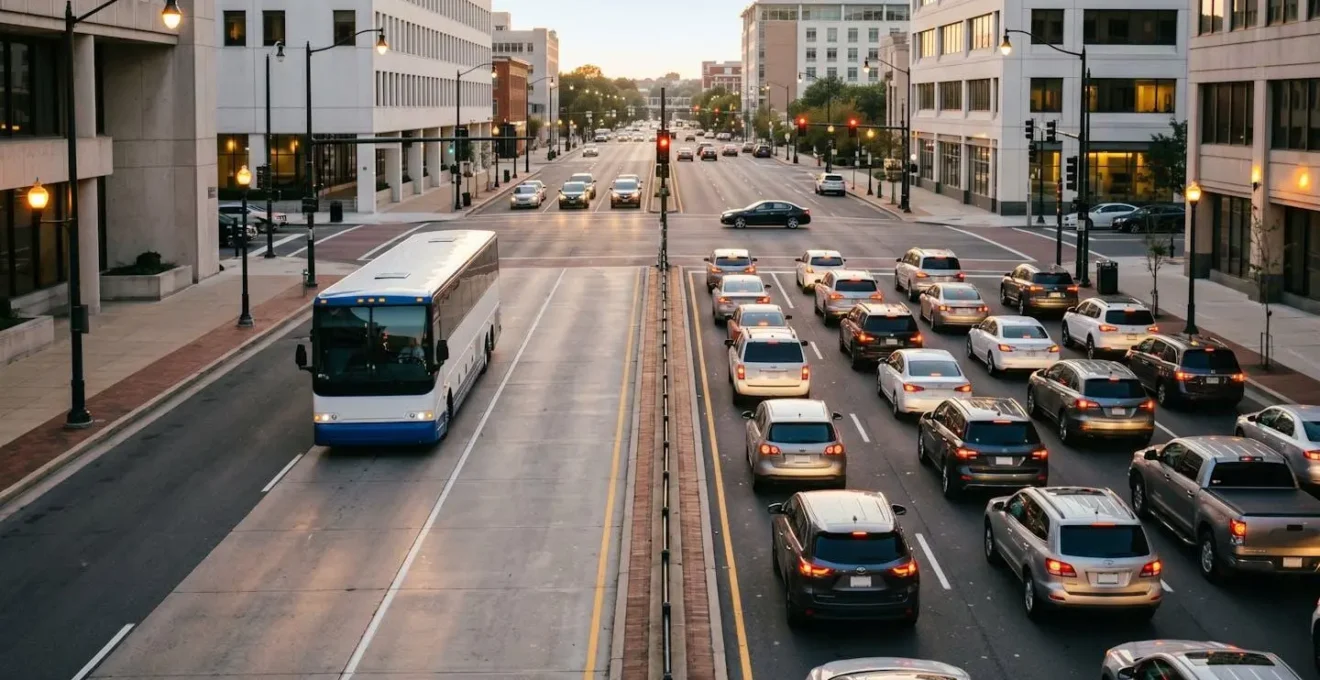
For a large group, the perceived convenience of rideshare is an illusion. It offloads the logistical burden from the planner to each individual guest, which guarantees failure. For an event where timely group arrival is a mission-critical objective, the centralized command and control of a charter shuttle is the only viable operational choice.
Key Takeaways
- Time is the critical resource: Your schedule’s integrity depends on building explicit buffers into every leg of the journey, accounting for boarding, transit, and de-boarding.
- Information is control: Secure a reliable headcount via transportation-specific RSVPs and use redundant communication channels to broadcast departure times.
- Control equals reliability: A chartered shuttle provides a predictable, manageable system with fixed costs, professional drivers, and unified movement, mitigating the chaos of on-demand services.
The Check-In Bottleneck: How to Streamline Guest Arrival at Your Venue?
The final, often overlooked, point of failure in a transport operation is the arrival itself. Successfully transporting 100 guests on time is a victory, but if they all arrive at the venue door at the exact same moment, you have simply replaced a travel problem with a new one: the check-in bottleneck. This can overwhelm the venue staff, create a long, frustrating queue for guests, and delay the start of the cocktail hour, undoing all the precise scheduling that came before.
The transition from transport to event is a distinct logistical phase. As wedding timeline experts note, even a simple movement of guests from the cocktail hour to the reception room takes 8 to 10 minutes. A full de-boarding and venue entry process is significantly more complex. To manage this, the arrival must be as carefully orchestrated as the departure. The goal is to create a smooth, steady flow of guests into the venue, not a single, massive wave.
If you are using multiple vehicles, the solution is to implement staggered arrivals. Do not have all three of your shuttle vans pull up at once. Instead, schedule their arrivals 3-5 minutes apart. This simple instruction to your drivers allows the first group to enter and disperse before the second group arrives, preventing a logjam at the door. If using a single large bus, work with your venue coordinator to have staff ready at the entrance to direct guests efficiently, perhaps to multiple entry points or with ushers guiding them toward the welcome drinks to keep the flow moving. A designated point person in the hotel lobby can also coordinate staggered boarding to ensure the flow starts right from the beginning. This level of detailed planning ensures the final step of your transport mission is as successful as the journey itself.
Stop treating guest transportation as an afterthought. Take control of your wedding day timeline by implementing a robust, schedule-obsessed logistics plan. Build your transportation strategy with the precision it deserves, and ensure your day runs not just smoothly, but like clockwork.