The higher price of fine art film photography is not a cost, but a direct investment in the artistic integrity and security of your wedding memories.
- It funds the meticulous craftsmanship, including premium materials and the mastery of light, that digital can only emulate.
- It covers extensive risk mitigation—from hand-checking film at airports to specialized workflows—to protect your irreplaceable moments.
Recommendation: Approach your photographer search not as hiring a vendor, but as commissioning an artist whose process and protection plan justifies the investment in your family’s first heirloom.
You’ve spent hours scrolling through Pinterest, captivated by wedding photos that feel different. They are luminous, soft, and seem to glow with an inner light. This is the “light and airy” aesthetic, the signature of fine art photography. But when the pricing guides arrive, you’re met with a figure that’s significantly higher than standard digital packages, often citing the use of film as the reason. The immediate reaction is sticker shock, followed by a logical question: in an era of high-tech digital cameras, why does this seemingly “old” technology command such a premium?
The common answer—that film rolls and development cost money—is true, but it’s a fraction of the story. It’s like saying a couture gown is expensive because the fabric costs more. The reality is far more nuanced. Choosing a fine art film photographer isn’t about paying more for an outdated method; it’s about making a deliberate aesthetic investment in a tangible, archival-quality art form. The price reflects a deep commitment to craft, a rigorous process of risk management, and a mastery of light that is fundamentally different from digital photography.
So, what if the key to understanding the cost isn’t comparing film to digital, but understanding the value of the entire artistic process you are investing in? This guide will deconstruct the hidden factors that contribute to the price of fine art film photography. We will explore the unseen labor, the technical necessities, and the artistic choices that work in concert to create the very aesthetic you fell in love with, transforming your perception from cost to invaluable investment.
To fully appreciate the dedication behind this art form, this article will walk you through the specific challenges and choices a fine art photographer makes. From navigating airport security to mastering difficult lighting, each step is a testament to the value embedded in the final images.
Summary: Deconstructing the Value of Fine Art Film Photography
- The Risk of X-Ray Scanners: How Photographers Protect Your Film Rolls?
- Why Fine Art Photographers Refuse to Shoot at Noon?
- Dark and Moody vs. Light and Airy: Which Ages Better?
- Do You Really Need a Second Shooter for a Guest List Under 80?
- How to curate a Shot List That Doesn’t Stifle the Photographer’s Creativity?
- Fly-In Photographer or Local Talent: Which Is Safer for Your Investment?
- The Colored Light Mistake That Turns Guest Faces Purple in Photos
- How to Get Candid Photos If You Are Awkward in Front of the Camera?
The Risk of X-Ray Scanners: How Photographers Protect Your Film Rolls?
One of the first, and most stressful, parts of a destination wedding for a film photographer happens before they even greet you: navigating airport security. Unlike digital memory cards, film is a delicate, physical medium highly susceptible to radiation. Standard X-ray scanners used for carry-on luggage can fog or streak film, especially professional-grade stocks. The damage is cumulative and irreversible. To prevent this, your photographer must budget extra time and energy to request a hand inspection for their entire film supply—a process that can be time-consuming and sometimes met with resistance.
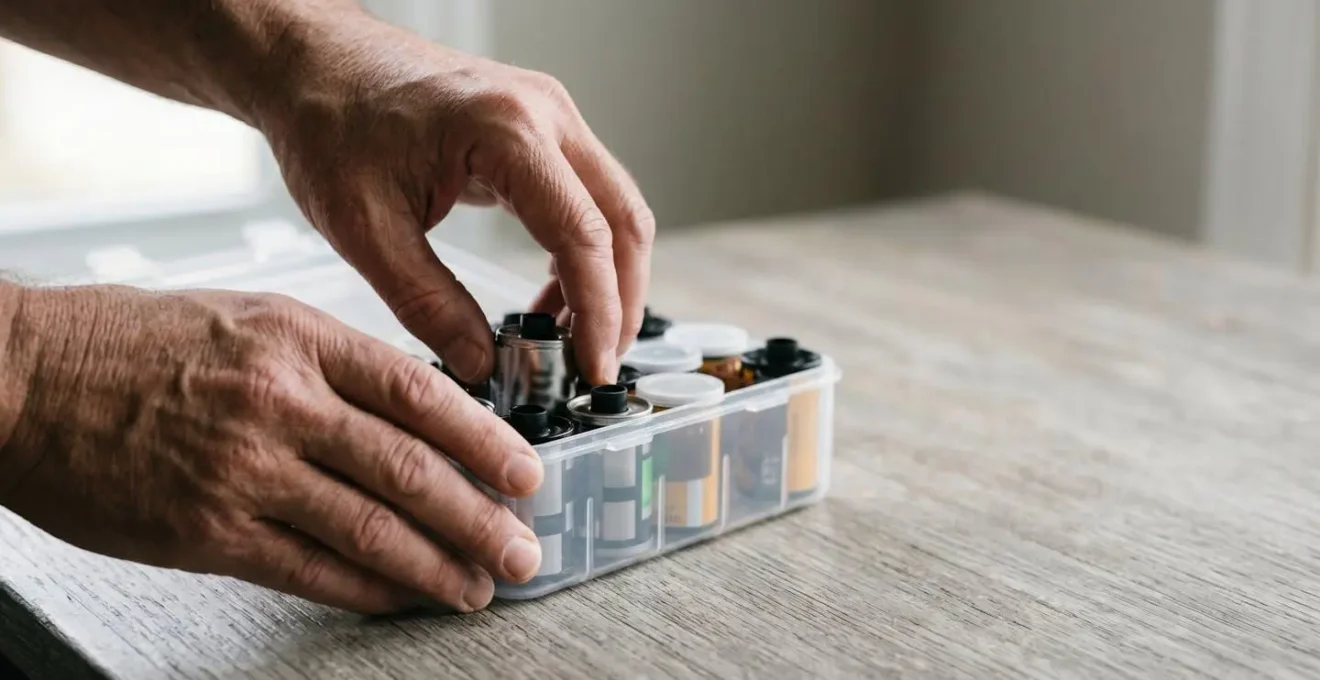
The situation is even more dire with the new, powerful CT scanners being rolled out in airports globally. As film photographer and lab owner Lina Bessonova warns, these scanners cause immense, shocking damage at every ISO level. While TSA guidelines suggest film under ISO 800 is the safety threshold for older scanners, this provides no protection from CT technology. This unseen labor and risk management is a core part of the service. Your investment covers not just the photographer’s time at your wedding, but the professional diligence required to protect your memories from the moment they leave the studio until they are safely developed.
CT scanners can go around in circles as many times as the security staff wants, causing immense damage to the film. Yes, immense. Shockingly more than I expected. At every ISO.
– Lina Bessonova, Film Photographer and Lab Owner
Why Fine Art Photographers Refuse to Shoot at Noon?
A common piece of advice for any photography is to avoid the harsh midday sun, but for a fine art film photographer, this is less of a suggestion and more of a creative mandate. The reason lies in a technical characteristic called dynamic range—a camera’s ability to capture detail in the brightest highlights and the darkest shadows of a single scene. This is where film’s inherent magic, and a key justification for its cost, truly shines.
The “light and airy” aesthetic is defined by its soft, luminous quality, with creamy highlights and gentle shadows, preserving delicate details in a wedding dress without losing the texture in a dark tuxedo. Film is uniquely suited to achieve this. According to comparative testing, film has a usable dynamic range that is heavily biased towards highlights, able to absorb a tremendous amount of overexposure while retaining beautiful detail. Digital sensors, by contrast, have a much narrower tolerance for overexposure; once a highlight is “blown out” to pure white, the data is gone forever.
At noon, the sun creates extreme contrast: blindingly bright highlights and deep, dark shadows. A digital camera struggles to balance this, often forcing a choice between crushed, detail-less shadows or blown-out, unflattering highlights on faces and clothing. A film photographer avoids this scenario because their medium excels in the softer, more directional light of the “golden hours” (early morning and late afternoon). Their refusal to shoot at noon isn’t about being difficult; it’s an act of artistic integrity to ensure every shot aligns with the luminous, flattering aesthetic you’re investing in.
Dark and Moody vs. Light and Airy: Which Ages Better?
The debate between editing styles often positions “light and airy” against its popular counterpart, “dark and moody.” While many claim that light and airy is inherently more timeless, the truth is more nuanced. Any heavily stylized trend, whether it’s desaturated greens or crushed blacks, risks feeling dated in a decade. True timelessness isn’t about applying a specific filter; it’s about creating images that are authentic to the feeling and atmosphere of the moment they were captured.
This is where the philosophy of a true fine art photographer differs from that of a trend-follower. Instead of forcing one aesthetic onto every situation, they let the environment dictate the mood. A skilled photographer captures the bright, ethereal light of a getting-ready suite with large windows, but will embrace the intimate, dramatic shadows of a candlelit reception. The goal is to produce a gallery that tells a complete story, with images that reflect what the day *actually* looked and felt like.
Case Study: The Contextual Approach to Timelessness
As detailed in her work, wedding photographer Laura Billingham exemplifies this approach. She consciously adapts her editing to match the natural atmosphere of each part of the day. This results in luminous, airy portraits during the day and rich, moody candids during the evening reception. By prioritizing authenticity over a monolithic style, her work achieves a deeper sense of timelessness, ensuring the photos serve as a genuine record of the day’s emotions and environments.
The best investment is in a photographer who demonstrates a mastery of light and shadow, not just a proficiency with a preset. Their ability to render true-to-life colors and tones, regardless of the dominant style, is what ensures your photos will feel as beautiful and relevant on your 25th anniversary as they do today.
Do You Really Need a Second Shooter for a Guest List Under 80?
For large weddings, the need for a second photographer is obvious—one person can’t be in two places at once. But for intimate weddings, many couples question if it’s a necessary expense. When your photographer shoots on film, the answer often becomes a resounding “yes,” but for a reason you might not expect: it’s a critical form of risk mitigation. The second shooter isn’t just for capturing more angles; they are insurance against missed moments due to the mechanical nature of film cameras.
Unlike a digital camera that can fire off dozens of shots in seconds, a medium format film camera—the tool of choice for many fine art photographers for its incredible detail—holds only 15 or 16 exposures per roll. Reloading a film back, while quick for a professional, still takes a crucial 15-30 seconds. This is a significant gap during fast-moving, unscripted moments like the bride walking down the aisle, the first kiss, or an emotional reaction during speeches. If the primary photographer has to reload at that exact instant, the moment is lost forever.
Case Study: The Hybrid Shooter’s Safety Net
In her explanation of her workflow, film photographer Molly Carr highlights this exact scenario. While she prioritizes film, she uses a digital camera (or has a second shooter do so) during critical moments like the processional. This hybrid system ensures that even while she is creating meticulously crafted film images, there is a digital safety net capturing every split second. This isn’t about film vs. digital quality; it’s about leveraging the strengths of both to provide complete, gap-free coverage.
So, whether it’s a dedicated second shooter or a hybrid-shooting lead photographer, this redundancy is non-negotiable. It protects your investment from equipment failure, technical limitations, and the simple physics of reloading. The added cost is for peace of mind, guaranteeing that no irreplaceable moment is left to chance.
How to curate a Shot List That Doesn’t Stifle the Photographer’s Creativity?
One of the biggest anxieties for couples is ensuring their photographer captures everything important. This often leads to the creation of a long, Pinterest-inspired “shot list” of specific poses and compositions. However, for a fine art photographer, being handed a rigid checklist can feel like being asked to paint by numbers. You’ve hired them for their unique artistic eye and ability to hunt for authentic, fleeting moments—the very things that can’t be scheduled or scripted. A prescriptive list forces them to be a technician checking boxes rather than an artist telling your story.
The solution is not to abandon the shot list entirely, but to transform it from a task list into an emotional brief. Instead of dictating the *what*, you communicate the *why*. This approach empowers your photographer, giving them the context needed to seek out the moments and relationships that are most meaningful to you. It’s the difference between asking for “a photo of me and my mom” and “capture the quiet, proud way my mom looks at me; she’s very reserved, so it will be a subtle moment.” The latter gives the artist a narrative to follow and a specific emotion to hunt for.
This collaborative approach respects the photographer’s expertise while ensuring your priorities are central. By focusing on people, relationships, and sentimental heirlooms, you create a guide that enhances, rather than restricts, their creative process. You are investing in their ability to see and feel, and an emotional brief is the best tool to direct that talent.
Action Plan: From Task List to Emotional Brief
- Provide Emotional Context: Replace specific pose requests (e.g., ‘Photo of bride and mom’) with the underlying emotion (‘Capture the way my mom looks at me with pride; she’s very reserved, so it will be a quiet moment’).
- Explain Relationship Dynamics: Instead of a generic group name (‘Photo with college friends’), describe the energy (‘My 3 college friends: we have a very sarcastic, playful energy. Capture the laughter and inside jokes’).
- Create an ‘Heirloom Object’ List: Guide detail shots by specifying tangible, sentimental items like ‘My grandmother’s earrings,’ ‘the hand-stitched handkerchief,’ or ‘the family crest on the invitations.’
- Focus on the ‘Why’ Over the ‘What’: Give your photographer the story behind a moment or item. This context is more valuable than dictating the exact composition you want.
- Trust the Artist’s Eye: The final step is to trust that your investment is in their trained ability to find authentic moments. Let them hunt for emotions rather than check off a list.
Fly-In Photographer or Local Talent: Which Is Safer for Your Investment?
When you discover a photographer whose artistic vision perfectly matches your own, but they live halfway across the country, you’re faced with a new decision: is it worth the added cost and logistical risk of flying them in? This choice pits a specific, unique artistic style against the security and familiarity of a local professional. From an aesthetic investment perspective, there’s no single right answer, only a calculated decision based on your priorities.
Hiring a “fly-in” photographer is the ultimate commitment to a singular artistic vision. You are investing in an artist whose work is so unique that no local equivalent will suffice. This premium covers not only their travel and accommodation but also the peace of mind that you will get the exact style you desire. However, it introduces risks: flight delays, lost baggage (containing gear or film), and a lack of familiarity with local venues, vendors, and lighting conditions. A top-tier professional will have contingency plans for these issues, but the risk, however small, remains.
Opting for local talent offers a different kind of security. A local photographer has an established network, knows the best portrait locations at your venue, and understands how the light changes throughout the day in that specific region. There are no travel risks involved. The trade-off is that you might need to be more flexible on your stylistic ideals, finding a local artist whose work you love, even if it’s not an exact match for your original inspiration. The investment here is in reliability, local expertise, and a smoother logistical process.
The Colored Light Mistake That Turns Guest Faces Purple in Photos
You’ve hired a fine art photographer to capture luminous skin tones and soft, romantic colors. But as evening falls, the reception hall is bathed in vibrant purple, blue, and magenta uplighting from the DJ or lighting designer. While this creates a high-energy party atmosphere, it can be a nightmare for your photographer and can actively undermine the aesthetic you’ve invested in. This is the colored light mistake, and it’s one of the most common ways that reception photos deviate from the desired fine art look.
Photography, at its core, is the art of capturing light. Film stocks and digital sensors are balanced to render colors accurately under natural or white light. When a scene is saturated with a single, strong color like purple, that color contaminates everything. Skin tones become unnatural and ghastly, a wedding dress takes on a lavender hue, and all the subtle, nuanced colors of your floral arrangements are lost. While a photographer can use a flash to try and overpower the colored light on the subjects, the background will remain saturated, creating a stark, disconnected look.
Correcting this in post-production is incredibly difficult and often impossible without making the photos look heavily processed and artificial. It can involve painstakingly masking and desaturating the colored spill on every single person in a photo, a process that destroys the natural quality of the image. To preserve the integrity of your photos, communicate with both your photographer and your lighting designer. Consider using colored uplighting on architectural features or walls, but request that the dance floor and key areas (like the cake table) be lit with warm, white light. This protects your aesthetic investment and allows your photographer to create the beautiful, timeless images you expect.
Key takeaways
- The cost of fine art film photography reflects a deep investment in artistic process, risk management, and the materials needed for a luminous aesthetic.
- Technical factors, like film’s superior dynamic range, dictate creative choices such as avoiding harsh midday light to ensure flattering, soft images.
- True timelessness in photography comes from authenticity to the moment’s atmosphere, not just applying a trendy filter like “light and airy” or “dark and moody.”
How to Get Candid Photos If You Are Awkward in Front of the Camera?
The most cherished wedding photos are often the candid ones—the unscripted laugh, the stolen glance, the tearful hug. But for many people, the mere presence of a camera makes them feel self-conscious and awkward, turning natural moments stiff and posed. If this sounds like you, the key to getting authentic photos lies not in learning to “pose,” but in building trust and connection with your photographer. The final, and perhaps most important, part of your aesthetic investment is in an artist who is also a skilled director of people.
A great fine art photographer knows that their job is 90% psychology and 10% technical skill. They are experts at creating an environment where you feel comfortable enough to forget you’re being photographed. This process starts long before the wedding day, with engagement sessions that serve as a “practice run” to build rapport. During portraits, they won’t just tell you where to stand; they will give you actions and prompts. Instead of “look at each other and smile,” they might say, “whisper what you’re most excited about for your honeymoon into your partner’s ear.” This shifts your focus from the camera to your connection, prompting genuine emotion and natural interaction.
Your role is to be open and to trust their process. Share your anxieties with them beforehand. Let them know what makes you laugh and what your relationship feels like. The more they understand your dynamic, the better they can guide you into moments that feel true to you. Remember, you hired them for their vision. By relaxing and trusting that vision, you allow them to see and capture the authentic beauty of your relationship, transforming awkwardness into the effortless, candid images you desire.
By understanding the immense craft, risk management, and artistic integrity behind fine art film photography, the price tag transforms from a cost into a clear and justifiable investment. Your decision should now be guided not by comparing line items, but by choosing the artist whose vision and process you trust to create your family’s first and most precious heirloom.