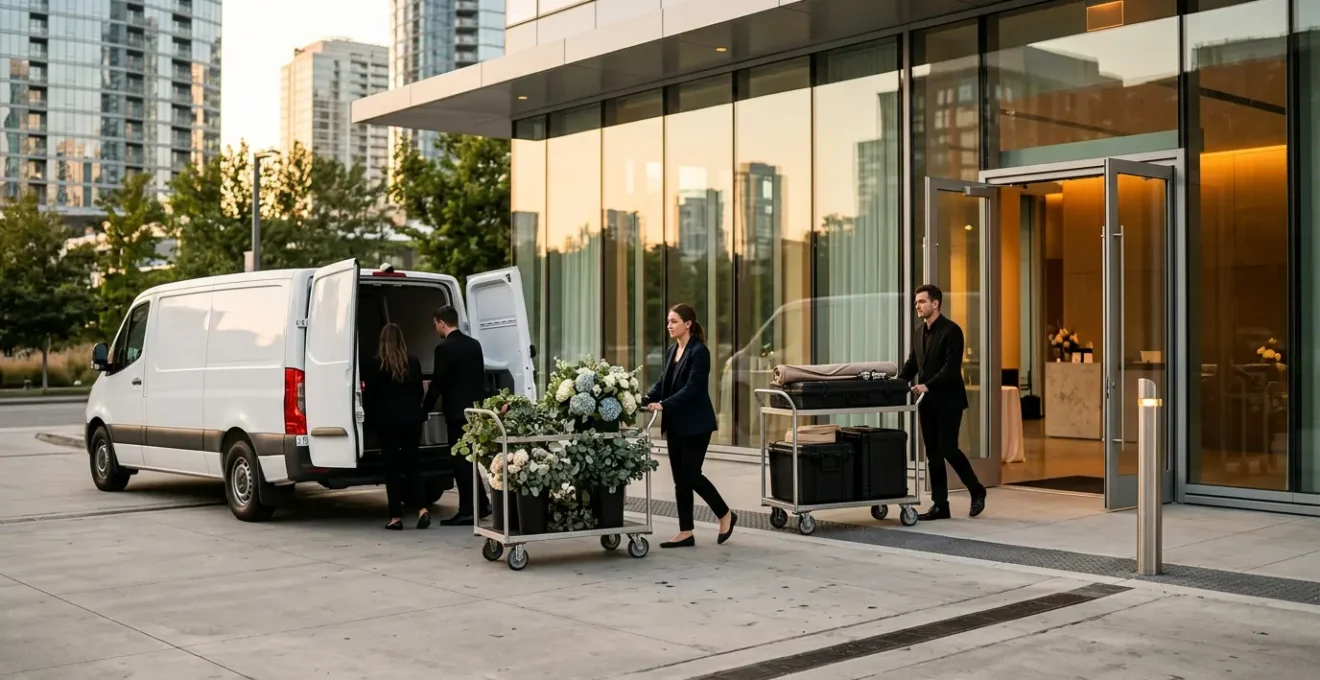
A flawless city wedding isn’t determined by the venue’s view, but by mastering the hidden logistics of vendor and guest flow.
- Critical “choke points” like freight elevators and narrow streets dictate your entire event timeline and can cause catastrophic delays.
- “All-inclusive” hotels often beat “blank canvas” venues on total cost by including complex logistical infrastructure (power, HVAC, staff) that you would otherwise have to rent and coordinate.
Recommendation: Build your schedule backward from non-negotiable constraints like noise curfews and vendor elevator access, not forward from the ceremony start time.
You’ve booked the stunning downtown venue with breathtaking skyline views. The contract is signed, the deposit is paid, and the vision is set. But what no one tells you is that the single greatest threat to your perfect day isn’t a misplaced ring or a sudden downpour; it’s the freight elevator. For couples booking urban venues, there’s a dangerous gap between the romantic vision and the gritty reality of logistics. The dream of a chic, central celebration can quickly turn into a nightmare of vendor access issues, traffic jams, and unexpected fees.
Most planning advice focuses on aesthetics and guest lists. It tells you to pick great vendors but doesn’t explain how those vendors will get a ten-foot floral arch, three-tiered cake, and a full band’s worth of equipment up 30 floors with one shared service elevator. This isn’t just about a lack of parking; it’s about understanding that a city wedding is a complex logistical ecosystem. Every element—from guest transportation to power sources to trash removal—is interconnected. A failure in one area creates a cascade failure across the entire event.
But what if the key wasn’t just hiring a good planner, but thinking like a logistics manager yourself? This guide shifts the focus from the what to the how. It’s about flow management: the strategic direction of people and materials through the tight constraints of an urban environment. By understanding the critical choke points and hidden dependencies, you can proactively design a wedding that flows seamlessly, protecting your timeline, your budget, and your sanity.
This article will dissect the most common and costly logistical traps of city weddings. We will explore everything from transportation and venue choice to the critical importance of elevators and scouting, providing the street-smart insights you need to ensure your day is remembered for the celebration, not the chaos.
Table of Contents: Navigating the Complexities of Urban Wedding Logistics
- Why Your City Venue Might Cut the Music at 10 PM Sharp?
- Uber Codes vs. Shuttle Bus: Which Works Better in Heavy Traffic?
- Rooftop vs. Floor-to-Ceiling Windows: Which Offers the Best Skyline Experience?
- The Freight Elevator Bottleneck That Delays Dinners by an Hour
- How to Scout City Photo Spots That Aren’t Swarming with Tourists?
- Why “Blank Canvas” Venues Often Cost More Than Hotels to Furnish?
- One Large Bus or Three Vans: Which Navigate Narrow European Streets Better?
- How to Find Secret Photo Spots That Aren’t All Over Instagram?
Why Your City Venue Might Cut the Music at 10 PM Sharp?
One of the harshest realities of an urban wedding is that the city itself is an uninvited and uncompromising guest. The most common way it makes its presence felt is through noise ordinances. That dream of dancing under the stars until midnight can come to an abrupt halt because of municipal law. Many couples are shocked when the band has to power down at 10 PM, but for an experienced event producer, it’s the most predictable part of the night. These rules are not venue policies you can negotiate; they are legal statutes with potential fines for the venue, which they will pass on to you.
These regulations are especially stringent for venues with any outdoor component, like a rooftop, terrace, or even large open windows. The time is the most critical factor. In most major metropolitan areas, quiet hours begin promptly, and a clear understanding of these times is essential. In fact, an analysis of municipal codes shows a consistent pattern where quiet hours are enforced between 10:00 PM and 7:00 AM, making a 10 PM music cutoff the standard, not the exception.
Understanding this single constraint is the first step in building a realistic timeline. It dictates not only the end of the reception but also influences the ceremony start time, the dinner service, and the entire flow of the evening. Ignoring this non-negotiable deadline is the first domino in a potential cascade failure. If you want the party to continue, your plan must include moving the festivities to a fully-enclosed, soundproofed indoor space after the cutoff time. This isn’t a problem to be solved on the night-of; it’s a fundamental part of the logistical ecosystem that must be designed from the very beginning.
Uber Codes vs. Shuttle Bus: Which Works Better in Heavy Traffic?
Guest transportation is a classic urban wedding challenge. The choice often boils down to two models: the decentralized, on-demand approach of rideshare codes (Uber, Lyft) or the centralized, scheduled system of a shuttle bus. While rideshare codes seem modern and flexible, they introduce dozens of individual points of failure into your logistical ecosystem. Imagine fifty different cars, all subject to surge pricing, getting lost, or stuck in traffic, trying to converge on one location. This not only creates scattered guest arrivals but also clogs the street for your other vendors who are trying to load in or out. It’s a recipe for chaos.
A shuttle bus, by contrast, consolidates the entire guest flow into a single, controllable unit. You dictate the departure points and times, ensuring everyone arrives together and on schedule. This predictability is invaluable. While a shuttle has a higher upfront cost, it eliminates the financial risk of unpredictable surge pricing. More importantly, it demonstrates a premium level of guest care and keeps the area around your venue clear. According to The Knot’s Real Weddings Study, transportation costs are significant, with couples of over 100 guests spending nearly $1,200, making it a line item that demands strategic thinking.
The following table breaks down the core logistical differences, highlighting why the control offered by a shuttle often outweighs the perceived flexibility of rideshares in a high-density environment.
| Factor | Wedding Shuttle | Rideshare (Uber/Lyft) |
|---|---|---|
| Hourly Cost | $125-225/hour (4-5 hour minimum) | Variable (surge pricing risk) |
| Per-Person Cost | $25-50 per person | Unpredictable |
| Coordination | Single departure/arrival time | Scattered arrivals, potential delays |
| Vendor Interference | Minimal (consolidated transport) | High (50+ individual vehicles blocking load-in) |
| Guest Experience | Unified, premium service | Fragmented, inconsistent quality |
Ultimately, choosing a shuttle is a proactive move to manage guest flow. It transforms a potential source of chaos into a streamlined, elegant part of the wedding experience, ensuring your timeline starts off on the right foot.
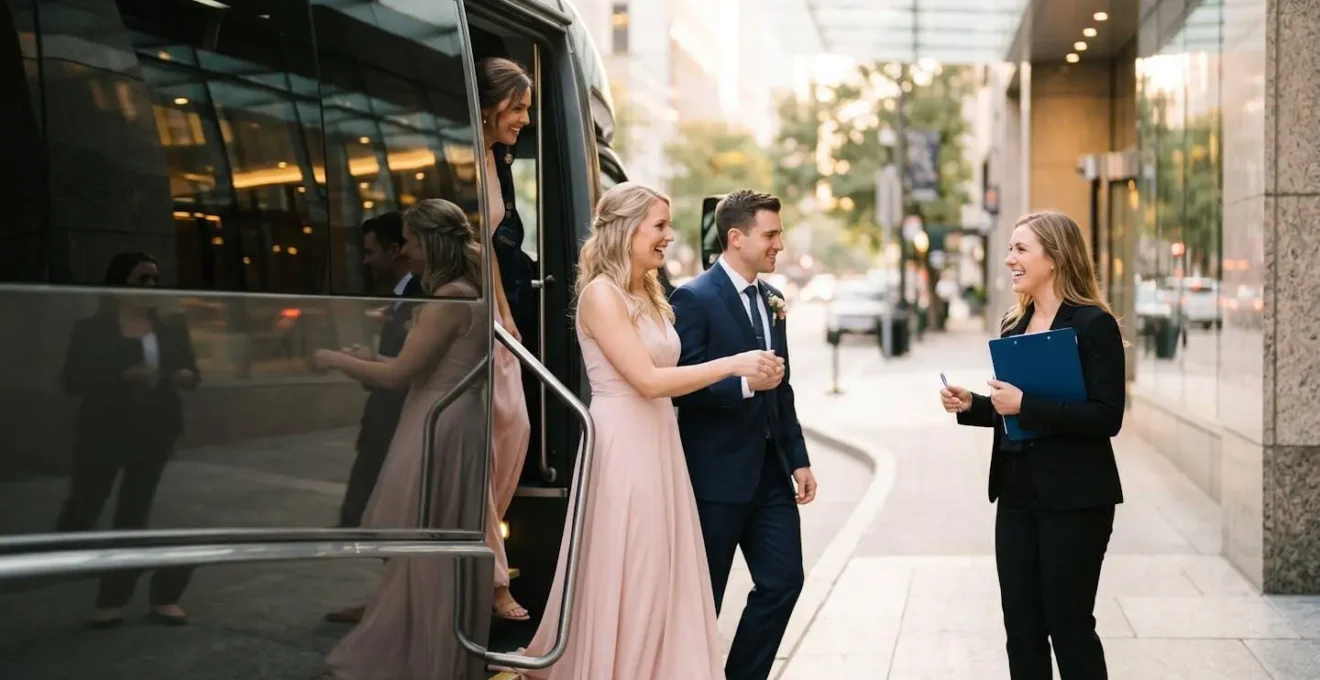
As you can see, the sense of order and seamless hospitality conveyed by a well-organized shuttle arrival sets a completely different tone for the event than the unpredictable nature of individual car services. It’s the first and most visible sign of masterful flow management.
Rooftop vs. Floor-to-Ceiling Windows: Which Offers the Best Skyline Experience?
The allure of a rooftop wedding is undeniable: open air, 360-degree views, and an unparalleled sense of glamour. But from a logistical perspective, a rooftop is one of the most challenging environments imaginable. Every single guest, vendor, piece of equipment, and plate of food must be transported vertically. This makes the elevator the most critical—and often most limited—resource. As Somer Khouri Bedran, co-founder of A Charming Fête, points out, the challenge is real. She notes in an ALHI blog article on rooftop wedding logistics:
One of the most challenging aspects of a rooftop wedding is transporting all the guests up at about the same time, especially when there are a limited number of elevators to use.
– Somer Khouri Bedran, A Charming Fête
This “vertical bottleneck” is a perfect example of a single point of failure. A slow elevator or, worse, a shared elevator with other building tenants, can completely derail a timeline. By contrast, an indoor ballroom with floor-to-ceiling windows offers a nearly identical skyline view but exists within a much more controlled logistical ecosystem. The climate is managed, power is integrated, and vendor access is typically more streamlined.
Case Study: Rooftop Wedding Logistics – Hidden Costs and Infrastructure Challenges
An analysis of rooftop venues reveals significant hidden logistical expenses not found in traditional ballrooms. Venues may impose “elevator fees” on vendors for multiple trips, a cost passed directly to the couple. Furthermore, rooftops often lack sufficient electrical infrastructure for live bands or extensive lighting, necessitating expensive generator rentals. The most significant cost, however, is weather contingency. A proper backup plan for a rooftop requires a complete secondary logistical setup—tents, heaters, wind-resistant décor—which can nearly double the complexity and cost compared to a climate-controlled ballroom that offers the same view through a window.
The choice is not simply about an indoor versus an outdoor experience. It’s about trading a small amount of “open-air” feeling for a massive gain in logistical stability. A ballroom with a view provides 90% of the aesthetic benefit with only 10% of the logistical risk, making it the smarter choice for a stress-free event.
The Freight Elevator Bottleneck That Delays Dinners by an Hour
In a high-rise city venue, the freight elevator is the central artery of your entire event. It is the single point through which every chair, table, floral arrangement, speaker, and tray of hors d’oeuvres must pass. When its use is not meticulously managed, it becomes a bottleneck that can cause a cascade failure, delaying everything from the cocktail hour to the dinner service. Vendors often operate on razor-thin margins for setup time, and a 15-minute delay waiting for an elevator can mean the caterer’s hot food goes cold or the band is still sound-checking when guests are supposed to be entering.
The common mistake couples make is assuming vendors will “figure it out.” In reality, without a master plan, every vendor will logically try to use the elevator at the same peak times, creating a logjam. The solution is to treat elevator access like an air traffic control system. It requires a hyper-detailed, minute-by-minute manifest that is shared with and contractually agreed upon by all vendors. This isn’t a suggestion; it’s a command-and-control document that dictates the entire load-in and load-out flow.
Proactive management of this critical asset is non-negotiable. Some venues have onsite managers who can help coordinate, but ultimately, the responsibility falls to your planner or a designated logistics lead. Techniques like “vertical staging”—renting a small room on the event floor to pre-stage items—can reduce elevator dependency. But nothing replaces a well-communicated and enforced schedule. This level of detailed planning is what separates a smooth, professional production from an amateur event that runs an hour behind schedule before the first guest even arrives.
Action Plan: Mastering Freight Elevator Logistics
- Create an Elevator Manifest: Develop a hyper-detailed, minute-by-minute schedule shared with all vendors, dictating not just who uses the elevator, but what they are bringing and their allotted time slot.
- Coordinate with Venue Managers: Work closely with onsite support teams who assist in managing logistics, coordinating with vendors, and ensuring smooth transitions between activities.
- Implement Vertical Staging: For venues with limited elevator access, rent a small room on the event floor as a secondary staging area to reduce last-minute trips.
- Establish Contractual Penalties: Write specific clauses into vendor agreements financially penalizing vendors who miss assigned elevator slots, protecting your timeline from disorganization.
- Reduce Load-In Times: Leverage venue managers’ expertise to help vendors plan efficient equipment transport, minimizing elevator dependency and congestion.
How to Scout City Photo Spots That Aren’t Swarming with Tourists?
The quintessential city wedding photo—the couple posed against an iconic skyline or landmark—is a staple. However, the reality of capturing this shot often involves battling crowds of tourists, navigating traffic, and burning precious time on your wedding day. The “street-smart” approach to city photography isn’t about finding a secret, unknown spot (in a major city, those don’t exist), but about a strategic application of time and access. The goal is to make a common location feel exclusive.
First, you must treat photo location scouting as a logistical task, not just an aesthetic one. Does the spot have a legal place for a limousine or shuttle to stand for 15-20 minutes? What is the walking distance from the vehicle to the photo spot, and is it feasible in wedding attire? Are there public restrooms nearby? Answering these questions is just as important as checking the view. Many couples fall in love with a photo they saw on Pinterest without considering the practicalities of getting their entire bridal party to that location on a tight schedule.
The most effective strategy is what event producers call “temporal scarcity”—it’s not about *where* you shoot, but *when*. The Brooklyn Bridge is swarming with tourists at 2 PM, but at sunrise, it’s a completely different world. Planning your day backward from a sunrise photo shoot at a famous landmark can transform an overexposed location into a private, magical experience. Another professional tactic is to gain access to locations that are normally off-limits. Consider booking a one-hour rental at a museum or art gallery on a day it’s closed to the public. The cost is often less than you’d think and guarantees a unique, crowd-free backdrop that is impossible to replicate.

Ultimately, the best photos come from efficient planning. A well-scouted location with a solid logistical plan means more time for your photographer to be creative and less time spent stressing about traffic and tourists. It’s about managing the flow of your day to create pockets of calm and beauty.
Why “Blank Canvas” Venues Often Cost More Than Hotels to Furnish?
The term “blank canvas” venue—think industrial lofts, warehouses, or art galleries—evokes a sense of creative freedom. It’s a space you can truly make your own. However, this freedom comes at a steep and often hidden logistical price. While the initial rental fee for a raw space might seem lower than a hotel ballroom, the total cost is frequently much higher. In fact, a 2025 market analysis highlights that urban venues command approximately $10,000 more than suburban counterparts, partly due to the complex build-outs these blank spaces require.
The reason is simple: you are not just renting a space; you are building a fully functional event venue from scratch for one night. A hotel provides a complete logistical ecosystem—a commercial kitchen, power, HVAC, lighting, tables, chairs, linens, restrooms, and the staff to manage it all. In a raw space, you are responsible for sourcing, renting, delivering, setting up, and removing every single one of these elements. This requires coordinating a dozen different vendors in a specific sequence, a process known as “vendor stacking.” If the power generator vendor is late, the lighting vendor can’t work, which means the floral designer is working in the dark, and so on. It’s a house of cards.
Couples are often blindsided by the sheer number of infrastructure items that must be rented. These are not glamorous choices like flowers and music; they are the fundamental, unsexy necessities of hosting a large group of people. Before signing a contract for a “blank canvas” venue, a thorough audit of its hidden infrastructure needs is essential.
- Power Generation: Raw spaces often lack dedicated circuits for sound systems and lighting. You may need to budget for commercial generator rentals.
- Water Access: Industrial venues may not have commercial kitchen hookups, requiring temporary water solutions for your caterer.
- Climate Control: All heating, cooling, and ventilation (HVAC) equipment will likely need to be rented and installed.
- Restroom Facilities: You must confirm the number and quality of existing restrooms or budget for luxury portable restroom trailers.
- Trash Removal Services: Unlike hotels, you are responsible for contracting a service to remove all event waste at the end of the night.
- Vendor Stacking Coordination: The complex dependency chain of vendors requires an expert day-of coordinator to manage the intricate load-in sequence.
A hotel ballroom, while perhaps less unique, offers cost certainty and logistical peace of mind. It’s a turnkey solution that allows you to focus on the celebration, not on whether the caterer has access to running water.
One Large Bus or Three Vans: Which Navigate Narrow European Streets Better?
When planning transportation in a city with historic, narrow streets—like those in Boston’s North End, Philadelphia’s Old City, or many European capitals—the choice of vehicle is a critical logistical decision. The intuitive thought might be that smaller vehicles are better. However, splitting a group of 50 guests into three or four sprinter vans can create more problems than it solves. While a single van can navigate a tight corner more easily, coordinating multiple vehicles introduces significant risk into your flow management.
This multi-vehicle approach creates what logistics experts call “Dispersal and Re-Gathering Time.” You now have three separate chances for a vehicle to get stuck in traffic, make a wrong turn, or have a breakdown. The time spent waiting for the last van to arrive and re-gathering all the guests at the destination can easily erase any time saved by the vehicles’ smaller turning radius. As event planner Michelle Norwood states in The Knot, local knowledge is paramount:
For example, in New Orleans, the streets are quite tight and larger buses can’t make certain turns. Research the transportation needs and requirements for the city and venue your wedding is taking place, before booking your ride.
– Michelle Norwood, Michelle Norwood Events
The key is not just vehicle size, but a holistic analysis of the route. A single, slightly smaller charter bus (often called a shuttle bus) that has been route-tested by a professional transportation company is almost always the superior choice.
Case Study: Vehicle Capacity vs. Urban Navigation
A transportation analysis for urban venues reveals that while full-size charter buses have a lower per-person cost, their viability in cities like Chicago and Boston is limited by turning radius constraints. The optimal solution is often a mid-size wedding shuttle. Crucially, the analysis points out that using three separate vans creates “Dispersal and Re-Gathering Time” costs. This includes the tripled potential for traffic delays, lost passengers, and extended regrouping periods at the destination—logistical friction that a single, consolidated vehicle completely avoids.
The goal is consolidated movement. A single vehicle with a professional driver who knows the city’s quirks ensures your entire guest list moves as one predictable unit. It minimizes points of failure and keeps your timeline intact. It’s better to have one 40-passenger bus take a slightly longer, pre-vetted route than to have three 15-passenger vans get lost on a “shortcut.”
Key Takeaways
- Your wedding timeline is dictated by logistical constraints (like noise curfews and elevator access), not your desired ceremony start time. Plan backward from them.
- A “blank canvas” venue requires you to rent and coordinate an entire logistical ecosystem (power, HVAC, water, staff), often making it more expensive than an all-inclusive hotel.
- Consolidated movement is always better. One shuttle bus is logistically superior to dozens of Ubers for moving guests, just as one freight elevator manifest is better than a vendor free-for-all.
How to Find Secret Photo Spots That Aren’t All Over Instagram?
In the age of social media, the concept of a “secret” photo spot in a major city is largely a myth. If it’s a beautiful location, it has likely been geotagged into oblivion. The truly savvy approach to unique wedding photography is not about discovering a hidden gem, but about creating an exclusive experience in a known location or finding a place that is personally, not publicly, significant. It’s a shift from location-scouting to opportunity-scouting.
The most powerful strategy is to prioritize locations that are meaningful to your personal story. The doorway of your first apartment, the bar where you had your first date, or a favorite park bench carry an emotional weight that no generic “scenic view” can match. These locations are inherently unique to you and ensure your photos tell a story that is genuinely your own, far from the clichés seen on Instagram feeds. This approach turns the focus from public spectacle to private significance.
If a more traditionally “scenic” backdrop is desired, the key is access, not location. Instead of fighting crowds, think like a film producer. Here are some professional strategies for securing unique photo opportunities:
- Hire a Commercial Location Scout: For a one-hour consultation fee, a film or commercial location scout can provide a list of legally shootable, visually interesting locations that are completely off the wedding industry’s radar.
- Leverage Temporal Scarcity: As mentioned, the secret isn’t the place, but the time. A sunrise shoot at a landmark, or shooting during a unique city event like a street festival, provides a dynamic and exclusive backdrop.
- Book “Off-Hours” Access: Contact museums, galleries, or historic theaters about booking a one-hour photo session on a day they are closed to the public. This guarantees a stunning, empty, and exclusive environment.
- Conduct Logistical Scouting: Any potential spot must be vetted for logistics first. Check for parking/standing zones for your transport, walkability, and public access. The most beautiful view is worthless if you can’t get to it on your wedding day.
By focusing on personal meaning and professional access rather than chasing an overused “secret” spot, you create a photographic experience that is both logistically sound and emotionally resonant. You are not just finding a location; you are creating the conditions for a perfect memory.
Now that you understand the critical logistical levers of an urban wedding, the next step is to apply this mindset to your own planning, turning potential chaos into a flawlessly executed celebration.