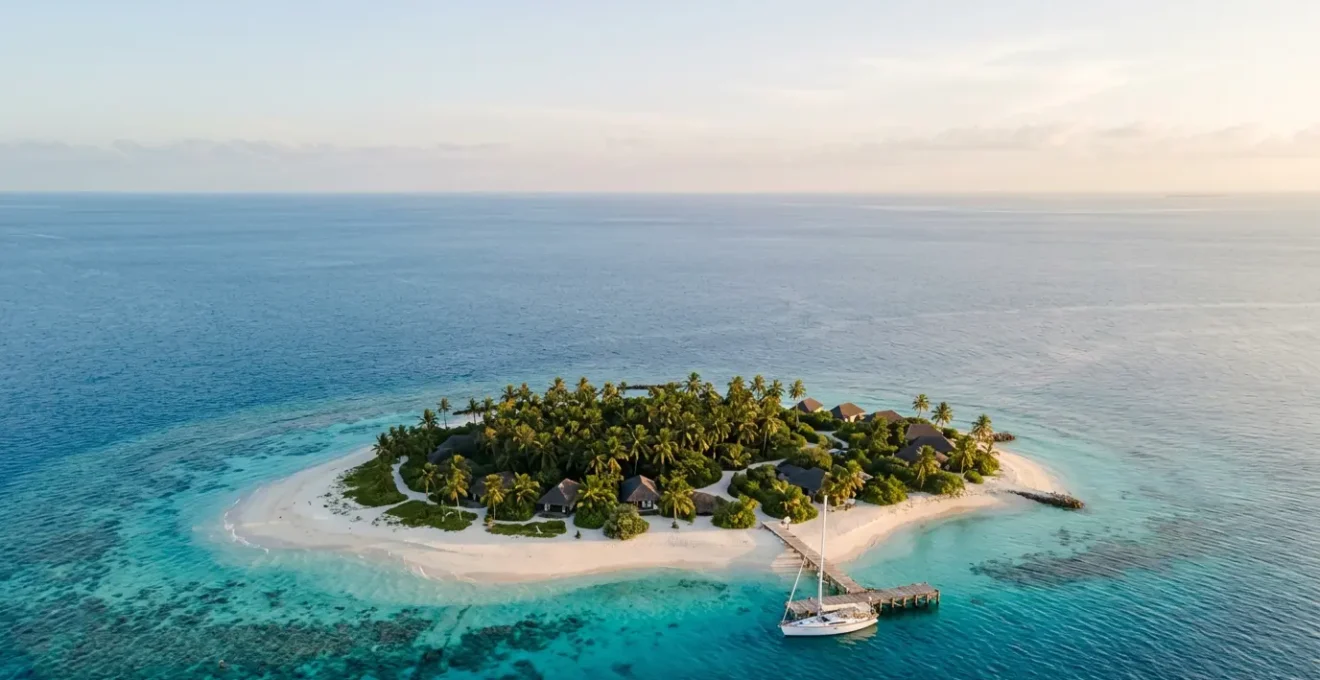
The success of a private island wedding buyout hinges not on aesthetic choices, but on mastering the critical, non-negotiable supply chain that underpins the entire event.
- Vendor transport and hidden customs fees can easily double the logistics budget if not meticulously audited.
- Catering for a remote location is a cold-chain integrity challenge, where food safety depends on flawless transport and storage.
- Robust contingency architecture for weather, power, and communication is not optional—it’s the primary safeguard for your investment and guest safety.
Recommendation: Prioritize a logistics-first approach. Vet all vendor transport contracts and establish clear, multi-layered contingency protocols before any creative decisions are made.
Executing a private island buyout for a wedding is the pinnacle of exclusivity and privacy. However, the fantasy of a secluded paradise can quickly dissolve into a series of logistical crises if approached with the mindset of a traditional venue-based event. While most planning focuses on guest lists and decor, the reality for high-net-worth couples is that the entire endeavor is fundamentally a military-grade logistical operation. Success is not measured by the beauty of the floral arrangements, but by the resilience of the supply chain that brings every single element—and person—to a remote location and sustains them flawlessly.
The common advice to “hire a good planner” or “create a budget” is woefully inadequate for this scale of undertaking. The critical failure points lie in the unglamorous details: the integrity of the cold chain for imported cuisine, the true landed cost of a vendor after accounting for transport and customs, and the viability of a storm shelter-in-place plan when evacuation is impossible. The core challenge is a shift in perspective. If the true key to a seamless experience was not in managing the event, but in mastering the complex, non-negotiable supply chain that supports it?
This guide moves beyond aesthetics to provide a strategic, logistics-heavy framework for mitigating the inherent risks of a remote island buyout. We will dissect the critical operational pillars, from vendor transport and food importation to staffing models and contingency architecture, providing the high-level oversight necessary to ensure your private paradise remains just that.
This article provides a detailed breakdown of the essential logistical considerations for your event. The following summary outlines the key areas we will cover, from initial budget allocation to on-the-ground execution, to ensure a seamless and successful private island buyout.
Summary: The Strategic Logistics of an Island Buyout
- Why Ignoring Vendor Transport Costs Can Double Your Logistics Budget
- How to Menu Plan When All Food Must Be Imported by Boat
- Resort Buyout or Private Estate: Which Offers Better Staffing Ratios
- The Risk of Being Stranded on a Private Island During Tropical Storm Season
- Coordinating Boat Transfers: The Secret to a Seamless Guest Arrival
- One Large Bus or Three Vans: Which Navigate Narrow Island Paths Better
- How to Blend Local Culture Into Your Itinerary Without It Feeling like a Tour Group
- Pole Tent vs. Frame Tent: Which Structure Suits Your Land Best
Why Ignoring Vendor Transport Costs Can Double Your Logistics Budget
The foundational error in budgeting for a private island event is viewing vendor pricing at face value. A supplier’s fee is merely the starting point; the true cost is the “landed cost”—the total expense to get that vendor’s service or product operational on your island. This includes not just freight but also customs duties, currency exchange fees, specialized transport, and return logistics. For a typical destination wedding, these logistical overheads are significant, with the average event cost approaching high figures even before adding the “island premium.” In fact, an analysis of wedding expenses shows that the average destination wedding is a $39,000 investment, a figure that serves as a baseline before remote logistics are factored in.
For an island buyout, this multiplier effect is even more pronounced. A florist from the mainland isn’t just charging for flowers; they are charging for climate-controlled transport. A renowned photographer’s fee must be augmented with their travel, accommodation, and potentially insurance for operating in a remote environment. These are not incidentals; they are core components of the budget that can easily match or exceed the original service fee. Ignoring these hidden logistical expenses is the fastest way to see a carefully planned budget spiral out of control.
A meticulous audit of every vendor contract is non-negotiable. Scrutinize what is included in their travel and transport fees and what is not. Key items to verify include:
- Currency exchange fees and international transaction charges that can inflate budgets by 10-20%.
- Vendor shipping costs for specialized items, especially those requiring climate-controlled transport.
- Coordination with international customs regulations and the potential for delivery schedule delays.
- Multi-day accommodation and travel fees for vendors and their teams.
- Equipment return freight charges, which can often match the initial delivery cost.
Failing to account for these variables transforms them from predictable expenses into budget-breaking emergencies. The financial stability of the event depends on treating vendor transport not as a line item, but as a primary cost center requiring its own strategic plan.
How to Menu Plan When All Food Must Be Imported by Boat
On a private island, the catering menu is not just a culinary document; it’s the end result of a complex and fragile supply chain. When every ingredient, from produce to protein, must be imported by boat or small aircraft, the primary concern shifts from taste to cold-chain integrity. A single failure in refrigeration during transit or storage can compromise food safety and jeopardize the entire event. Therefore, menu planning must begin with logistics, not with flavor profiles. The choice of dishes should be dictated by their resilience to transport and their storage requirements.
This means prioritizing ingredients that hold well, such as root vegetables, cured meats, and hardy fruits, and designing dishes that can be prepared with a combination of fresh and high-quality frozen or preserved components. Delicate items like fresh seafood or leafy greens require a dedicated, unbroken cold chain with temperature monitoring from mainland to island kitchen. A case study on island event logistics highlights that success is contingent on meticulous supply chain coordination, especially when local resources are non-existent and every essential item must be transported. This requires deep collaboration with suppliers who have proven experience in remote catering.
The visual below represents the core of this logistical challenge: maintaining a precise, controlled temperature to ensure the safety and quality of your provisions from source to table. This is the unseen foundation of every meal served.

Beyond the cold chain, menu planning must also account for redundancy. What is the contingency if a specific food delivery is delayed by weather or customs? A well-designed menu has built-in flexibility, with alternative dishes that can be prepared using on-site, shelf-stable inventory. This “pantry-first” approach ensures that service can continue uninterrupted, regardless of external disruptions. The menu should be a strategic asset, designed for resilience rather than being a potential point of failure.
Resort Buyout or Private Estate: Which Offers Better Staffing Ratios
The choice between a full resort buyout and a private estate rental dictates the entire service architecture of your event. While both offer exclusivity, they present fundamentally different models for staffing and management. A resort buyout provides an existing, integrated ecosystem of specialized staff—from sommeliers and pastry chefs to on-site coordinators and maintenance teams. This offers a higher degree of cost predictability and operational reliability, as the teams are accustomed to working together within an established infrastructure. As noted by one industry expert, the primary benefit is clear. Lauren Reichwald, an Account Executive at Maverick Creative, points out in the ALHI Blog on hotel buyouts:
The advantage of a buyout for a wedding on property is that the staff is fully dedicated to your guests.
– Lauren Reichwald, Account Executive at Maverick Creative
A private estate, conversely, offers a blank canvas with maximum flexibility but requires you to build the entire service infrastructure from scratch. This involves hiring and coordinating a disparate group of external vendors, including a head chef, a logistics coordinator, and service staff, who may never have worked together. While this allows for hyper-customization, it introduces significant risks in team cohesion and management oversight. The service density—the concentration and specialization of staff—is inherently lower, and a dedicated management layer must be hired to orchestrate the entire operation.
The following table breaks down the critical differences in the staffing models, providing a clear framework for deciding which option aligns best with your event’s complexity and your tolerance for logistical risk.
| Criteria | Resort Buyout | Private Estate |
|---|---|---|
| Staffing Model | Specialist-focused (sommelier, pastry chef, event coordinator) | Generalist-focused (versatile staff with cross-functional skills) |
| Typical Staff-to-Guest Ratio | 1:40 (standard industry ratio) | Variable, often requires external hiring |
| Flexibility | Limited due to established protocols | High customization potential |
| Management Layer | Included (on-site coordinator provided) | External hire required (producer, head chef, logistics coordinator) |
| Staff Wellness Fee | Often included as operations surcharge | Must be budgeted separately |
| Cost Predictability | Higher (bundled services) | Lower base but hidden costs accumulate |
Ultimately, the decision rests on a trade-off. A resort buyout trades some customization for operational security and predictable costs. A private estate offers ultimate personalization but demands a far greater investment in logistical planning and external management to achieve the same level of seamless service.
The Risk of Being Stranded on a Private Island During Tropical Storm Season
Operating in a remote island environment requires confronting the most powerful and unpredictable variable: weather. During tropical storm season, this risk is magnified exponentially. The possibility of being stranded is not a distant threat but a tangible scenario that demands a robust and pre-scripted contingency architecture. This goes far beyond a simple “Plan B”; it is a multi-layered emergency protocol that assumes the worst-case scenario: all transport links to the mainland are severed, and you must shelter in place for an extended period.
The window for evacuation is deceptively short. Official guidelines state that once a hurricane warning is issued, the storm is typically expected to make landfall within a short timeframe. For instance, OSHA states that hurricane warnings generally mean a storm is expected to reach the area within 24 hours, often leaving insufficient time to safely evacuate dozens or hundreds of guests and staff by boat or small aircraft. Therefore, the only responsible approach is to have a comprehensive shelter-in-place plan that can be activated instantly. This plan must be validated long before the event and understood by all key personnel.
This is not a theoretical exercise but a practical necessity. The plan must include physical preparations, supply stockpiles, and communication protocols to ensure the safety and well-being of every person on the island for a minimum of 72 hours post-storm. A detailed audit of the island’s emergency readiness is a critical due diligence step.
Action Plan: Shelter-in-Place Emergency Protocol
- Assemble physical protections: Ensure emergency kits with flashlights and generators are fully stocked and storm shutters are functional and ready for immediate deployment.
- Stockpile essential supplies: Verify a non-perishable food and potable water supply sufficient for all guests and staff for a minimum of 72 hours.
- Prepare medical resources: Compile comprehensive first-aid kits with essential medications, medical supplies, and any specific prescriptions required by guests.
- Establish communication lifelines: Implement and test satellite communication protocols and ensure backup power systems for them are fully operational.
- Review and confirm insurance: Scrutinize all relevant insurance policies to confirm adequate coverage for property damage, event cancellation, and personal belongings.
Ignoring the statistical probability of a weather event during storm season is a catastrophic planning failure. A private island’s isolation is its greatest appeal, but in an emergency, it becomes its greatest liability. A professional, pre-vetted contingency plan is the only way to mitigate that risk.
Coordinating Boat Transfers: The Secret to a Seamless Guest Arrival
The guest experience for a private island wedding begins the moment they step off their flight. The final leg of the journey—the transfer from the airport to the island—sets the tone for the entire event. A chaotic, poorly coordinated transfer can instantly erode the sense of luxury and exclusivity, while a seamless, elegant arrival reinforces it. The secret to success lies in treating guest transfers not as a taxi service, but as the first act of the wedding experience itself. This requires centralized coordination, clear communication, and a focus on comfort and privacy.
The primary logistical challenge is managing staggered arrivals from multiple flights. Relying on individual taxis or ride-shares is inefficient, costly, and creates a fragmented experience. A far superior model involves chartering group transport, which provides a more controlled and cost-effective solution. This approach allows for a dedicated welcome team at the airport, streamlined luggage handling, and a shared, festive atmosphere as guests travel to the marina. The arrival at the island’s jetty should be a moment of orchestrated beauty, the culmination of a flawless journey.
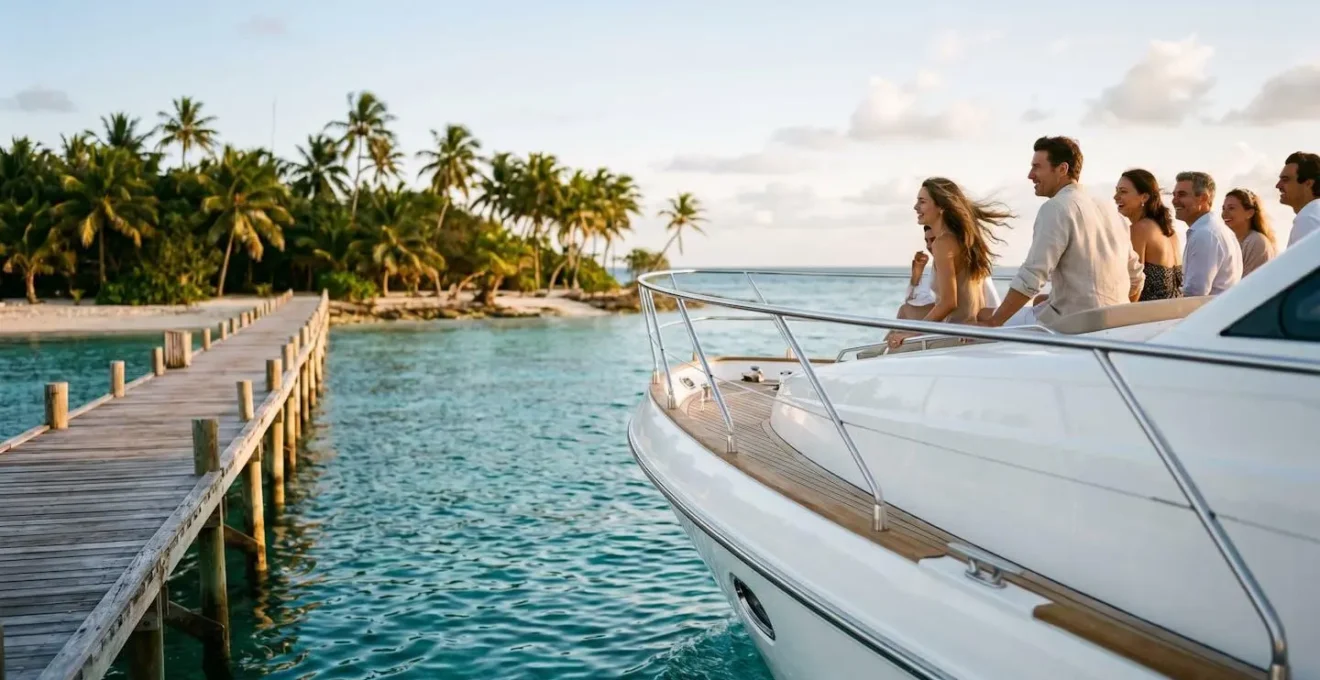
The financial and logistical benefits of centralized transport are significant. Instead of dozens of individual journeys, the logistics are consolidated into a few well-managed group movements. This not only improves the guest experience but also provides substantial cost savings, as demonstrated by industry data on destination wedding transport.
Case Study: The Economics of Centralized Guest Transport
For destination weddings, coordinating airport transfers is a major logistical and cost component. Data shows that chartering buses or large vehicles for round-trip airport-to-venue transfers typically costs between $75 and $150 per person. This group approach is far more cost-effective than coordinating dozens of individual rides, especially when guests are arriving on staggered flights. In contrast, private transportation for the wedding couple alone can range from $300 to $600, depending on the vehicle and distance. By centralizing guest transport, planners can create a seamless arrival experience while managing costs far more effectively than a decentralized model would allow.
Ultimately, a flawless arrival is a direct reflection of meticulous back-end planning. It requires a dedicated transport coordinator, real-time flight tracking, and contingency plans for delays. When executed correctly, the boat transfer becomes more than just a journey; it’s an unforgettable welcome.
One Large Bus or Three Vans: Which Navigate Narrow Island Paths Better
Once guests have arrived on the island, a new logistical challenge emerges: on-site mobility. The idyllic, narrow paths of a private island are often incompatible with traditional large vehicles. The decision between using a single, large-capacity vehicle (like a multi-passenger shuttle) versus a fleet of smaller vehicles (such as two- or three-seater golf carts) has significant implications for guest experience, flexibility, and operational complexity. This isn’t just a transport choice; it’s a strategic decision that shapes how guests interact with the property.
A single, larger vehicle enforces a synchronized, fixed schedule. It is efficient for moving an entire group from one location to another simultaneously, such as from villas to a ceremony site. However, it offers zero flexibility for individual needs and diminishes the sense of privacy and personal freedom. A fleet of smaller, on-demand vehicles provides the ultimate in flexibility, allowing guests to move at their own pace. This high-touch service model aligns perfectly with the ethos of a luxury buyout but introduces its own logistical hurdles, including the need for multiple drivers, complex charging or fueling schedules, and distributed luggage management. The decision also has a direct impact on budget, as research shows that doubling the guest count from 30 to 75 can double the total costs, with transportation being a key driver.
The optimal choice depends entirely on the event’s itinerary and the desired guest experience. A side-by-side comparison reveals the clear trade-offs between these two models, contextualized here for an island environment using golf carts as the vehicle archetype.
| Factor | One Large Vehicle (e.g., 6-seater golf cart) | Multiple Small Vehicles (e.g., 2-seater golf carts) |
|---|---|---|
| Flexibility | Low – Fixed schedule | High – Accommodates staggered arrivals |
| Guest Privacy | Low – Shared space | High – Intimate groups |
| Luggage Management | Simple – Centralized | Complex – Distributed across vehicles |
| Driver Requirements | 1 driver per trip | Multiple drivers needed |
| Charging/Fuel Logistics | Single charging station | Multiple charging points required |
| Cost per Person-Journey | Lower for full capacity | Higher but more efficient for partial loads |
| Best Use Case | Synchronized group movements | Flexible, on-demand guest mobility |
The most effective solution is often a hybrid approach: using larger shuttles for key, timed events (like the ceremony) and maintaining a small fleet of on-call carts for individual guest requests. This provides a balance of efficiency and personalized service, ensuring both operational smoothness and a bespoke guest experience.
How to Blend Local Culture Into Your Itinerary Without It Feeling like a Tour Group
Integrating local culture into a high-end wedding itinerary is a delicate art. The goal is to create an authentic, meaningful connection to the destination, not a staged, tourist-like performance. For a private island buyout, where the environment is curated and controlled, this challenge is even greater. The key to success is moving away from passive observation (e.g., watching a traditional dance) and toward genuine, hands-on interaction that feels both exclusive and respectful. This requires sourcing and collaborating with true local artisans, musicians, or chefs, not just entertainment troupes.
Instead of a generic “cultural show,” consider commissioning a local craftsman to create personalized wedding favors for guests on-site, allowing them to witness the creative process. Or, arrange for an intimate cooking class with a celebrated local chef who can share the stories behind the regional cuisine. These experiences are immersive and personal, fostering a sense of discovery rather than consumption. They transform cultural elements from a simple add-on into a core, memorable part of the event’s narrative.

This approach requires significant logistical planning. It involves identifying and vetting authentic local talent, arranging their transport to the island, and providing the necessary resources for them to practice their craft. It also demands a deep respect for their work, compensating them as the skilled professionals they are. The result is an experience that enriches the event for everyone, creating a bridge between the guests and the soul of the destination. This is about creating a dialogue, not a spectacle.
The most successful integrations feel organic and are woven into the fabric of the wedding. A local musician playing traditional instruments during cocktail hour, a master weaver demonstrating their technique in a quiet lounge area, or a local storyteller sharing folk tales around a bonfire—these moments feel discovered, not scheduled. They provide depth and authenticity, making the celebration not just a beautiful party, but a profound sense of place.
Key Takeaways
- Prioritize Landed Costs: The true cost of a vendor includes transport, customs, and accommodation. Budgeting for this “logistical overhead” is non-negotiable.
- Design for a Resilient Supply Chain: Menu planning must be logistics-first, prioritizing ingredients and cold-chain integrity to ensure food safety and quality in a remote setting.
- Build a Contingency Architecture: A detailed, multi-layered shelter-in-place plan for severe weather is a critical safeguard for your guests and your investment.
Pole Tent vs. Frame Tent: Which Structure Suits Your Land Best
For an outdoor event on a private island, the choice of tent structure is a critical decision with profound implications for safety, aesthetics, and site viability. It is not merely a stylistic choice but a technical one, dictated by the island’s specific geography and weather patterns. The two primary options, pole tents and frame tents, offer vastly different performance characteristics, particularly in coastal environments prone to high winds and varied ground surfaces. As the Global Events Agency notes, planners must be mindful of an island’s unique weather patterns and have contingency plans, with the tent being a central part of that plan.
A pole tent, with its classic, romantic peaks, relies on tension created by guy-ropes staked deep into the ground. This makes it suitable only for protected locations with soft, penetrable soil. Its reliance on stakes makes it invasive to the landscape and creates an unusable perimeter around the tent, reducing the effective space. In an exposed beach or cliffside location, its wind resistance is moderate at best and it can become a significant liability in a storm.
A frame tent, by contrast, is a self-supporting, rigid structure. It does not require center poles, offering 100% usable interior space, and can be anchored with non-invasive methods like engineered weight ballasts or helical anchors. This makes it adaptable to any surface, from sand to rock to hard-packed earth. Its superior structural integrity provides far greater wind resistance, making it the default choice for exposed coastal settings. While its aesthetic is more modern, the safety and versatility it offers are paramount in a remote, unpredictable environment.
The following table provides a clear comparison of the features that are most critical when selecting a tent for a private island, where ecological footprint and weather resilience are top priorities.
| Feature | Pole Tent | Frame Tent |
|---|---|---|
| Wind Resistance | Moderate – Requires guy-ropes for stability | Superior – Self-supporting structure |
| Anchoring Method | Stakes driven into ground (invasive) | Engineered weight ballasts or helical anchors (non-invasive) |
| Usable Space Ratio | ~70% (guy-ropes create unusable perimeter) | 100% (no internal obstructions) |
| Aesthetic Appeal | Classic, romantic peaked roof | Modern, clean lines |
| Ground Surface Compatibility | Requires penetrable soil | Adaptable to sand, grass, or hard surfaces |
| Ecological Footprint | Higher (ground penetration, larger footprint) | Lower (minimal ground disturbance) |
The decision must be driven by a technical site survey and a realistic assessment of weather risk. On a private island, prioritizing structural safety and environmental sensitivity over pure aesthetics is not a compromise; it is a professional necessity.
To translate these strategic insights into a viable operational plan, the next step involves a detailed logistical audit of your chosen venue and vendors. This ensures every potential failure point is identified and mitigated long before it can impact your event.