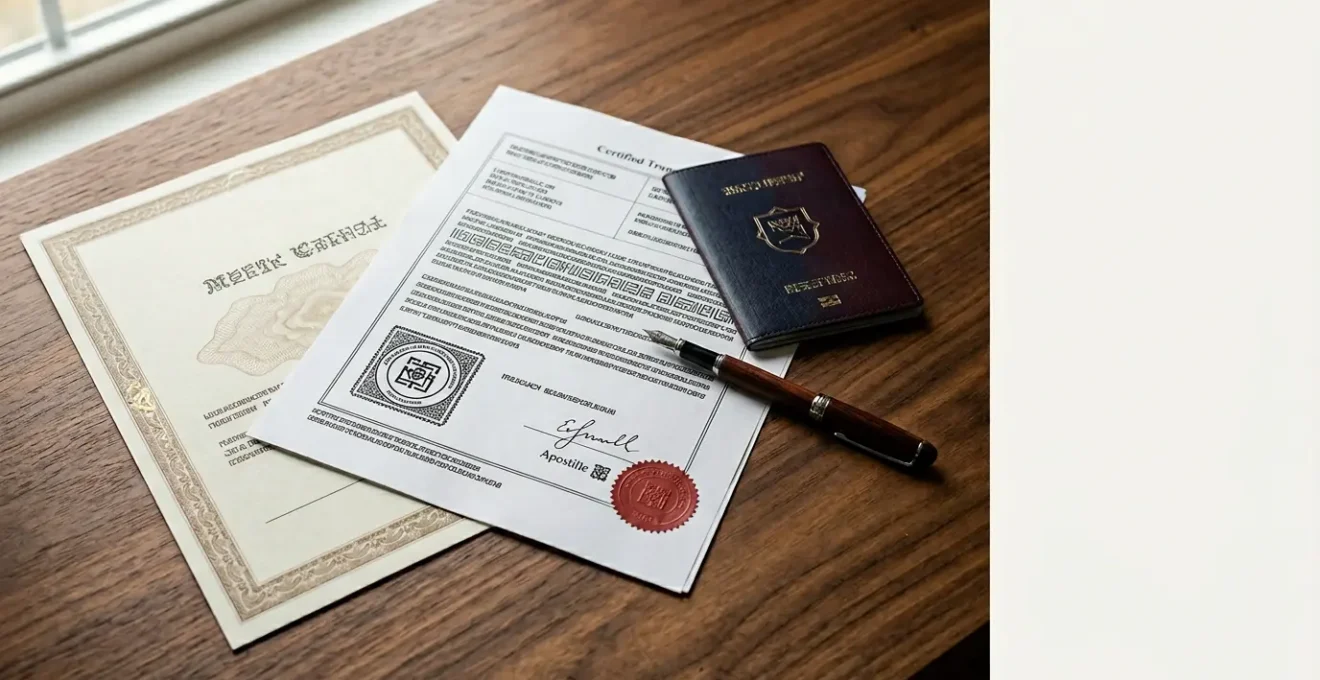
A non-certified translation is not a budget alternative; it is a procedural point of failure that guarantees your legal documents will be rejected by foreign governments.
- The legal validity of your marriage documents depends on an unbroken “chain of custody,” which machine translation or non-certified translators immediately sever.
- Mistakes like an unrecognized notary, a minor typo, or an expired Apostille lead to procedural nullity, halting your marriage application and incurring significant costs and delays.
Recommendation: Only a certified translation, often accompanied by an Apostille, has the legal standing to be accepted. Bypassing this is not a calculated risk; it is a certain administrative complication.
For couples planning a destination wedding, the budget is a primary concern. The temptation to reduce costs on administrative tasks like document translation is understandable. Many believe a tool like Google Translate or a bilingual friend can handle a birth certificate, assuming accuracy is the only requirement. This assumption is not just incorrect; it is the root of significant legal and financial complications. You cannot, under any circumstances, certify your own translation, as this completely invalidates the third-party verification that governments require.
The core issue is not linguistic accuracy alone, but procedural validity. Foreign governments, consulates, and legal bodies do not just need to understand the words on your documents; they need to trust their authenticity through a verifiable legal process. This process forms an unbroken “chain of custody” where each step—from the original document to the final translated version—is certified by a recognized authority. Using an uncertified method, no matter how accurate, breaks this chain at its most critical link.
But if the real issue isn’t just translation, but a complex legal framework, what are the specific points of failure? This article provides a technical deconstruction of the official translation process for marriage documents. We will move beyond the generic advice to “get it certified” and instead dissect the precise reasons why shortcuts lead to administrative dead-ends. We will examine the roles of notaries, the devastating impact of minor errors, the intricacies of timing, and the absolute necessity of the Apostille stamp. This is not a guide of best practices; it is a technical manual on avoiding procedural nullity.
This guide will detail the technical requirements for legal document translation, providing a clear map of the administrative landscape you must navigate for a legally recognized international marriage.
Summary: Certified Translation for International Marriage: A Technical Guide
- Why Your Local Notary Might Not Be Recognized Internationally?
- The Hidden Cost of Translating 4 Birth Certificates and Divorce Decrees
- How Long Does Sworn Translation Take During Peak Wedding Season?
- The Typo in Your Birth Place That Can Halt Your Marriage Application
- Agency vs. Freelancer: Who Handles Urgent Legal Translations Better?
- Passport vs. Marriage Certificate: Which Name Should You Book Travel Under?
- Why You Shouldn’t Apostille Your Birth Certificate 6 Months in Advance?
- The Apostille Stamp: What It Is and Why Your Wedding Certificate Is Void Without It?
Why Your Local Notary Might Not Be Recognized Internationally?
A common misconception is that any notary public can validate a document for international use. This is a critical error. A standard notarization in your home country simply verifies the identity of the person signing the document. It holds no inherent legal weight abroad. For a document to be accepted across borders, it must be authenticated through a process recognized by the destination country. The primary mechanism for this is the Hague Apostille Convention.
This international treaty simplifies the authentication process among member nations. An Apostille is a specific certificate, affixed to a public document (like a birth certificate or a notarized translation), that authenticates the origin of that document. As the U.S. Department of State clarifies, this system is recognized by 120+ member countries, making it the global standard. Without an Apostille, your local notary’s seal is merely an official-looking stamp with no authority in a foreign clerk’s office. This is a crucial point of failure; a document notarized but not apostilled is procedurally incomplete.
The distinction is technical but absolute, as explained by experts in legal documentation. As the team at Notarize.com points out:
An apostille is a certificate of authentication verifying the authenticity of a document to be used in one of the 120+ countries that are part of the Hague Apostille Convention.
– Notarize.com, What is an Apostille? Legal Documentation Guide
Therefore, the question is not whether your notary is legitimate, but whether their authority is certified for international use via an Apostille. Engaging a service that only offers standard notarization for an international document is paying for a functionally useless step. The document will be rejected, forcing you to start the process over, this time with the correct authentication procedure.
The Hidden Cost of Translating 4 Birth Certificates and Divorce Decrees
Opting for a “cheap” translation often means ignoring the bundled services that constitute a legally valid document package. The price quoted by a professional service is not just for converting words from one language to another; it covers a series of procedural necessities that uncertified options omit. The “hidden costs” of a cheap translation manifest when you are forced to pay for these missing services separately and under urgent deadlines.
A certified translation for legal purposes typically involves multiple components. These can include per-page translation fees, notarization fees (if required by the specific jurisdiction), charges for physical copies with “wet ink” signatures, and expedited service surcharges. Crucially, it can also include the service of obtaining the Apostille itself. When you receive a quote from a reputable translation agency, you are paying for an end-to-end service that ensures the final document is procedurally sound.
Consider the typical costs for a couple requiring translation for two birth certificates and two prior divorce decrees—four documents in total. An uncertified freelancer might quote a low per-page rate, but the couple is then left to navigate the separate, and often confusing, processes of notarization and apostilling. This piecemeal approach almost always results in higher total costs and significant administrative friction.
A professional service’s pricing structure, while initially appearing higher, reflects the true, all-inclusive cost of producing a legally compliant document. The following table, based on industry data, breaks down the typical components you should expect from a comprehensive service.
| Service Component | Typical Cost Range | Notes |
|---|---|---|
| Per-page translation (birth/divorce certificates) | $18 – $40 per page | Standard certification included |
| Notarization fee (if required) | $10 – $15 per document | Separate from translation cost |
| Physical copy with wet ink signature | $15 – $30 | Plus shipping costs |
| Expedited service (50% faster turnaround) | 50% surcharge | Rush processing fee |
| Apostille service | $20 – $30 per document | State-level authentication |
As this breakdown of certified translation services shows, the initial translation is only one part of the total cost. The real value is in the procedural guarantee that all necessary components are correctly assembled.
How Long Does Sworn Translation Take During Peak Wedding Season?
Time is a resource that cannot be recovered. During peak wedding season, typically from April to August, the demand for sworn and certified translators surges. Unlike standard translation, which has a vast pool of providers, the number of legally authorized sworn translators is finite. This creates a significant processing bottleneck that can severely impact your wedding timeline if not anticipated.
A sworn translation is not a simple task that can be completed overnight. It is a multi-stage process where each step has a specific duration. The translator must often work with the original physical document, not a digital copy, which immediately adds shipping time to the equation. Once received, the document enters a queue. During peak season, this queue can be substantial.
The core process involves several distinct phases: document verification, the translation itself, an independent quality check for legal accuracy, and finally, the application of the translator’s official stamp and seal. Each step is mandatory and cannot be skipped to save time. A rush job that bypasses the quality check, for example, risks introducing an error that could nullify the entire document. The timeline is not flexible; it is a sequence of necessary legal procedures.

This visualization helps to conceptualize the limited capacity and high demand that define this period. The total turnaround time is often much longer than couples expect. Here is a realistic breakdown of the timeline you must account for:
- Document Triage & Receipt Verification: 1 business day (work cannot begin until the translator has the physical document).
- Assignment to Available Sworn Translator: 1-3 business days (dependent on the queue, especially from April to August).
- Core Translation Work: 2-4 business days (varies with document complexity).
- Independent Proofreading & Quality Check: 1 business day (essential for legal accuracy).
- Certification, Stamping & Official Seal Application: 1 business day.
- Physical Shipping: 2-7 business days (depends on courier and destination).
Factoring in weekends, this process can easily take two to three weeks from the day you ship your documents. Attempting to start this process a month before your wedding is a high-risk strategy.
The Typo in Your Birth Place That Can Halt Your Marriage Application
In legal documentation, there is no such thing as a “minor” error. A single mistyped letter in a name or a wrongly transcribed place of birth can create a discrepancy that brings the entire application process to a halt. Government agencies and foreign consulates operate on a standard of exact-match verification. Their task is not to interpret your intent, but to verify that the information presented on the translated document is a perfect mirror of the original.
When you submit a birth certificate, for example, the clerk processing your marriage application will compare the translated version against your passport and other official IDs. If the spelling of your name or birthplace on the translation does not exactly match the spelling on your passport, it creates a red flag. This discrepancy breaks the chain of identity. The clerk has no authority to assume it’s a simple typo; they must treat it as a potential mismatch of identity, and the document is summarily rejected.
This is where the value of a certified translation service becomes paramount. A certified translator attests not only to the linguistic accuracy of the translation but also to its completeness and correctness as a replication of the original document. Their certification is a legal statement assuming responsibility for this exactness. This is a level of accountability that Google Translate or a non-professional cannot provide.
Case Study: USCIS Visa Application Success
A couple from Mexico applying for a U.S. spouse visa required their Spanish marriage certificate to be translated for USCIS submission. The professional service they engaged provided a certified translation that meticulously ensured all names, dates, and official seals were transcribed with 100% accuracy. Because of this precision, the visa application was approved smoothly, without any delays or requests for evidence that often arise from document discrepancies. This illustrates the principle that procedural correctness is the key to an uninterrupted application.
The consequence of a typo is not a simple request for correction. It often means you must have the document re-translated and re-certified from scratch, potentially including re-notarization and re-apostilling. The cost is not just financial; it’s the loss of weeks or even months in your application timeline, which can jeopardize your wedding date.
Agency vs. Freelancer: Who Handles Urgent Legal Translations Better?
When time is critical, the structure of the translation provider is as important as the skill of the individual translator. While a freelance translator may offer a lower price, a translation agency is structurally better equipped to handle urgent and complex legal translation projects. The key difference lies in project management and resource allocation.
A freelance translator is a single point of failure. If they fall ill, have a personal emergency, or are simply overbooked, your project stops. An agency, by contrast, maintains a roster of vetted, certified, and sworn translators. If one translator becomes unavailable, a project manager can immediately reassign the task to another qualified linguist, ensuring continuity and minimizing delays. This built-in redundancy is crucial for time-sensitive legal work.
Furthermore, agencies are designed for efficiency at scale. They possess workflow systems that a freelancer cannot replicate. For large projects, such as a family’s worth of documents or a complex divorce decree, an agency can leverage its team to expedite the process in a way a single person cannot.
Their project managers are scheduling wizards whose literal job is to ensure translation projects reach clients on time, every time. They can split files between multiple linguists, then use one proofreader to ensure consistency between sections.
– Circle Translations, Freelance Translators or Translation Agencies Guide
This ability to parallel-process work and then consolidate it under a single proofreader for consistency is a powerful advantage. It allows for a faster turnaround without sacrificing the quality and uniformity essential for legal documents. For a couple facing a tight deadline for their destination wedding, the robust infrastructure and professional project management of an agency provide a level of security and reliability that a freelance provider, no matter how skilled, typically cannot match.
Passport vs. Marriage Certificate: Which Name Should You Book Travel Under?
One of the most common and disruptive post-wedding travel mistakes involves a name mismatch between travel tickets and official identification. The rule is absolute and enforced by every airline and immigration authority worldwide: the name on your boarding pass must exactly match the name on the government-issued photo ID you present at security and passport control. For international travel, this ID is your passport.
Many couples, in their excitement, book honeymoon travel under a future married name. This is a critical error. Until you have legally changed your name and received a new passport reflecting that change—a process that takes weeks or months—your legal travel name remains the one on your current passport. An airline agent has no authority to accept a marriage certificate as a primary form of travel ID. A marriage certificate is supporting evidence of a name change; it is not a travel document.
Attempting to travel with a ticket in your married name and a passport in your maiden name will likely result in being denied boarding. The airline’s system is linked to government security databases like the Advance Passenger Information System (APIS), which flags mismatches automatically. This is not a matter of discretion for the check-in agent; it is a security protocol.

The only correct strategy is to book all travel using the name that is currently on your passport. Carry a certified copy of your marriage certificate as a supplementary document, but do not rely on it for check-in or immigration. The name change process for your passport should only begin after all planned international travel is complete.
- The Golden Rule: The name on your flight and hotel bookings MUST EXACTLY match the name on your passport.
- Book all honeymoon and post-wedding travel in the name currently on your passport.
- Do not attempt to travel internationally with a ticket in your new married name until you have a new passport in that name.
- Understand that airlines transmit passenger data to governments; a name mismatch is an automatic security flag.
- Wait to officially change your name on your passport until after your honeymoon is completed to avoid being denied boarding.
Why You Shouldn’t Apostille Your Birth Certificate 6 Months in Advance?
In the world of legal documents, “freshness” is a formal requirement. Many foreign governments and consulates will only accept official documents—and the Apostilles that authenticate them—if they have been issued within a specific timeframe. Getting your documents apostilled too far in advance is just as problematic as doing it too late. This is because an old Apostille can be considered stale and therefore invalid.
The logic behind this requirement is to ensure the document reflects the most current information and has not been superseded. While practices vary, a common standard is that the underlying document and its authentication should not be older than a few months. For instance, the Georgia Superior Court Clerks’ Cooperative Authority, which handles Apostilles, notes that many foreign governments require that official documents and their authentications be issued within a 3 to 6-month validity window. Submitting a birth certificate that was apostilled 8 months ago is a common reason for rejection.
This creates a complex timing challenge. You must initiate the process early enough to accommodate translation and processing times, but not so early that the documents expire before your submission deadline. The solution is to use a reverse timeline strategy, starting from your required submission date and working backward.
Action Plan: Reverse Timeline for Your Apostille
- Identify Wedding Date: Mark your definitive wedding date on a calendar.
- Determine Submission Deadline: Contact the foreign consulate or authority to confirm their document submission deadline (typically 30-60 days before the wedding). This is your key date.
- Subtract Shipping & Processing: From the deadline, subtract time for international shipping (7-14 days), Apostille processing by your Secretary of State (check current times, as they vary wildly), and translation (1-3 weeks).
- Calculate Request Window: This calculation reveals your optimal window to request the Apostille, ensuring the “issue date” falls within the required 3-6 month freshness period upon submission.
- Add a Buffer: Always add a 2-3 week buffer to this timeline to account for unexpected postal delays, government office backlogs, or requests for additional information.
This methodical approach turns a guessing game into a predictable project plan, ensuring your documents are both ready on time and considered legally “fresh” by the receiving authority.
Key Takeaways
- A certified translation is a legal necessity, not a style choice. Its purpose is procedural validity, not just linguistic accuracy.
- The Apostille is the standard for international document authentication; a simple notary seal is insufficient and will lead to rejection.
- Budgeting for translation must include all procedural costs (notarization, shipping, Apostille fees) to avoid surprise expenses and delays.
The Apostille Stamp: What It Is and Why Your Wedding Certificate Is Void Without It?
The Apostille is perhaps the most misunderstood yet most critical component in the legal chain of custody for international documents. It is not a stamp of approval on the content of your document. An Apostille does not certify that the facts on your birth certificate are true. Its function is far more specific and technical: it authenticates the signature and seal of the public official who issued the document. It verifies that the document is a legitimate public record from its country of origin.
As the official guidance from the Georgia Superior Court Clerks’ Cooperative Authority clarifies, “The apostille authenticates the signature and seal of the issuing public official or notary public… It does not authenticate the contents of the document.” This distinction is vital. It is the proof that your document is not a forgery. Without it, a foreign clerk has no basis to accept your birth certificate or certified translation as an official record.
For a destination wedding, the Apostille journey happens twice. First, you must obtain Apostilles in your home country for your source documents (birth certificates, divorce decrees) to prove your eligibility to marry abroad. After your wedding, you will receive a marriage certificate issued by the foreign country. This new document, on its own, has no legal standing back home. You must then complete the process in reverse, obtaining an Apostille from the competent authority in the foreign country for your new marriage certificate. Without this second Apostille, your home government will not recognize your marriage for the purposes of changing your name on a passport, filing taxes, or other legal acts.
The entire two-way process is non-negotiable and follows a strict sequence:
- Phase 1 – Pre-Wedding: Obtain Apostilles for your birth certificates/divorce decrees from your home state.
- Phase 2 – Submission: Present these apostilled documents to the foreign authority to be cleared for marriage.
- Phase 3 – Foreign Marriage: Legally marry and receive a foreign-issued marriage certificate.
- Phase 4 – Foreign Apostille: Get an Apostille for your new marriage certificate from the foreign country’s government.
- Phase 5 – Recognition at Home: Present the foreign marriage certificate with its foreign Apostille to your home government agencies.
A destination wedding certificate without a foreign Apostille is, for all legal intents and purposes, just a souvenir. It is the Apostille that gives it legal force in your home country.
To avoid procedural nullity and ensure the full legal validity of your international marriage, the next step is to engage a professional service that guarantees both ATA-certified translation and manages the complex Apostille process on your behalf.