In summary:
- Managing heat at an Italian summer wedding is a logistical challenge, not just a matter of providing water and fans.
- Adopt a producer’s mindset: proactively choreograph the guest experience around the sun’s path, regional infrastructure, and venue limitations.
- Prioritize a later ceremony timeline (after 5:30 PM) to align with cooler temperatures and the “golden hour” for photography.
- Assess the total “guest experience value” of a region, factoring in travel accessibility and microclimates, not just venue cost.
- Strongly consider a symbolic ceremony in Italy after handling the legal marriage in your home country to avoid significant bureaucratic stress.
Benvenuti! The dream of a mid-summer wedding in Italy is a beautiful one: sun-drenched landscapes, long golden evenings, and the vibrant joy of an alfresco celebration. But as producers, we know the reality behind this romantic vision. The same glorious sun that paints the Tuscan hills can become an adversary, turning a dream day into a sweltering ordeal for your guests. Many couples think the solution lies in providing hand fans and chilled water, but this is merely a reaction, not a strategy. True Italian hospitality is about anticipation and care, ensuring your loved ones feel cherished and comfortable from the moment they arrive.
The secret to a flawless summer wedding isn’t just about mitigating the heat; it’s about mastering it. It requires a shift in thinking, from simply hosting an event to producing an experience. We call this environmental choreography. This is the art and science of orchestrating every element—from the timing of your vows and the flow of your aperitivo to the power demands of your band and the very structure of your menu—to work in harmony with the climate, not against it. It’s a system designed to protect your guests’ energy and elevate their enjoyment.
This guide will walk you through that professional framework. We will deconstruct the key logistical pillars that transform a potentially hot and stressful day into a seamless, joyful, and utterly memorable Italian celebration. We will explore how to create abundant shade, design a heat-proof timeline, choose the right region, navigate local challenges like Ferragosto, and ensure every technical and culinary detail contributes to your guests’ absolute comfort.
This article provides a complete roadmap for planning a comfortable and elegant summer wedding in Italy. Below, the table of contents outlines the key production strategies we will cover, from guest comfort and logistics to legal considerations.
Summary: A Producer’s Guide to a Comfortable Italian Summer Wedding
- Why You Need Twice as Much Shade as You Think for an Italian Aperitivo?
- The Best Timeline for an August Ceremony to Avoid the Mid-Day Sun
- Lake Como or Tuscany: Which Region Is More Accessible for International Guests?
- The Risk of Planning a Wedding During Ferragosto Week in Italy
- How to Power a Full Band in a Villa Garden Without Tripping the Circuit?
- Loire Valley or Provence: Which Offers Better Value for a 3-Day Buyout?
- How to “Deconstruct” Local Dishes to Make Them Approachable?
- How to Ensure Your Destination Marriage Is Actually Legal Back Home?
Why You Need Twice as Much Shade as You Think for an Italian Aperitivo?
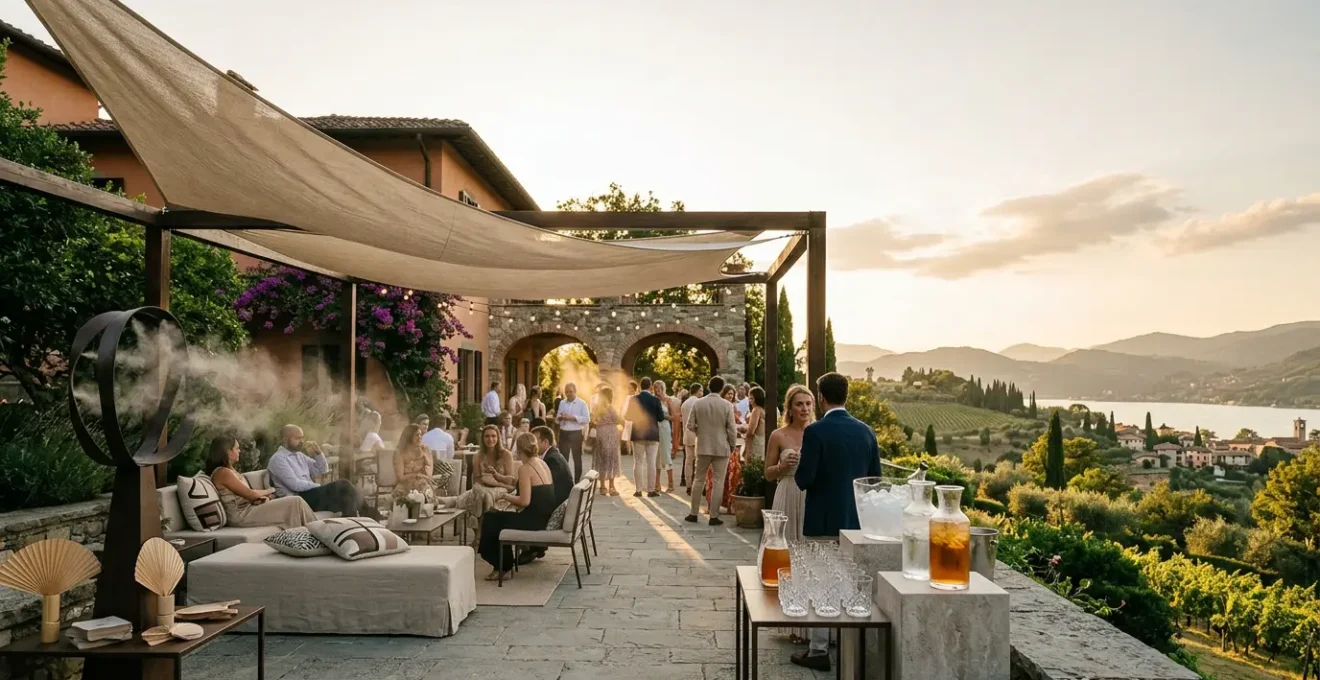
The Italian aperitivo is a cornerstone of the celebration—a relaxed, flowing two-hour period of mingling and merriment. In August, however, it can quickly become the most uncomfortable part of the day. The sun, even in the late afternoon, is intense. As producers, we see couples consistently underestimate the amount of shade required. It’s not just about having a few umbrellas; it’s about creating a comprehensive thermal comfort blueprint. With peak summer temperatures often reaching an average high of 30.6°C (87.1°F) in Rome, providing inadequate shade is a critical failure in hospitality.
The key mistake is assuming a single tree or a small pergola will suffice. You must account for the sun’s trajectory; the shade you have at 4:00 PM can completely vanish by 6:00 PM. A successful aperitivo requires layers of shade and dedicated cooling zones that allow guests to escape the sun’s direct glare entirely. This isn’t just an aesthetic choice; it’s a health and safety necessity. Guests in formal wear will not enjoy themselves if they are forced to stand in direct sun, and the entire energy of your event will plummet before dinner has even begun. You need enough shaded space for 100% of your guests to be comfortable at the same time, not just 50%.
A multi-layered approach to shade is the professional standard. It combines natural elements with elegant structural solutions to guarantee comfort throughout the entire aperitivo. Here are the essential layers to consider:
- Natural Shade Priority: Always start by maximizing existing natural shade. Position the main aperitivo areas under mature olive groves or established, vine-covered pergolas that provide deep, consistent coverage.
- Sailcloth Structures: Deploy chic, airy sailcloth tents as a secondary layer. Unlike heavy marquee tents, they provide elegant UV protection while allowing crucial air circulation, which is essential in temperatures over 30°C.
- Cooling Zone Design: Go beyond just shade by creating dedicated comfort stations. Combine misting fans, cool stone benches that don’t retain heat, and refreshment stands offering iced towels or hydrating facial mists.
- Sun-Tracking Reconnaissance: A non-negotiable step is to conduct a site visit at the exact time of your aperitivo or use a sun-tracking app. This allows you to map the sun’s path and ensure your shaded zones will remain effective for the full two-to-three-hour duration.
- Flexible Backups: High-quality, large cantilever umbrellas are your flexible reserves. Use them to fill in any sun-exposed gaps where permanent solutions are not feasible. Prioritize function over pure aesthetics for the sake of guest well-being.
By thinking of shade not as an add-on but as the foundational infrastructure of your aperitivo, you ensure the celebration begins with a feeling of relaxed, sophisticated comfort—the very essence of Italian hospitality.
The Best Timeline for an August Ceremony to Avoid the Mid-Day Sun
One of the most significant decisions in your environmental choreography is the wedding timeline. A common mistake we see with international couples is attempting to apply a standard home-country timeline to an Italian summer climate. A 3:00 PM ceremony in August in Tuscany or Puglia is a recipe for disaster, exposing your guests (and yourselves) to the most brutal heat of the day, typically between 12:00 PM and 4:00 PM. The best approach is to work backward from the most beautiful light, not forward from an arbitrary start time.
The professional strategy is to reverse-engineer your timeline from sunset. The “golden hour”—that magical period of soft, warm light just before the sun dips below the horizon (typically 7:45-8:30 PM in August)—is not only the best for photography but also coincides with a significant drop in temperature. By anchoring your timeline to this moment, you naturally create a more comfortable experience for everyone. This means pushing your ceremony much later than you might instinctively plan.
This late-afternoon timeline allows you to capture stunning portraits in perfect light, while your guests transition comfortably from a beautiful, temperate ceremony to a magical evening aperitivo as the day cools. The visual below captures the very essence of this strategy, showing a ceremony space bathed in the warm, gentle glow of the late Italian afternoon—the reward for strategic timing.
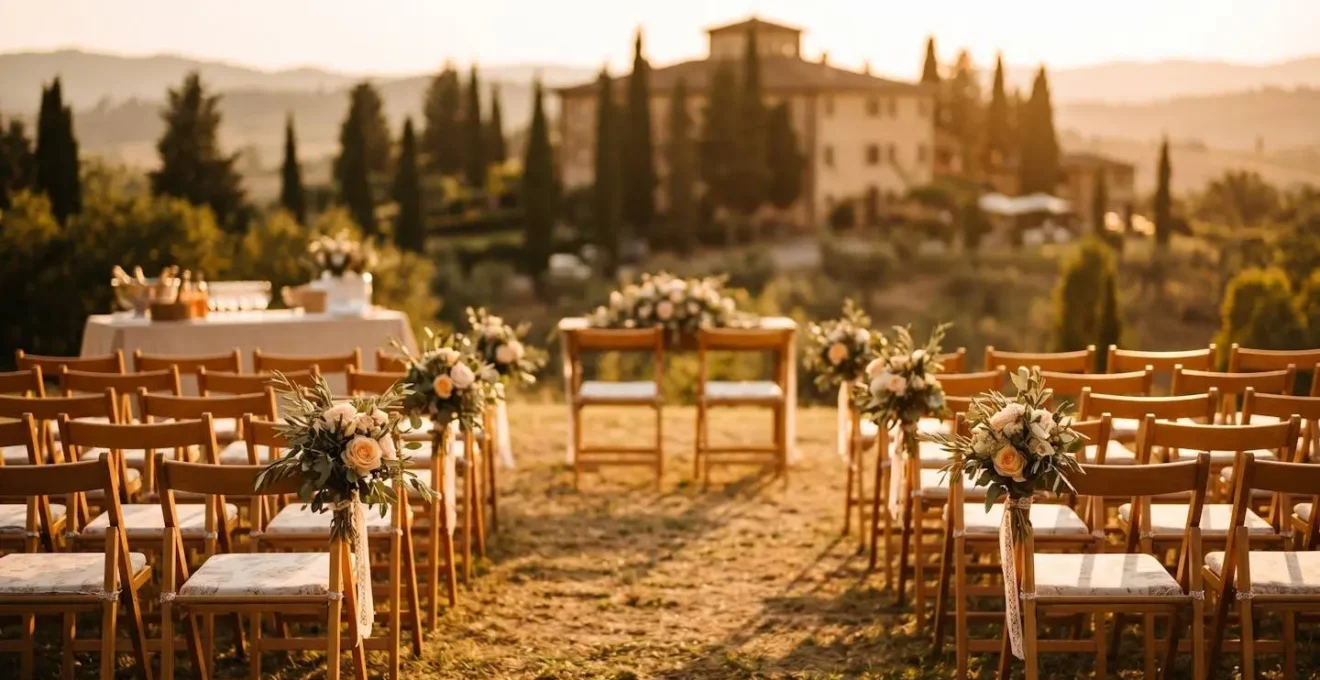
As you can see, the quality of light transforms the atmosphere. This is the ambiance you are aiming for. Alternatively, for a full-day celebration, consider embracing the traditional Italian ‘riposo’ (rest period) model. This involves a late morning ceremony, a light lunch, and then a long afternoon break for guests to swim, nap, and recharge before reconvening in the early evening for the main reception. This civilized pace is perfectly adapted to the climate and allows guests to truly enjoy every part of the day without fatigue.
Regardless of the model you choose, a dedicated pre-ceremony welcome station is essential. This is a fully shaded area, separate from the ceremony seating, where guests can relax for 30-45 minutes before the proceedings begin. Equip it with cold beverages, comfortable seating, and hand fans. This structured comfort prevents guests from waiting in exposed seating during the hottest pre-ceremony moments.
Ultimately, a later start is not a compromise; it is an upgrade. It demonstrates a thoughtful consideration for guest comfort and results in a more energetic, beautiful, and enjoyable celebration for all.
Lake Como or Tuscany: Which Region Is More Accessible for International Guests?
Choosing a region is about more than just aesthetics; it’s a critical logistical decision that directly impacts guest comfort, especially in summer. While the rolling hills of Tuscany are iconic, the practical experience of getting there and navigating the area in August can be challenging. Lake Como, with its unique geography, often presents a more accessible and temperate option for international guests. The “final leg” of the journey—the last 60-90 minutes of travel to the venue—sets the tone for the entire experience. A scenic, breezy ferry ride across Lake Como is a far more pleasant welcome than a hot, stuffy car ride through the Tuscan countryside.
Lake Como benefits from its proximity to Milan’s major international airports (Malpensa and Linate) and an excellent train system. More importantly, its alpine microclimate and the thermal mass of the vast lake create cooler, breezier conditions than the intense, humid inland heat of Tuscany. The very nature of the venues differs as well. Como is known for contained, single-property villas where guest flow is centralized. Tuscan venues are often sprawling ‘borgo’ estates, requiring guests to walk long distances on sun-drenched paths between accommodations, the ceremony, and the reception.
While Tuscany can offer better value on venue rentals, a complete analysis must include the “guest experience value.” According to a 2026 regional budget analysis, typical venue costs in Tuscany range from €1,330-€11,000, whereas Lake Como’s premium venues are higher. However, a lower-cost but remote and sweltering Tuscan villa may ultimately provide a poorer overall experience than a slightly pricier but more accessible and comfortable Como location. The following table breaks down these key differences.
| Factor | Lake Como | Tuscany |
|---|---|---|
| Airport Access | Milan Malpensa/Linate (1 hour), excellent train connections | Florence Airport (30-45 min) or Pisa Airport (1-1.5 hours), good highway access |
| Final Leg Experience | Scenic ferry ride across lake with cooling alpine breezes—arrival is part of the experience | Potentially long drive through hot Tuscan hills to remote villas in non-air-conditioned vehicles |
| August Microclimate | Cooler due to alpine breezes and thermal mass of water; more temperate feel despite summer heat | Intense, humid, stagnant inland heat; temperatures 28-35°C with limited natural cooling |
| Venue Layout Style | Contained single-property villas; easier to navigate, centralized guest flow, minimal sun exposure between spaces | Sprawling ‘borgo’ estates requiring long walks on sun-drenched paths between ceremony, reception, and accommodations |
| Heat-Stress Travel Time | Lower overall heat stress; water proximity and breezy ferry transport reduce discomfort | Higher heat-stress factor during ground transfers and on-property navigation in peak afternoon heat |
This doesn’t mean Tuscany is a poor choice—it’s magnificent. It simply means that for a mid-summer wedding, you must be prepared to invest more heavily in on-site heat mitigation (shade, cooling, transport) to achieve the same level of guest comfort that Lake Como may offer more naturally.
The Risk of Planning a Wedding During Ferragosto Week in Italy
There is one week in August that every seasoned Italian producer treats with extreme caution: Ferragosto. Centered around the national holiday on August 15th, this period (roughly August 10th-20th) is when the entire country goes on vacation. While this may sound festive, for a wedding, it creates a perfect storm of logistical chaos. Infrastructure is strained to its breaking point, vendor availability plummets, and costs skyrocket. Planning a wedding during this week without understanding the risks is one of the most significant and costly mistakes a couple can make.
The primary issue is that the country’s entire service and transport infrastructure becomes overwhelmed. Highways are gridlocked with ‘bollino nero’ (black dot) traffic, trains are fully booked and run on reduced holiday schedules, and local taxis are nearly impossible to find. What is normally a one-hour airport transfer can easily become a three-hour ordeal, wrecking carefully planned timelines and leaving guests exhausted and stressed before they even arrive at the venue. This isn’t a minor inconvenience; it’s a systemic shutdown.
Furthermore, many of your most essential vendors—from florists and musicians to hair and makeup artists—take their own holidays during this time. Those who are willing to work often charge significant surcharges of 20-40%. Outside of your venue, local life largely closes down. Restaurants, shops, and attractions may be shut, leaving your guests with limited options for entertainment outside of your planned events. This “guest captivity” scenario requires you to provide all amenities on-site.
Case Study: The Real Travel Impact of Ferragosto
A couple driving from Lake Como to Chianti during Ferragosto experienced a journey that should have taken under 5 hours but instead took 10 hours due to bumper-to-bumper holiday traffic on the Autostrada A1. This real-world case, documented by More Time to Travel, demonstrates how the national holiday creates massive infrastructure strain. The conditions included ‘bollino nero’ traffic, fully booked trains, overwhelmed local taxis, and even cellular network congestion, turning routine one-hour transfers into three-hour ordeals that can wreck wedding timelines and severely impact guest comfort.
If your dates are inflexible and fall within this period, a survival strategy is essential. You must confirm and lock in all vendor contracts at least 18 months in advance, build 2-3 times the normal travel time into all logistical planning, and create a “Ferragosto Survival Guide” for your guests with realistic expectations and pre-booked reservations. The simplest solution? If possible, schedule your wedding for early August (1-10) or late August (21-31) to avoid the peak chaos.
Ignoring Ferragosto is not an option. Acknowledging its impact and planning for it meticulously is the only way to protect your budget, your timeline, and your guests’ experience.
How to Power a Full Band in a Villa Garden Without Tripping the Circuit?
You’ve found the perfect historic villa with a breathtaking garden for your reception. The dream is a full band playing under the stars as your guests dance the night away. The hidden reality? The villa’s charming, ancient electrical system was designed for lamps and a refrigerator, not for a modern event’s “power perfect storm.” The simultaneous demands of a full band’s sound system, the catering team’s warming ovens, and extensive decorative lighting can require 60-100+ amps. A typical domestic villa circuit provides only 15-30 amps. Without a professional power strategy, a blackout is not a risk; it’s a near certainty.
This is a critical, behind-the-scenes aspect of event production that is often overlooked. The solution is almost always an external power source, but simply renting any generator is another common mistake. Standard construction generators are noisy and produce foul-smelling fumes, completely destroying the romantic ambiance you’ve worked so hard to create. The professional standard is to invest in a ‘silent’ or ‘film-grade’ generator. Just as important is its strategic placement—hidden behind a building or dense hedge at least 50 meters from the reception, with all wiring concealed using camouflaged cable ramps.
The image below shows the kind of discreet, professional infrastructure required. It’s not about the generator itself, but the meticulous planning that makes its presence unfelt, ensuring the magic of the evening is uninterrupted by technical failures.
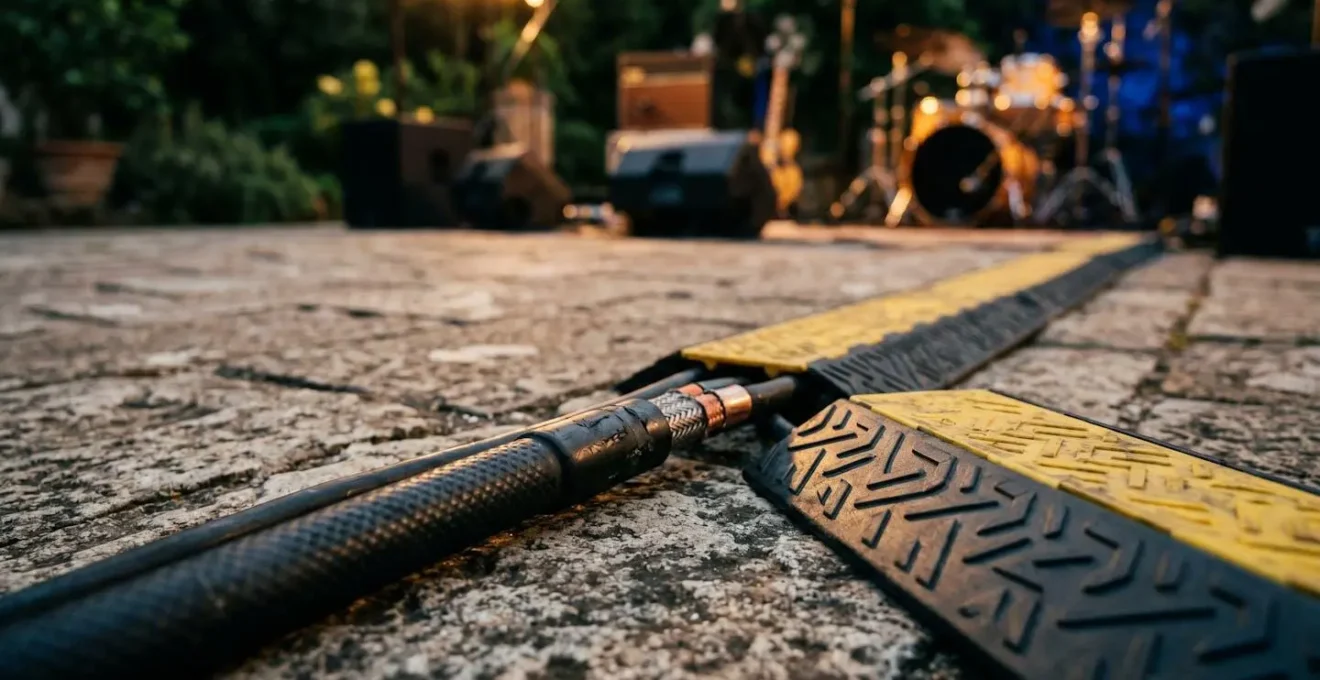
As you can see, the focus is on seamless integration. The reality of villa power, as many a seasoned planner will attest, is that you must bring your own robust infrastructure. Creating redundant power zones with a certified local electrician is another key step. This means mapping separate circuits for critical systems (band, catering, lighting) so that if one trips, it doesn’t cause a total blackout. This is not a DIY task; it requires expert assessment and execution.
A non-negotiable part of this process is a full technical audit and load test. This ensures that on the day of your wedding, the only sparks flying are the romantic ones.
Your Action Plan: Villa Power Grid Audit
- Mandatory Technical Walkthrough: Schedule a site inspection with your planner, band leader, AND a certified local electrician to assess the villa’s actual available amperage versus the total required amperage for the event. This is non-negotiable.
- Map the ‘Power Perfect Storm’: Itemize every single electrical component: band equipment, all catering appliances (warming ovens, refrigerators, coffee machines), and every string of decorative lighting. Sum their power requirements to get your total load.
- Specify a Silent Generator Solution: In your rental contracts, specify a ‘silent’ or ‘film-grade’ generator. Plan its placement for minimal noise and visual impact, at least 50 meters away from guests.
- Design Redundant Power Zones: Work with the electrician to create and map separate circuits for critical systems (e.g., Zone 1: Band; Zone 2: Catering; Zone 3: Lighting). This isolates potential failures.
- Conduct a Full Load Test: One or two days before the wedding, run all equipment simultaneously for at least 30 minutes. This is your only chance to identify and fix weaknesses before the first dance.
Power is the invisible foundation of your reception. Securing it professionally means you can relax and enjoy the music, knowing the lights will stay on.
Loire Valley or Provence: Which Offers Better Value for a 3-Day Buyout?
To truly master the art of a summer wedding in Italy, it is wise to look at other European regions that have perfected the hot-weather celebration. In France, planners face a similar choice between the temperate, formal Loire Valley and the hot, rustic-chic Provence. The strategies used in Provence, a region built around managing intense summer heat, offer a powerful playbook for anyone planning a wedding in Tuscany, Puglia, or Sicily. The key lesson is to redefine “value” beyond just the venue cost and focus on the total guest experience value. A cheaper venue that is brutally hot offers poor value; a venue that invests in guest comfort commands its price.
The Loire Valley, with its grand châteaux and formal gardens, is analogous to Italy’s Lake Como. Here, the appeal is prestige and structure, and the climate is more forgiving. Provence, with its sprawling lavender fields and relaxed ‘mas’ properties, is the counterpart to a Tuscan ‘borgo’ or a Puglian ‘masseria’. In Provence, event design is dictated by the heat: timelines are late, menus are chilled, and elegant shade structures like sailcloth tents are standard. This heat-centric approach is precisely what’s needed for a successful southern Italian wedding.
When comparing a 3-day buyout, the value formula changes. In the Loire, value is `Venue Cost / (Formality + Prestige)`. In Provence, it becomes `Venue Cost / (Guest Comfort + Heat Mitigation Quality)`. Italian summer weddings must adopt the Provence model. The following table adapts this French framework to the Italian context, showing how these principles translate directly.
| Characteristic | Loire Valley (France) Analog | Provence (France) Analog | Italian Equivalent |
|---|---|---|---|
| Formality & Structure | Structured, grand château estates with formal gardens | Relaxed, sprawling lavender-field properties with rustic charm | Lake Como (Loire-like: formal, grand) vs. Puglia Masseria (Provence-like: rustic, heat-focused, relaxed) |
| Heat Management Priority | Lower—temperate climate, less focus on cooling infrastructure | Higher—intense summer heat drives design: sailcloth tents, late timelines, chilled soups, rosé focus | Tuscan and Southern Italian venues must adopt Provence playbook: strategic shade, cooling stations, temperature-appropriate menus |
| Guest Experience Value Formula | Value = (Venue Cost) / (Formality + Prestige) | Value = (Venue Cost) / (Guest Comfort + Heat Mitigation Quality) | Apply Provence model: A cheaper remote Tuscan villa in brutal heat = poor value; Pricier accessible Lake Como villa with natural cooling = high value |
| Buyout Cost Comparison | €25,000-45,000 for 3-day château exclusivity (80-120 guests) | €20,000-40,000 for 3-day mas/bastide with heat-optimized design | Tuscany villa: €20,000-25,000 (2-3 nights); Lake Como: €14,000-28,000 venue fee (higher total costs); Puglia: €15,000-22,000 (best value) |
The lesson is clear: for a summer wedding in a hot Italian region, you are not just renting a property; you are investing in a climate-controlled experience. Importing these proven strategies from Provence is the smartest way to ensure success:
- Adopt Sailcloth Tent Architecture: Specify elegant, airy sailcloth structures (‘voile d’ombrage’) that provide shade while promoting airflow.
- Implement a Heat-Optimized Timeline: Push the ceremony to 6:00 PM or later, with dinner starting after 9:00 PM as temperatures drop.
- Design a Temperature-Appropriate Menu: Emphasize chilled soups, sophisticated room-temperature dishes, and a continuous flow of small plates over heavy, hot courses.
Ultimately, a successful summer buyout is measured by the smiles on your comfortable, happy guests’ faces, a principle the producers in Provence mastered long ago.
How to “Deconstruct” Local Dishes to Make Them Approachable?
An authentic Italian wedding menu is a feast for the senses, but a traditional multi-course meal (antipasto, primo, secondo, dolce) can feel heavy and overwhelming in 30°C heat. The key to a successful summer menu is not to abandon Italian culinary traditions, but to strategically deconstruct them. This means adapting classic dishes and the meal structure itself to be lighter, cooler, and more interactive, ensuring your guests are refreshed and energized rather than weighed down.
The first method is “uncooking” through temperature transformation. This involves reimagining hot classics as chilled or room-temperature versions. For example, a hearty, hot Ribollita soup is transformed into a sophisticated, chilled Pappa al Pomodoro gazpacho. A traditional hot pasta course can be swapped for an elevated pasta salad featuring the best local olive oil and fresh seasonal vegetables. The authenticity remains in the quality of the ingredients and the flavor profiles, but the presentation is perfectly aligned with the climate.
Another powerful strategy is to deconstruct the dishes themselves into interactive “build-your-own” stations. This not only accommodates a wide range of dietary preferences but also reduces heat in the kitchen and creates a fun, engaging atmosphere. Imagine a Bruschetta Bar with a dozen different toppings, or a Caprese Station showcasing various heirloom tomatoes and artisanal mozzarella. This format empowers guests and turns the meal into a dynamic part of the entertainment. You can even deconstruct the entire meal structure, opting for a ‘grand aperitivo’ or ‘apericena’ format—a continuous flow of elegant, cicchetti-style small plates that replaces the formal, seated progression.
This approach allows you to showcase the best of Italy’s renowned cold classics, dishes inherently designed for warm weather. Here’s how you can apply this philosophy:
- Leverage Italian Cold Classics: Build your menu around naturally temperature-appropriate dishes like Vitello tonnato, insalata di mare (seafood salad), carpaccio variations, and burrata served with seasonal fruit.
- Rethink the Primi/Secondi Structure: If a traditional structure is desired, serve the hot courses only after sunset (9:00 PM or later) when the air has cooled significantly. Keep all earlier courses chilled or at room temperature.
- Focus on Interactive Stations: Deconstruct classics into customizable stations (e.g., pasta, bruschetta, caprese) to increase guest engagement and cater to diverse tastes and dietary needs.
By deconstructing the menu with intention, you honor the spirit of Italian cuisine while delivering a dining experience that is both authentic and perfectly suited to a magical summer evening.
Key Takeaways
- Heat is a production challenge, not just a weather issue. Address it with a systemic approach covering shade, timing, power, and food.
- Think like a producer, not just a host. Choreograph the entire guest experience by anticipating needs and controlling the environment.
- For international guests, the symbolic ceremony is the most intelligent path, preserving the romance while eliminating immense bureaucratic stress and uncertainty.
How to Ensure Your Destination Marriage Is Actually Legal Back Home?
Amidst all the creative and logistical planning, there is one crucial detail that can be easily overlooked: the legal validity of your marriage. The process of getting legally married in Italy as a non-resident is notoriously complex, bureaucratic, and time-consuming. As producers, our strongest recommendation to nearly all our international couples is to embrace the symbolic ceremony strategy. This means getting legally married in a simple civil ceremony in your home country before or after your trip. You can then have a deeply personal, meaningful symbolic ceremony in Italy without any of the governmental red tape.
Opting for a legal ceremony in Italy involves a labyrinthine process that includes securing a ‘Nulla Osta’ affidavit from your home country’s consulate in Italy, obtaining an Apostille-certified ‘Atto Notorio’ from an Italian consulate in your home country, and coordinating with the local ‘comune’ (town hall). The hidden “costs” go far beyond paperwork fees; they include the stress of navigating offices where staff may only speak Italian, the risk of translation errors invalidating documents, and inflexibility with timing and location. According to Italian marriage requirements for US citizens, the entire process can take up to two months, often requiring a mandatory in-country presence for court appearances a week or more before the ceremony.
The symbolic route frees you from all of this. It allows you to have your ceremony anywhere you wish—in a villa garden, an olive grove, or on a cliffside—officiated by a friend, family member, or a professional celebrant who can craft a ceremony that is 100% about you. There are no scripts, no restrictions, and no bureaucratic hurdles. Your Italian celebration becomes purely about the romance and commitment, while the legal validity is already secured and guaranteed back home.
If a legal ceremony in Italy is non-negotiable for personal or religious reasons, the critical step is to hire a specialized legal fixer. Most wedding planners are creative and logistical experts, not lawyers versed in the nuances of Italian marriage bureaucracy. A dedicated agency that handles only the legal paperwork will isolate this complexity from your creative planning process, ensuring it is handled correctly without derailing the rest of your preparations.
By separating the legal act from the celebratory one, you give yourself the freedom to focus on what truly matters: creating a beautiful, personal, and stress-free celebration of your love in one of the most romantic settings on earth.