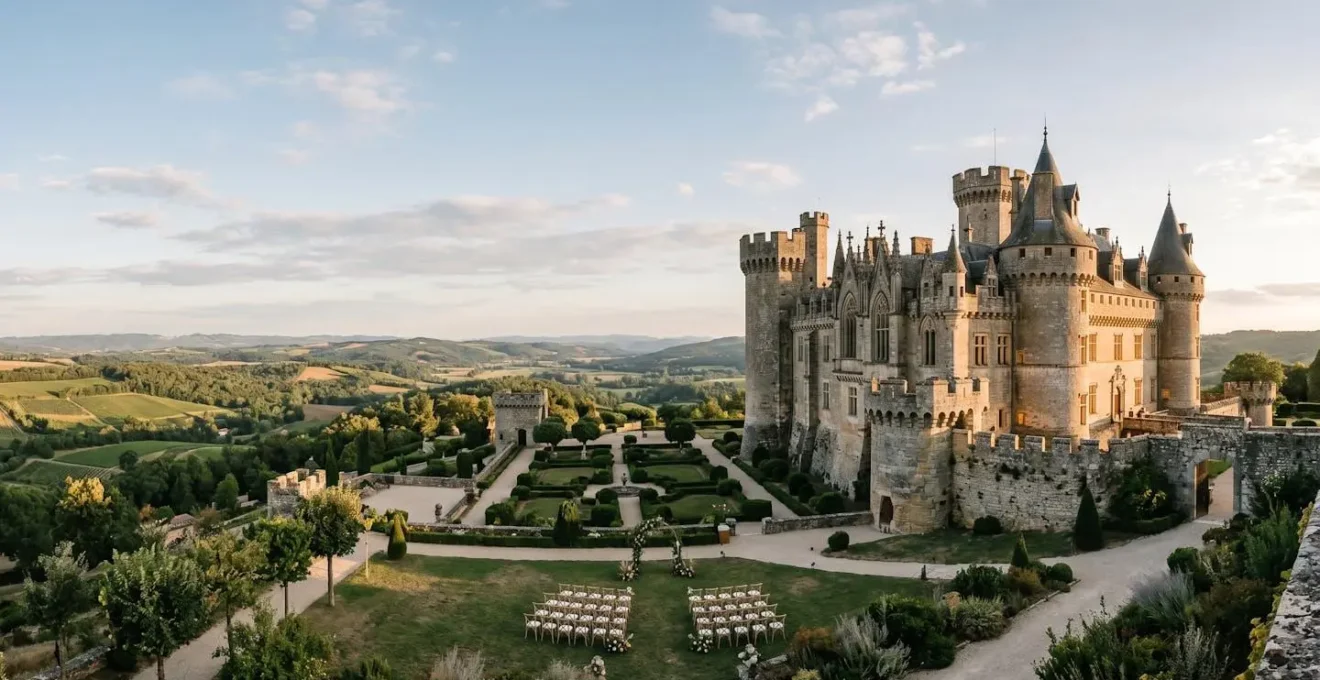
The fairytale of a castle wedding often hides a reality of strict logistical, structural, and regulatory constraints that can derail your plans and budget.
- Historic buildings are bound by preservation rules that impact everything from heating and power to accessibility and decorations.
- Amenities you take for granted (modern plumbing, ample power outlets, even ground) are not guaranteed and often require costly workarounds.
Recommendation: Shift your mindset from simply ‘booking a venue’ to ‘becoming an informed partner’ with the property, proactively auditing its limitations to manage expectations and costs effectively.
The allure of a historic European castle wedding is undeniable. You picture yourselves exchanging vows against a backdrop of ancient stone, celebrating in a grand hall steeped in history, and creating a memory that feels timeless. It’s a dream shared by many couples charmed by the romance and grandeur of a bygone era. This dream, however, is often built on a cinematic fantasy that conveniently ignores the practical realities of a 15th-century structure.
While most wedding advice focuses on aesthetics and capacity, the real challenge of a heritage venue lies in its inherent limitations. These are not flaws but features of its history—limitations on heating, accessibility, power, and even candlelight. Ignoring them leads to surprise costs, guest discomfort, and last-minute crises. The key is not to abandon the dream, but to approach it with the informed realism of a heritage specialist.
But what if the secret to a successful castle wedding wasn’t just finding the perfect-looking venue, but understanding its structural and regulatory soul? The true magic happens when you learn to negotiate with the past, anticipating the constraints imposed by history and preservation. This guide moves beyond the surface-level checklist to reveal the critical questions you must ask, demystifying the hidden logistical challenges of booking a historic castle for a large wedding.
We will explore the practical realities of heritage properties, from the physics of keeping guests warm in a stone fortress to the legalities of fire safety. By understanding these core constraints, you can transform potential disasters into manageable expectations and ensure your historic wedding is remembered for its magic, not its mishaps.
Summary: Your Guide to Navigating the Realities of a Castle Wedding
- Why Ancient Castles Often Fail to Keep Guests Warm in October?
- How to Make a 15th-Century Fortress Accessible for Elderly Guests?
- Open Flame vs. LED Candles: Understanding Heritage Site Restrictions
- The Generator Cost Trap That Surprises Couples at Remote Castles
- How to Fix Echo Issues in Large Stone Banqueting Halls?
- Why “Sleeps 20” in a Chateau Usually Means Shared Bathrooms?
- Hay Bales and Sparklers: The Fire Risk You Must Avoid in Wood Barns
- How to Transformation a Dull Venue Using Only Lighting Techniques?
Why Ancient Castles Often Fail to Keep Guests Warm in October?
One of the most common—and uncomfortable—surprises at an autumn castle wedding is the persistent chill. The issue isn’t negligence; it’s physics. Ancient stone walls possess immense thermal mass, meaning they absorb and store heat very slowly. During the day, they soak up warmth, but as evening falls, they begin radiating cold, actively pulling heat from the air and your guests. A standard heating system, even if functional, is often no match for this effect in a cavernous space filled with over 100 people.
This isn’t just a comfort issue; it can be a catastrophic failure. For example, a lawsuit following a wedding at a US castle venue highlighted how an inadequate HVAC system failed to handle the thermal load of nearly 200 guests, leading to extreme temperatures. While that case involved heat, the principle is identical for cold: historic systems are rarely designed for modern, large-scale events. You must verify that the venue has a specific, robust heating plan for large gatherings, not just for day-to-day operations. This might include powerful, silent radiant heaters or underfloor systems in key areas.
The solution is a combination of proactive inquiry and thoughtful planning. Ask the venue manager directly about their experience managing thermal mass challenges in October. Beyond the heating system itself, consider elegant solutions like a “comfort station” with high-quality pashminas or blankets. A simple note on your wedding website encouraging guests to bring an elegant layer can also make a significant difference, turning a potential problem into a thoughtful gesture.
How to Make a 15th-Century Fortress Accessible for Elderly Guests?
The very features that make a 15th-century fortress so enchanting—spiral staircases, uneven cobblestones, raised thresholds, and sprawling grounds—are logistical nightmares for elderly guests or those with mobility impairments. A venue being “technically accessible” is not enough. You must perform what planners call Guest Journey Mapping: physically walking the complete path an elderly guest will take, from the car park to the ceremony, reception, and, crucially, the restrooms.
Modern accessibility laws often have exemptions for listed heritage sites due to the need to preserve structural integrity. Installing a modern lift or ramp might require altering ancient walls, which is often forbidden. Therefore, venues must rely on creative, non-structural solutions. This is where you separate a truly prepared venue from one that simply ticks a box. Do they have portable ramps for single steps? Are staff trained to assist guests? Is there a comfortable, accessible lounge where guests who cannot manage the main space can still feel part of the event, perhaps via a live video feed?
Some heritage venues have pioneered brilliant solutions. A detailed case study of One Great George Street, a historic Westminster venue, shows how they balanced preservation with access. They implemented a platform lift integrated into the main entrance steps, allowing wheelchair users to enter through the front door—a significant achievement. This demonstrates that with commitment, historic properties can provide genuine inclusivity. As a couple, your due diligence involves verifying these solutions exist and are fully operational, ensuring all your loved ones can celebrate with comfort and dignity.
Case Study: Accessibility Innovation at One Great George Street
The historic Westminster venue implemented a platform lift with integrated steps at the main entrance, allowing wheelchair users to access the building through the front door—a rare achievement for old properties. The venue also installed a wheelchair-accessible entrance at the side, multiple internal lifts, and excellent accessible toilet facilities. A wheelchair user testimonial praised the ingenious lift and noted that staff proactively helped with buffet access, demonstrating how historic venues can successfully balance preservation with modern accessibility.
Open Flame vs. LED Candles: Understanding Heritage Site Restrictions
The vision of a banqueting hall bathed in the warm, flickering glow of hundreds of real candles is a romantic staple. However, in a historic European castle, this is almost always a fantasy. Heritage sites, particularly those with original wood panelling, tapestries, or dry timbers, operate under stringent heritage compliance rules that strictly prohibit open flames. This isn’t a suggestion; it’s a non-negotiable condition of their insurance and preservation status.
This rule is not unique to wedding venues; it’s a universal safety standard for public and historic buildings. As the official policy from Cornell University’s Environment, Health and Safety department states, the risk is simply too high:
The use of candles and other open flame decorative devices are prohibited within all Cornell University Buildings and within all tents. Battery powered LED candles are recommended as an alternative for indoor decorative displays.
– Cornell University Environment, Health and Safety, Open Flame Devices and Candles Policy
Before you get your heart set on a specific ambiance, you must confirm the venue’s policy on candles, incense, and any other form of open flame. The good news is that modern technology offers stunning alternatives. High-quality, warm-toned LED candles with a subtle flicker effect can replicate the romantic atmosphere of real candlelight with remarkable accuracy and zero fire risk. When clustered in hurricane lamps or interspersed with floral arrangements, they provide a beautiful and, more importantly, safe glow that respects the building’s history.
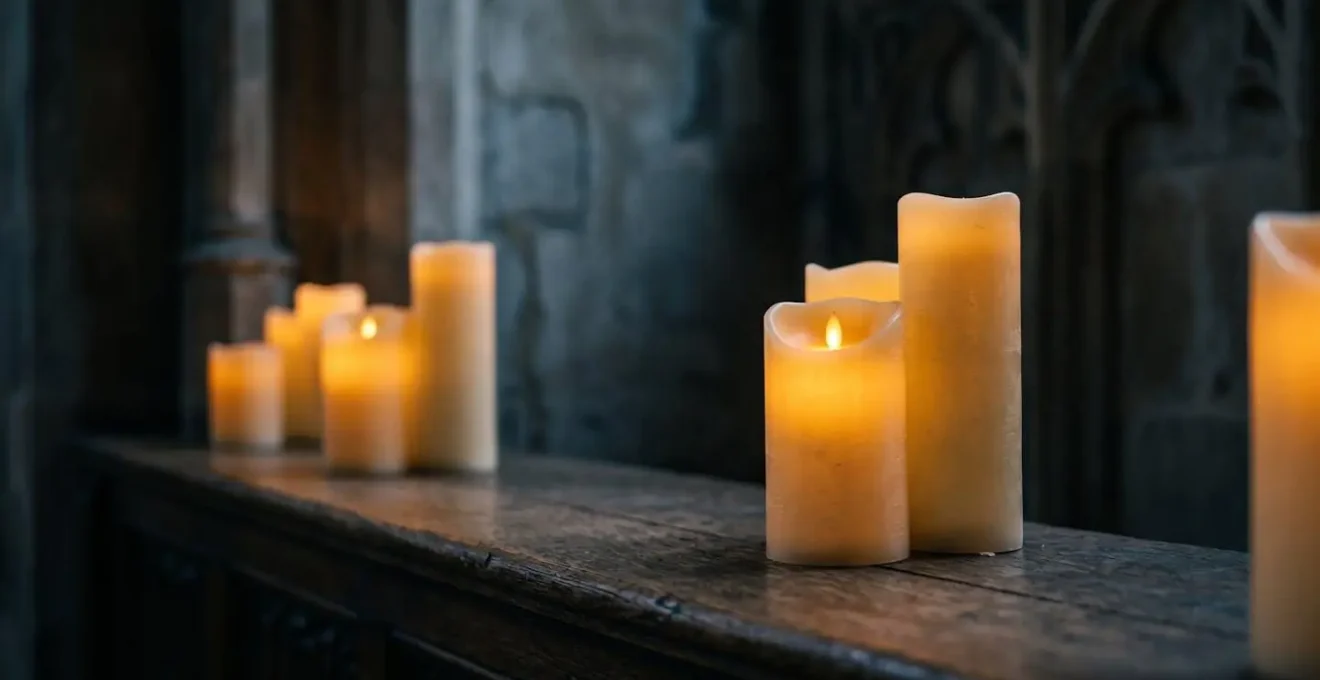
By embracing these modern solutions, you can achieve the desired mood without compromising the safety and integrity of the irreplaceable heritage site you’ve chosen for your special day.
The Generator Cost Trap That Surprises Couples at Remote Castles
Many remote and historic castles were built long before the concept of a national grid. While they may have house power sufficient for daily life, it’s often completely inadequate for the demands of a 100+ guest wedding. A catering team’s warming ovens, a band’s sound system, the DJ’s equipment, and a professional lighting rig can create a massive power draw that will instantly trip an old fuse box. The solution is an external generator, but this is where a significant hidden cost trap lies.
The base rental for a generator might seem manageable; industry data suggests a range of $300-$800 depending on the power requirements. However, this is just the starting point. The true cost includes delivery and collection fees (especially for a remote location), mandatory fees for a technician to operate it, hourly fuel consumption costs, and potentially extra charges for noise-baffling enclosures to prevent a loud hum from ruining your ceremony. This can easily quadruple the initial quote, adding thousands to your budget unexpectedly.
To avoid this, you must conduct a thorough Power Load Audit with your suppliers well in advance. This isn’t a casual question; it’s a formal process of gathering a list of every single electrical item that will be used and calculating the total simultaneous wattage required. This ensures you rent a generator of the correct size—not too small to be ineffective, and not too large to be wasteful. A professional venue or wedding planner should guide you through this critical step.
Your Action Plan: The Power Audit Checklist
- Compile a Master List: Work with all suppliers (caterer, band, DJ, lighting designer) to list every single electrical item they will bring.
- Calculate the Load: Add the total watts needed for all items that will be running simultaneously to determine the accurate kilowatt (kW) requirement.
- Understand Distribution: Realize that most generators have a limited number of breakers, so you must plan how to distribute the load across different circuits.
- Factor in All Costs: Demand a full quote that includes delivery, collection, technician fees, fuel estimates, and any noise-reduction equipment.
- Create a Backup Plan: Discuss with the venue what happens if the generator fails. Is there any house power to run absolute essentials, like a single speaker for announcements?
How to Fix Echo Issues in Large Stone Banqueting Halls?
A grand banqueting hall with soaring stone walls and a vaulted ceiling looks spectacular, but it can be an acoustic disaster. Hard, parallel surfaces—stone floors, stone walls, high ceilings—create a nightmare of reverberation and echo. Speeches become an unintelligible mess, and music turns into a cacophony of noise. Guests will struggle to hold conversations, leading to a loud, unpleasant atmosphere where everyone is shouting to be heard.
The solution is not to crank up the volume, which only makes it worse. It is to introduce soft surfaces that absorb sound. This doesn’t mean you have to ruin the historic aesthetic with ugly foam panels. An experienced design and production team can use decor to solve the problem elegantly. Heavy, luxurious drapes along walls, plush area rugs on the floor, and even large, lush floral arrangements can do wonders to break up sound reflections. Furthermore, a professional sound technician will use a distributed sound system—multiple smaller speakers placed strategically throughout the hall—rather than two large speakers at the front. This allows for clear sound at a lower volume, creating an intimate feel even in a vast space.
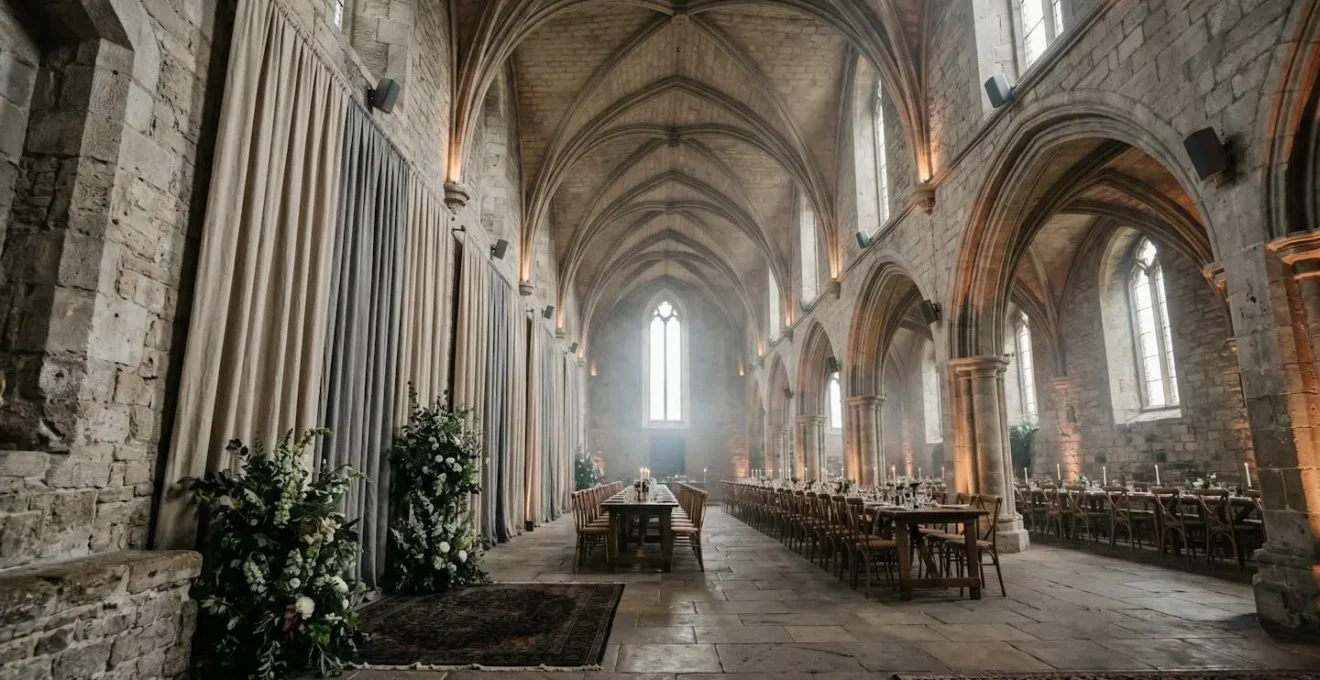
Interestingly, lighting design can also play a role in managing the atmosphere of acoustically challenging spaces. A study on lighting at a National Trust property demonstrated that by using specific lighting techniques to create a “homely atmosphere,” designers could enhance the visitor experience. This highlights a key principle: the solutions to a venue’s challenges are often interconnected. By hiring professionals who understand how sound, lighting, and decor work together, you can transform a reverberant hall into an intimate and elegant space.
Why “Sleeps 20” in a Chateau Usually Means Shared Bathrooms?
A venue’s accommodation listing can be one of the most misleading aspects of planning a castle wedding. When a chateau brochure says it “sleeps 20,” your mind might leap to 10 luxurious en-suite bedrooms. The reality is often far more rustic. This number frequently includes sofa beds in common areas, small trundle beds, and annex rooms of varying quality. Most critically, the plumbing in a historic building was not designed for modern expectations. Adding new bathrooms and plumbing systems is an invasive, expensive process that can compromise the building’s structural integrity, so many venues have a very low guest-to-bathroom ratio.
You must decode the “venue lingo” by demanding a detailed floor plan. Calculate the Guest-to-Bathroom Ratio yourself. A ratio above 4 guests to 1 shared bathroom is a major red flag for morning gridlock and discomfort. Even if a bridal suite looks grand, its plumbing might be ancient. Before committing, ask for a video of the shower running to check the water pressure. An overnight trial stay is the ultimate test.
For a 100+ guest wedding, the on-site accommodation is only for a small VIP group anyway. The real challenge is what planners call the “90-Guest Problem”: housing and transporting everyone else. As a wedding specialist from Celtic Castles advises, limited on-site lodging shouldn’t be a dealbreaker if good alternatives are available.
If a castle doesn’t appear to have enough on-site accommodation, don’t immediately rule it out, as we will usually be able to advise on other accommodation nearby.
– Beth, Senior Wedding Specialist, Celtic Castles Wedding Planning Tips
Your task is to vet these nearby hotels early, ensure they meet your standards, and arrange for reliable, late-night shuttle transportation. This logistical piece is just as important as the castle itself.
Hay Bales and Sparklers: The Fire Risk You Must Avoid in Wood Barns
The rustic charm of a historic wooden barn or a castle courtyard is undeniable, often leading to ideas like hay bale seating or a spectacular sparkler send-off. However, these elements pose an extreme fire risk that heritage venues simply cannot permit. Old, dry wood, hay, and the general structure of historic properties make them incredibly vulnerable to fire. As a result, heritage compliance and insurance policies enforce a near-total ban on open flames and pyrotechnics.
This isn’t an arbitrary rule designed to spoil your fun; it’s a critical safety measure to protect an irreplaceable building and, more importantly, your guests. As wedding planners who specialize in historic venues often note, restrictions on open flames, candles, and fireworks are standard practice and should be expected. The risk of a stray spark igniting dry material is too great to ignore. You must assume that sparklers will be forbidden and plan accordingly from the start to avoid disappointment.
Fortunately, there are many safe and equally spectacular alternatives that provide the “wow” factor without the fire hazard. Instead of a sparkler exit, consider a send-off where guests hold up fiber optic wands or high-quality glow sticks, creating a magical tunnel of light. For dramatic effect, professional “cold spark” fountains are a fantastic option. These devices are specifically designed for indoor and sensitive environments; they create a stunning pyrotechnic-like fountain of sparks that are non-flammable and cool to the touch, offering all the spectacle with none of the risk. Other beautiful, photo-friendly options include bubble machines or elegant ribbon wands customized to your wedding colors.
Key Takeaways
- Physics Over Fantasy: Issues with heating, cooling, and acoustics in historic venues are governed by physical principles like thermal mass and reverberation, not a lack of care.
- Assume Nothing is Included: Essential services like adequate power for a large event and full accessibility are not standard; they are logistical challenges that require specific audits and solutions.
- Safety is Non-Negotiable: Fire safety regulations, especially the ban on open flames like candles and sparklers, are strict and exist to protect both the heritage property and your guests.
How to Transformation a Dull Venue Using Only Lighting Techniques?
Sometimes, the most historically significant room in a castle can feel architecturally plain or dimly lit. Before dismissing it, understand that professional lighting is the single most powerful tool for transforming a space. A skilled lighting designer can add depth, drama, and atmosphere to even the dullest of rooms, turning blank walls into a dynamic canvas and guiding your guests’ emotions throughout the evening.
The key is to think of light not just as illumination, but as a design element. Several techniques can achieve this. Color washing floods entire walls with colored LED light, instantly setting a mood—perhaps a warm amber for dinner, shifting to a cool blue or vibrant magenta to energize the dance floor. For spaces lacking architectural detail, textural lighting uses patterns and shadows to create visual interest and dimension where none exists. This can be achieved through gobo projection, where custom templates are used to cast intricate patterns, your monogram, or botanical designs onto floors and walls.
To create focus and visual hierarchy, designers use pin-spotting. These are narrow, focused beams of light directed at specific elements like your cake or floral centerpieces, making them “pop” from the background. This layering of light—ambient color washes, textural patterns, and focused pin-spots—creates a rich, immersive environment. Ultimately, lighting is a form of storytelling. A designer can map out lighting changes that guide the event’s narrative: a soft, welcoming glow for guest arrival, a romantic, intimate light for dinner, and dynamic, colorful energy for the celebration that follows. This strategic use of light can make a simple room feel extraordinary and a grand room feel magical.
By shifting your perspective from that of a mere client to an informed custodian for a day, you not only protect your budget and your guests’ comfort but also honor the history of the magnificent setting you’ve chosen. Proactive planning, guided by a realistic understanding of these inherent constraints, is the true key to unlocking the fairytale. To begin putting these strategies into practice, your next step should be to build a comprehensive list of audit questions for any potential historic venue.