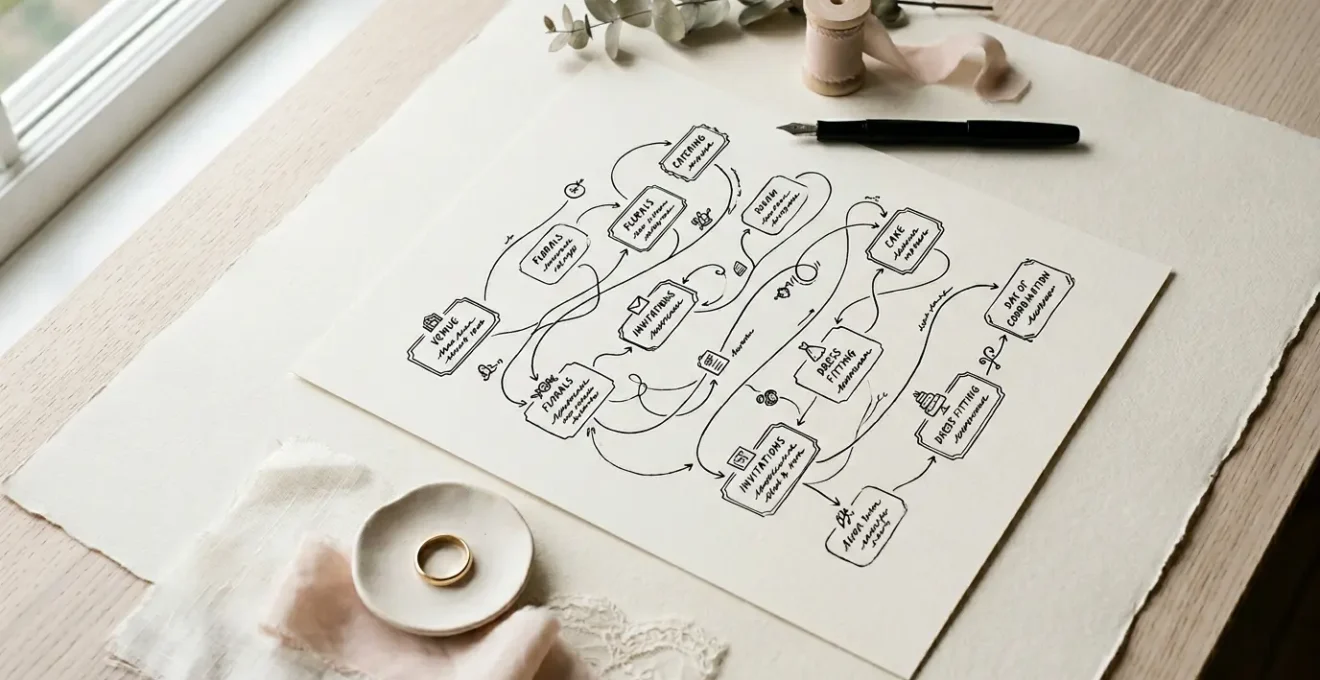
The key to a streamlined, on-budget wedding is to stop planning a party and start managing a project using the Critical Path Method (CPM).
- CPM identifies the essential sequence of tasks that determine your project timeline, preventing delays.
- Treating your wedding as a project clarifies roles, mitigates financial risks, and combats decision fatigue.
Recommendation: Shift your mindset from ‘bride/groom’ to ‘Project Sponsor.’ Your role is to set the vision and make key decisions, not to execute every task. Delegate execution to your ‘project team’ of vendors and planners.
The overwhelming nature of wedding planning is a universally acknowledged truth. You are instantly faced with hundreds of decisions, a mountain of tasks, and a budget that feels more like a suggestion than a rule. The standard advice offers tools like binders, spreadsheets, and countless apps, all promising to bring order to the chaos. While these can be helpful, they often treat the symptoms—disorganization—rather than the root cause: the lack of a professional management framework.
This is where most couples falter. They approach planning a $50,000 event with the same tools they use for a grocery list. The result is often budget overruns, missed deadlines, and significant stress. The secret of professional event managers isn’t a better app; it’s a better methodology. They don’t just make lists; they build systems.
But what if you could shift your perspective? Instead of seeing a party to plan, you see a complex, short-term project to manage. The solution lies in adopting a proven project management framework: the Critical Path Method (CPM). This isn’t about adding more complexity; it’s about applying a logical structure that identifies what truly matters, manages risks before they become crises, and ensures every component is delivered on time and on budget. This guide deconstructs wedding planning through a project manager’s lens, providing a structured, corporate, and efficient system to deliver your ultimate project successfully.
In this guide, we will deconstruct the core components of wedding project management. You will learn to identify critical tasks, allocate resources effectively, manage stakeholders, and mitigate the common risks that derail even the best-laid plans.
Summary: A Project Manager’s Framework for Wedding Planning
- When to Feed Your Vendors so They Don’t Miss the Speeches?
- Excel vs. Planning Apps: Which Tool actually Keeps You on Track?
- Wedding Planner vs. Venue Coordinator: Who is Responsible for What?
- The “Little Extras” That Cause 20% Budget Overruns in the Final Month
- How to Beat Decision Fatigue When You Have 500 Choices to Make?
- How to Structure a 3-Day Wedding Weekend Without Exhausting Your Guests?
- How to Vet Local Vendors Abroad When You Don’t Speak the Language?
- How to Ensure Your Destination Marriage Is Actually Legal Back Home?
When to Feed Your Vendors so They Don’t Miss the Speeches?
From a project management standpoint, your on-site vendors—photographer, planner, DJ—are critical, time-sensitive resources. Their performance is directly tied to their well-being. The question of when to feed them isn’t about etiquette; it’s about effective resource management to prevent a drop in operational efficiency. A hungry photographer or a DJ running on fumes is a project risk. The goal is to schedule their break during a period of low-impact activity to ensure they don’t miss a critical, unrepeatable project milestone, such as the toasts or first dance.
The optimal window is typically after the couple and head table have received their main courses but before the majority of guests have been served. This “lull” in the timeline ensures they are back on duty before the main events of the reception resume. You should coordinate this plan with your caterer and communicate it clearly during a pre-reception “vendor huddle.”
Regarding location, discuss preferences with your vendors beforehand. While some may prefer a separate room for a genuine break, many appreciate a designated vendor table within the reception hall. This allows them to eat quickly while remaining aware of the event’s flow, ready to act the moment they are needed. This small logistical step is a key part of maintaining your project team’s performance throughout the event’s lifecycle.
Excel vs. Planning Apps: Which Tool actually Keeps You on Track?
The debate between using a robust spreadsheet and a dedicated wedding planning app misses the fundamental point. The effectiveness of a tool is not in its features, but in its ability to execute the chosen methodology. For the Critical Path Method, one feature is non-negotiable: the capacity to map out task dependencies. This is the core of the entire framework, defining that Task B (e.g., booking a florist) cannot begin until Task A (e.g., securing the venue and date) is complete.
As one analysis on the topic of wedding project management states, the framework is more important than the software itself. A Wedding Project Management Analysis highlights this principle:
The specific tool is less important than its ability to execute the ‘method’. The key feature to look for is the ability to create task dependencies (i.e., this task can’t start until that one is finished), which is the core of the Critical Path Method.
– Wedding Project Management Analysis, Premium Papers – The Wedding Project: Critical Path and Network Diagram
This is where you must assess your own capabilities. Microsoft Excel, for a user with intermediate skills, is an incredibly powerful and customizable tool. You can build a full Work Breakdown Structure (WBS), create Gantt charts with dependencies, and integrate budget tracking with near-infinite flexibility. Conversely, planning apps offer a user-friendly, out-of-the-box experience, but may lack the deep customization required for true CPM. They are excellent for task management but can sometimes obscure the critical path by presenting all tasks as a simple, flat checklist.

Ultimately, the choice depends on your project management style. If you are a ‘Project Manager’ couple, Excel or a dedicated project management tool like Trello or Asana might be superior. If you prefer a guided experience, a high-quality wedding app will suffice, provided you are manually vigilant about tracking the critical task dependencies yourself.
Wedding Planner vs. Venue Coordinator: Who is Responsible for What?
Confusing the roles of a wedding planner and a venue coordinator is a classic project management failure—a breakdown in stakeholder role definition. This ambiguity leads to dropped tasks, duplicated work, and critical gaps in responsibility. In a formal project, these roles would be clearly defined in a RACI (Responsible, Accountable, Consulted, Informed) chart. For your wedding project, it’s essential to understand their distinct scopes of work.
Think of it this way:
- The Wedding Planner is your overall Project Manager. They are hired by you (the ‘Project Sponsor’) and are responsible for the entire project lifecycle, from initial concept and budget creation to vendor sourcing, timeline management, and execution of the final event. Their loyalty and responsibility are to you and your overall vision.
- The Venue Coordinator is a specialized sub-manager, an employee of the venue. Their responsibility is limited to all deliverables directly related to the venue itself: the physical space, in-house catering, on-site staff, and venue-specific logistics. They work for the venue, and their primary goal is to ensure the venue’s obligations are met.
Best Practice Example: The Responsibility Handoff
A best-practice model from the event industry applies formal project management methodology to weddings, creating distinct ‘wedstreams’ (workstreams) and clear logs of responsibility. In this model, the wedding planner manages all aspects of the project until a pre-defined “Responsibility Handoff” point, typically 30-60 days before the event. At this milestone, all relevant information—timelines, vendor contracts, floor plans—is formally transferred from the planner to the venue coordinator, who then takes over the on-site execution management. This treats the couple as ‘Project Sponsors’ who make final scope decisions, rather than getting lost in day-to-day execution.
Defining this boundary is critical. Your wedding planner manages the entire orchestra; the venue coordinator is only in charge of the string section. Knowing who is responsible for what prevents the costly assumption that “someone else is handling it.”
The ‘Little Extras’ That Cause 20% Budget Overruns in the Final Month
Budget overruns are not a matter of bad luck; they are a failure in risk mitigation and contingency planning. The staggering reality is that a significant majority of couples face this issue. Data confirms that 69% of couples exceed their initial wedding budget, often due to a handful of predictable but unplanned expenses that emerge in the final weeks. From a project manager’s perspective, these “little extras” fall into two categories: scope creep and un-budgeted fixed costs.
Scope creep includes any decision made during the project that adds cost beyond the initial plan, such as upgrading linens, adding a late-night snack station, or extending bar hours. These are often emotional, in-the-moment decisions that are not weighed against the total budget. The second category, un-budgeted fixed costs, is more insidious. These are the non-negotiable fees that are often buried in contracts’ fine print, including:
- State and local taxes on catering and rentals.
- Mandatory service charges or gratuities (often 18-25% of the total food and beverage bill).
- Vendor travel and accommodation fees.
- Cake-cutting and corkage fees.
- Overtime costs for staff and venue rental.

The project management solution is twofold. First, your initial budget must have a line item for every single potential vendor and fee—no “miscellaneous” category. Second, and most importantly, you must establish a contingency fund from day one. A standard of 10-15% of your total budget should be set aside and designated exclusively for these unforeseen costs. This isn’t “extra money to spend”; it is a risk management tool that ensures your project can absorb these predictable surprises without derailing your finances.
How to Beat Decision Fatigue When You Have 500 Choices to Make?
Decision fatigue is a cognitive bottleneck that poses a serious threat to your project’s success. It’s a state of diminished willpower and poor judgment that occurs after a long session of decision-making. In the context of wedding planning, it’s the reason why, after choosing a dozen vendors, the choice between ivory and ecru napkins can feel monumental and crippling. This is not just a feeling; it has measurable consequences. A poll of recently married couples revealed that 70% of couples experienced negative mental health impacts from wedding planning, a clear symptom of this relentless cognitive load.
Decision fatigue happens when the brain becomes overwhelmed by constant choices. The more decisions you make, the harder each one becomes. Confidence decreases. Doubt increases. Small choices begin to feel heavy.
– The Event Bay Wedding Planning Analysis
The project management solution to decision fatigue is to impose structure on the decision-making process through a Work Breakdown Structure (WBS). Instead of facing a random sea of 500 choices, you group them into logical “workstreams” or “sprints.” For example:
- Month 1: Foundational Decisions. Focus ONLY on the critical path items: Budget, Guest List Size, Venue, and Date. All other decisions are off-limits.
- Month 2: Creative Partner Sprint. Focus ONLY on vendors that define the look and feel: Photographer, Florist, and Entertainment.
- Month 3: Guest Experience Sprint. Focus ONLY on guest-facing elements: Invitations, Website, and Hotel Blocks.
By batching similar decisions together and time-boxing them, you prevent your brain from being pulled in a dozen directions at once. You are also empowered to say “no” to premature choices. If a family member asks about cake flavors during the “Foundational” month, the answer is simple and definitive: “That decision is scheduled for Month 4.” This structured approach preserves your mental energy for the high-stakes decisions that truly matter.
How to Structure a 3-Day Wedding Weekend Without Exhausting Your Guests?
A three-day wedding weekend extends the celebration, but it also transforms a single-day event into a multi-day logistical project. The primary resource you must manage is not just time or money, but your guests’ energy and attention. An exhausted guest cannot fully enjoy the main event, representing a failure in stakeholder experience management. The key to success is building a schedule with intentional pacing and significant, structured downtime.
View the weekend as a three-act project timeline:
- Day 1: The Welcome Event (Stakeholder Onboarding). This should be a low-pressure, informal gathering. A welcome cocktail party or casual dinner serves as an orientation. The goal is connection, not spectacle. Crucially, it must have a clear end time. A two-to-three-hour event allows guests to mingle before retiring early to rest for the main event.
- Day 2: The Wedding Day (Main Project Execution). This is the day with the tightest schedule and highest energy output. The critical management task here is to build downtime into the day. A 2-3 hour gap between the ceremony and reception is not dead time; it’s a vital “recharge” period for guests to return to their hotels, relax, and prepare for the evening’s festivities.
- Day 3: The Farewell Brunch (Project Debrief). This final event should be the most relaxed of all. A “drop-in” style brunch over a two-hour window is far superior to a formal, seated meal. It allows guests with early flights to say their goodbyes without feeling rude, and it provides a gentle, low-energy conclusion to the project.
Throughout the weekend, clear communication is paramount. Your wedding website and welcome materials should provide a detailed but easy-to-read schedule. Clearly labeling events as “optional” and providing information about transportation and downtime empowers guests to manage their own energy levels, ensuring they are present and engaged for the moments that matter most.
How to Vet Local Vendors Abroad When You Don’t Speak the Language?
Hiring vendors in a foreign country where you don’t speak the language is one of the highest-risk tasks in a destination wedding project. This is not simply vendor booking; it is international procurement and supply chain management under uncertain conditions. Relying solely on translated emails and curated Instagram feeds is insufficient due diligence. A professional project management approach requires a more robust vetting and risk-mitigation strategy.
First, you must create a formal Vendor Scorecard. This isn’t a simple pros and cons list; it’s a document with non-negotiable criteria. These may include requirements like: having a specific number of years in business, providing unedited galleries from full weddings (not just styled shoots), and holding provable liability insurance. This objective tool removes emotion and focuses on qualifications.
Second, you cannot manage this process remotely. You need a trusted local asset. Your best options are:
- A high-end, full-service wedding planner based in the destination. They are your ‘local procurement officer’ and are worth the investment as a primary risk-reduction tool.
- The concierge at a luxury hotel. These professionals have established relationships with the most reliable local suppliers and can act as an initial filter for quality.
Finally, insist on video calls for all primary vendor interviews. This allows you to assess their professionalism, communication style, and command of English (or your language) in a real-time environment. Pay close attention to their responsiveness and the thoroughness of their contracts. Any hesitation to provide a detailed, bilingual contract is a major red flag. This rigorous process is not about mistrust; it’s about ensuring your international supply chain is stable and capable of delivering on your project’s critical requirements.
Key Takeaways
- The Critical Path Method (CPM) is a framework that identifies the sequence of essential tasks that determine your project’s total duration.
- Treating your wedding as a project involves defining roles (stakeholder management), creating a contingency fund (risk mitigation), and batching choices (work breakdown structure).
- The most effective planning tool is one that allows for task dependencies, which is the core functionality required to implement CPM.
How to Ensure Your Destination Marriage Is Actually Legal Back Home?
Of all the potential project failures in a destination wedding, this is the most catastrophic: returning home to discover your marriage is not legally recognized. This is the ultimate risk mitigation task, and it must be addressed with legal precision, not romantic optimism. The laws governing marriage vary dramatically from country to country, and navigating them requires a clear, sequential plan.
The most effective risk-reduction strategy is to separate the legal event from the celebratory one. As the U.S. government’s primary advisory body for citizens abroad notes, this is a common and highly effective approach. According to the U.S. Department of State Bureau of Consular Affairs:
Some couples having destination weddings choose to get legally married in the United States before or after their destination wedding ceremony abroad. Completing the legal marriage in the United States and holding the celebration abroad avoids the complexity of obtaining a foreign marriage certificate and otherwise complying with local laws on marriage.
– U.S. Department of State Bureau of Consular Affairs, Travel.State.gov – Marriage
This “two-ceremony” approach transforms your destination wedding into a purely symbolic (and logistically simpler) event, completely eliminating the risk of legal invalidity. However, if having a legally binding ceremony abroad is a non-negotiable requirement of your project, you must follow a strict legal critical path.
Your Action Plan: The Legal Critical Path for Destination Weddings
- Initial Inquiry (9-12 Months Out): Contact the U.S. embassy or consulate in your destination country to get a comprehensive list of all legal requirements, documentation, and timelines.
- Document Gathering (6-9 Months Out): Collect all required documents, such as valid passports, original long-form birth certificates, and any divorce decrees or death certificates. Ensure passports are valid for at least 6 months beyond your wedding date.
- Eligibility Affidavit (3-6 Months Out): Obtain an “Affidavit of Eligibility to Marry” from the U.S. embassy in the destination country, as the U.S. does not have a central marriage registry.
- Certified Translation (2-3 Months Out): Have all necessary documents professionally translated into the destination’s official language by a certified translator. Do not use informal translation services.
- Residency Requirement Planning (1-2 Months Out): Research and plan for any mandatory in-country residency period before the ceremony can take place. This could range from days to weeks.
Upon your return, you must also follow the correct procedure for registering your foreign marriage certificate with your state’s authorities to ensure it is recognized. As this checklist from a legal resource guide for destination weddings shows, this process is exacting. Failure to complete even one step can invalidate the entire project deliverable.
To begin applying this framework, your first deliverable is to define the five most critical tasks that every other decision depends on. This is the foundation of your project’s success.